November 16, 2026.
Glenn Diesen: Welcome back everyone. We are joined again by Professor Michael Hudson, who does excellent work on his website. And I've made sure to leave a link in the description, so please follow his great work. Good to see you again.
Michael Hudson: It's good to be back, Glenn.
Glenn Diesen: So if we look around well across the Western world now, from Poland to Germany, France, United Kingdom, the United States, the question about what democracy means is well increasingly questioned. That is formerly we have democracies as a political system, but at the same time we see this rising economic and financial oligarchy. So I was wondering. I guess it's a big question, but how do you see this issue ? I mean, how does the financial oligarchy impact our democracies?
Michael Hudson: Well, Aristotle wrote long ago in his study of Greek constitutions that many constitutions claimed to be democracy, but they were actually all oligarchies. And he had a whole dynamic that he said, Well, there are autocracies and then some protestors within the autocracy take the public and the army and the citizenry into their camp and they overthrow the oligarchy and they create democracy, but it all turns back into oligarchy again. And oligarchies make themselves hereditary and that becomes an aristocracy and you have the whole eternal triangle all over again.
So I think that what claims to be a democracy has really turned out to be oligarchy because the voters in Europe, the reason they're having all of these riots from France and Spain and Germany demonstrations are that they don't have a voice at the polls, at electoral politics, in solving the immediate problems they have. And the problems they have are largely the financial squeeze on household budgets and also the closing down of employers, the economic shrinkage, especially that's going to be caused now that there's an oil crisis. Because the higher prices are increasing the cost to families of heating and lighting their homes and of gasoline and electricity for everything and for whole the danger is that this oil crisis is going to make many economies look just like Germany looked after two thousand twenty-two, when it stopped getting Russian gas and oil.
Well, the voters in Europe don't seem able to get rid of Merz and Macron and change the British Labour Party, so they really don't have a voice. So what kind of democracy in that ? It no matter what they vote for, they're subject to the world as it is and it's largely under the US policy to fight Russia, to fight Iran, and to do to them what it did to Venezuela. To take over their oil, and all of this is a fight for oil. We want to control the choke point of oil, and who's going to get the profits from all of the world oil trade ? If Russia and Iran want to keep these their oil export proceeds for themselves, that doesn't help us.
We're going to war with them. And that's really what is causing the whole backwash of problems. Well, obviously. There's a rising pressure in Europe from the populist group, the nationalists who want domestic sovereignty. They want their countries to be able to say, we're going to run our foreign policy and domestic policy in the interest of preserving prosperity and helping us not simply to be satellites of the US fighting in against Russia, Iran and all of its war on the rest of the world for its own self-interest. Well you saw on as we've discussed before the fight in Poland was over the constitutional crisis is could Poland have its own rules independently of the EU ? von der Leyen, Kaja Kallas, etc.
And they're basically arms of NATO, arms of the US policy and Pentagon. So all of this democracy, it really comes down to national sovereignty. Is Europe going to be run for the benefit of it the majority of its citizens who need less expensive energy or else enormous government subsidy, that the EU rules of national budgets won't permit governments to fund, especially if the government budgets are all moving away from social support to military spending, which I think the majority of European voters aren't in favor of what can they do in the fact that Europe seems to have lost its democracy.
Glenn Diesen: That's a good question. And it seemed that over all these years we've hollowed out everything of public ownership and we called it economic growth. And as we saw yeah the economic interest shift more away from the public, the political elites, they began to have less and less interest in the public or at l at least begin to respond to others, which has caused this populist growth now where the elites are very, very distant from the actual people. And you I guess in Europe you hear it so openly though. When you have political leaders from Germany to Italy, they're asked, Yeah, well, the public doesn't really support you know, sending the little money we have left off to wars.
And the argument essentially is well, you know, we know better. and that and that's kind of the end of it. And you know, you can wait for the next election. But it really doesn't matter who you vote for because the policies are written in stone. but how do you see this ? So what how do you conceptualize this ? Is it a political crisis, economic crisis, is it a civilizational crisis?
Michael Hudson: Well, it's a civilizational crisis in the sense that it's worldwide right now. How is the rest of the world going to respond to the United States trying to control and bully other countries by creating choke points in the international economy ? The oil trade is a choke point. It will force countries into the financial choke point. Are they going to have to make a swap agreement with the Treasury ? or the IMF and the World Bank. And will that will the Treasury and essentially its satellites in the IMF and World Bank said, Well, you know, we'll save you countries from having to depreciate your currency and you'll we'll lend you enough so that you can support your businesses so they don't have to close down and cause unemployment.
But there are conditions for this and you'll have to agree to the sanctions that the Trump administration has imposed on Russia and China, as well as Iran. You know, you'll have to break off you'll have to isolate Russia, isolate China, and especially do just what you're doing now, not permit a Chinese expansion there, and you'll have to shift to enable American AI and internet and computer technology to become monopolized in the United States. you Europeans can't have your own internet. We have to avoid China's open source AI and all of this. So it's a civilizational war in the sense that the United States, along with its European satellites and Japan and South Korea, are against the global majority.
China, Russia and Iran is a critical mass that are self-supporting, and any of the BRICS countries That they can absorb into their sphere of influence to say, well, you know, we don't the war is against us, but you will do much better with an alignment of us than an alignment of the United States. And the alignment with us is an alignment for your prosperity because the West is basically finance capitalist, as you just pointed out. And their idea is to make wealth financially, but that the result is deindustrialization. We're the major producers and you can join us in the kind of economy that we have.
And we want to go back to what the original policy of industrial capitalism is. in large corporate employers create goods and services and they plough their profits back into expanding production. to employ more labor and expand the economy. But that's not what's happening in the West since the nineteen eighties. You've had a whole pressure for financialization and corporations use their money for dividend payouts, for stock buybacks. They're trying to make increase the value of their stock prices, not the value of what and usefulness of what they produce.
So yes, it's a civilization is Our economies going to be run for the purpose of tangible industrial growth or making financial fortunes which end up in the hands of the wealthiest ten percent or even the one percent, and these fortunes take the form of financial claims on holding the majority of citizens in debt. And so it's an extractive policy and will civil will the world economy. become largely extractive, sucking foreign economic surpluses into the United States, or will other countries be able to use their own surpluses to grow and become successful by essentially keep ultimately keeping money creation and credit allocation in the hands of the public sector to steer in favor of actual tangible capital investment and social spending instead of into supporting the financial sector.
So it in a way you could say it's more than a class war. It's a war between what kind of capitalism are you going to have ? And industrial capitalism already in the nineteenth century was evolving into socialism because the whole idea of industrial success, making Britain the workshop of the world, And then making the United States replace Britain as its rise to affluence. Well, the govern we're the government is we're going to lower the cost of living, lower the cost of production by preventing monopolies. And we're going to keep natural monopolies in the public domain as public enterprises, transportation, education, medical care, communications, and all of the key technologies. and the idea n it was industrial capitalism that wanted the government to do this.
That's why in America we had the antitrust laws of eighteen ninety, the Sherman Act, you had Teddy Roosevelt, the trust buster. That's what you want in other countries, whereas the US plan is to establish as many monopolies, as choke points as it wants over other economies and to control them. and to become the beneficiaries of what they produce. Well, let's look at what's going to happen right now and how the how all of this is going to come to a head. countries are going to have in the next few months, most countries are going to run out of the ability of the US and Asian and European national petroleum reserves to be thrown onto the market to keep down oil and gas prices.
Well That means oil and gas prices are going to rise. And as you and I have discussed before, this is going to close force a lot of companies to close down, just as occurred in Germany in nineteen in 2022. Well, h how are other countries going to happen ? Look at what happened in the nineteen ninety-seven and ninety-eight Asia crisis. they had a balance of payments crisis like this, and again in the COVID crisis, they had to turn to the IMF, the World Bank, and on US swap agreements. Well Secretary of Bessent has said, well, other countries will can get our swap agreements, and but they're going to have to essentially the price of that is they're going to have to follow our policies and become political, military, and financial sacrifice the satellites.
That's going to be the sacrifice that they have to make. And where will Europe and the global south countries choose to go in all of this. there's I don't see what they can do except to say, well, we're not going to just passively give in to the U.S. plans that where Donald Trump has said, well, you know, we can keep the Strait of Hormuz closed, as Secretary Bessent said. It doesn't we don't have to reopen it. America is the main gainer. Well, I don't believe America will be. a gainer from this. I think the oil crisis will hit the United States economy too.
But certainly other countries will be the losers if they don't somehow respond to the balance of payments crisis that they're in by saying, well, we're gonna who are we going to put first ? Are we going to put our domestic economy first or our foreign bondholders ? About the only choice that foreign countries have is in the immediate term is to say we can't afford to pay our dollar debts to the US whose dollar zone has caused the war with Russia and Iran that's been causing the oil crisis to begin with. we're in an emergency. We there has to be a moratorium on this to save us from being forced into a depression.
And this is not only a problem for the global south countries, it's a problem for Europe, because Europe's going to be in exactly the same position. The demonstrations and the pressure right now you're having for let to avoid these high prices, l if the government cannot give us subsidies because it has to use its budget for military spending under the EU rules to fight Russia, then let's trade with Russia and keep our prices down. Why are is it really worth sacrificing our standard of living and our employment and our business expansion just to fight Russia and China?
What do we get out of this fight ? Well, this is like what happened when Israel withdrew from Judea, saying, What do we have to do with the house of David ? How is that benefiting all of us in the Bible that broke away ? This kind of split. From an exploitative center has gone on ever since biblical times in countries. And it I don't see how it can be done today, but it requires planning. You can't just say, well, there's going to be a crisis, what's going to happen ? They have to have a plan. And any plan that Europe and the global south countries and that global majority has is well, we have to have an alternative to the International Monetary Fund and the World Bank to supply credit on terms that do not require us to be satellites of American foreign policy and join America's war on oil, which is destroying our economies. There has to be a full blown alternative, and this must include United Nations reform, as President Putin has been saying in Russia. The Russians and the Chinese I think have been pretty open in the kind of an alternative that they're trying to sponsor.
And I think the this alternative that develops is going to be by Russia and China, primarily, along with Iran, because the BRICS countries are too diverse all over the place, politically, economically, and in terms of their geographic loyalties. Where is India going to stand, where will even Brazil stand ? There's it's going to take the crisis I think is going to take a few years to work out. It's not going to be brief. It's going to have a very problematic interregnum. And the there's no way of telling how it'll be right now, but I think it will be civilizational in the sense of a break from a unipolar world order to a multipolar order.
Glenn Diesen: I agree with the yeah the with the argument here though. But that's also why I keep wondering how Western capitalism can be reformed now, because as you argue, we strayed pretty far away from the industrial capitalism of the nineteenth century. I mean the what Alexander Hamilton, Friedrich List, all of those spoke about, I mean, that's very long gone. and we what we had now, especially the last forty years, this increasingly financialized economy defined largely by, as you said, this extractive rent-seeking activities, which also make sure that the West can't really recover well because how is the US or the Europeans gonna compete with China when you have all of these additional variables, all these extra forces extracting wealth from the production process?
You can't. possibly compete under these circumstances. So when we reached a point now also in this extraction where our own public has become impoverished, but also the ability to extract from other states, as you suggest, this is coming to an end. Because in the technological area, the financial there they're all pulling back and creating a large degree of geoeconomic autonomy. So it just feels like we reached the end of the line here. There is this is unlike you know the other economic crisis which are coming, there's a you know there's a dip, there's a recovery, but I don't see the recovery this time though.
So you know long making a long question short, how what comes after this for the West ? Where do we go?
Michael Hudson: Well, the question is I think we've been discussing now for a few months. The question is what kind of capitalism are countries going to have ? And how can Western capitalism be reformed ? That was the original question you were going to ask in this discussion. And my solution is well, the whole promise of industrial capitalism was a self-feeding economic growth. The idea of capitalism was, well, we're going to free economies from monopolies. We're going to free them from an absentee landlord class that extracts economic rent and adds to prices. The whole idea of capitalism was classical economics, the a concept of value and price and rent.
The whole idea of making a country competitive, like to make Britain the workshop of the world. You had to bring down prices in line with the actual cost value. You had to get rid of all the unnecessary costs of production that didn't have any role in production, like land rent paid to the landed aristocracy. Well, Europe got rid of the House of Lords power in Britain and similar upper houses in Europe to enable the landed aristocracy to control. tax policy. They cured that. They got rid of the monopolies that had were a carryover from feudalism when international bankers had helped kings create these monopolies in order to have some way of paying the war debts that they borrowed.
So the whole idea of capitalism was you know to look at the whole Victorian century, you know, from eighteen fifteen to when the Napoleonic Wars ended. To World War One was relatively free. There was the Crimean War, there was the Franco-Prussian War, but this didn't really tear American apart. The whole idea was, well, use the economic surplus for domestic growth and the whole international credit market beginning in the eighteen twenties. b British and French banks and stock brokerage companies, big credit fi companies. began to issue loans to government loans for purposes other than to go to war, but to try to industrialize.
The loans didn't go work, didn't work well, they defaulted very quickly, but at least there was a whole attempt by fine industrial capitalism to essentially evolve into socialism with a rising role of government spending instead of private monopolies. It was the opposite of Thatcherism. The opposite of Reaganomics. So you could say that what China has done, and what China calls socialism with Chinese characteristics, is exactly when you look at the details, what have they done ? It's the same policy that first Britain and then the United States was following.
Except what China has done that's been much more intensive than what occurred in the West is it's kept Money creation and credit allocation, who gets the loans and what are they going to spend the credit on ? They've kept that as a public utility. And that is what industrial capitalism always is moving towards. And it occurred informally in Germany in the late 19th century. The whole idea of Central European banking, a unity between three-way unity between government, heavy industry, steel and closely connected with the arms industry and the banks all together. the German banks were encouraged don't pay out your earnings and dividends, keep reinvesting them.
And we want our we creditors and banks want our profit and the increasing earning ability that you have as you increase production. That was the whole model of German industrial capitalism that was so far ahead Of British capitalism that still was dominated by the banking class. Well, in the United States too, there was a central idea of credit for industry. That was the ideology here. China has been able to actually do this. So when China creates money, it doesn't lend it to financial companies that say we're going to get use this, we're gonna borrow money. and buy up stocks and bonds to increase the prices and to take over corporations.
And we can take over a company and we can sell off its property, and then for a price create a property-owning corporation and the property-owning company, like no whether it's the hamburger joint or something else, can then release the parent company can lease the ownership of the to pay rent to this company and We the takeover artists can just pay ourselves a dividend. Well, at the end of this, the whole economy looks like Thames Water in England or all of the disastrous railway investments. They look like the post-Thatcher economy. That's really what the choice is.
So the way the w West can be reformed is to roll back this evolution that it's had into finance capitalism that is essentially predatory. The banking class doesn't actually produce a product. It lends money and takes its interest and financial fees and other revenue from the economy of production and consumption. same thing with monopolies, same thing with the in the United States, the whole AI monopoly. And the information technology monopoly is trying to be created. And that's what the whole fight against Nvidia is and Huang. It's an idea of isolating the Chinese economy from participating in this technological advance that we're having in the twenty-first century, so that it can be all subject to a US-centered financial monopoly because the financial sector has always been the mother of trusts.
That's what banks are called in the United States, the mother of trusts. It was the financial sector that organized the steel industry into trusts, the copper trust, all the different trusts. All of this was financial management that created all this, and that's what led the United States industrialists to say, well We're not going to be able to rise to industrial power like Britain did if we let the whole economy be monopolized and that's going to increase our price of production and the cost of living for people, and we're not going to be able to compete internationally.
We have to get rid of monopolies to bring prices in line with cost value. And that was the whole emphasis of classical value theory. Bring prices in line with value by getting rid of economic rent. And today's Western economies have all turned into rentier economies, rent-seeking economies, whether it's real estate for land rent, monopolies for natural resource rent, and technology rents, and wherever they can make a choke point. And of course, the biggest monopoly at all is banking. Because the private banks have something has happened in the last century that didn't occur at the beginning of banking. in Europe, central banking was developed as a means of the government providing credit to finance war spending by Britain and France.
That was the whole idea of the Bank of England and John Law's Bank of France. But in the United States in when it created the federal reserve the government had a rather backward bullionist not a very progressive financial policy and monetary policy and so the federal reserve said well our function is going to be to support the private banking sector not the US Treasury the US Treasury all the way right up to the 20th century insisted that all of the Its major revenues, tariff revenues, all be paid in bullion, in silver and gold coinage, not in paper currency at all.
And so the whole idea of the Federal Reserve was to enable the private banking system to create paper currency. That was the fight ever since President Andrew Jackson fought against Henry Clay in the eighteen nineties, where Henry Clay wanted the American system to include a banking system to fund industry. Well, it took a the Federal Reserve creation and a whole response to an American crisis to essentially bring create a kind of industrial capitalism that led to a strong enough banking sector that the banks took control of where credit would be created and who it was going to create for.
The banking sector here, and the same thing happened in Europe. integrated with the real estate sector and the monopoly sectors to fight against classical economics. And if you look at the history of economic thought, the whole fight in the early 20th century was, well, there it's a fight against a classical political economy. There's no such thing as economic rent. Don't tax the land, as it w Britain tried to do for a century. You know, don't you know, don't tax economic rent. Everybody's productive. Banks do contribute to the process. And if you look at, as we've said before, in the gross national income accounts and GDP accounts, bank interest is counted as a product.
Rent is a product, interest is a product, bank penalty fees are a product. There's the whole the whole if you look at what's the component of Western Europe's and America's GDP, it's largely rent extraction. It's largely land rent. and monopoly rent, natural resource rent and financial interest and returns. Well that's why in China they create money and credit creation, focusing on loans to productive economies, productive companies that are actually producing something. They've over-made loans to real estate and to building to construction industry as we've seen.
But they've also made sure that there's been credit available for long-term research and development and investment that takes a long time to build up in the whole Chinese policy that's enabled it to accumulate enough international reserves to have a critical mass so that it doesn't have to depend on America's plans and finance foreign financial control. It can afford to be self-supporting and actually provide belt and road investment and loans to its Asian neighbors so that it can expand its economy with other countries. Well, that's the expansion of a kind of you could say it's just what industrial capitalism is trying to do, and you can call it socialism, but in the late nineteenth century even the industrial capitalists called it socialism. before socialism became a bad word. and essentially that's what Europe has to do.
It has to pick up the tradition that it had that still made its social democracy so productive in the early decade after World War two. and i essentially it can it can go back to its origins, but for that it needs an analysis of well what is our GDP analysis going to look at what are we going to emphasize ? Are we going to emphasize the production and consumption sector ? Or are we going to emphasize the property-owning real estate sector and its financing and essentially create credit to buy property real estate and corporations and stocks and bonds already in existence or already existed that were just creating credit to bid up the price ? and in and inflate asset prices and that's how we create wealth in the West.
And is the kind of wealth we want to create rising stock and bond prices, or is it wealth in a form of productive capacity, productivity, employment, rising living standards, and doing what you're seeing the leading Asian countries do. What's the choice going to be?
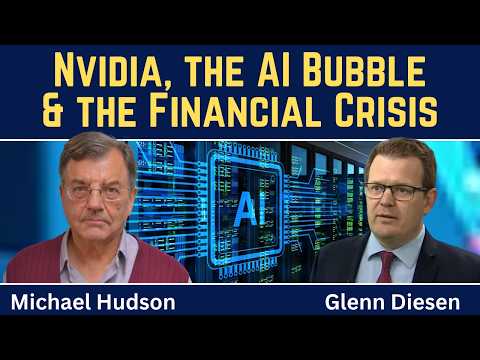
Glenn Diesen: Yeah, that's a good question. And well, I think the if there's no change being made, I think change will be forced upon many of these countries. but we do see some shakeup now in the financial system. I maybe it's yeah, it's a bit of a detour here, but since you mentioned the the technology industry, I was wondering how do you see now this whole financial crisis going on that with Nvidia and you know, 'cause this is linked directly to the tech industry. I mean d do you have a view on this whole drama playing out now with the Jensen Huang and all of these issues?
Michael Hudson: Well the financial crisis in the tech industry is purely financial so ca so far. and the from what I understand from the press reports, the Huang, the Chinese company that was buying Nvidia chips, was buying it actually to create data centers with na Nvidia chips that were open for other countries to use. including Chinese country companies as well as other countries. It's the same kind of data centers that the Arab Republics and Saudi Arabia and Bahrain have been trying to do. This is all very legal and there was there's already an argument that I've been reading for the last year or two, where the Nvidia head, Huang, has said, I want the Chinese market because that's twenty percent of our profits if you look direct and indirectly, you know, who's buying our chips.
And we need those profits in order to keep develop financing our research and development and our innovation. and we're using our profits to actually expand our operations. So that was his argument and he persuaded the commerce department under Lutnick and persuaded trump that all of that was in the interest that actually it made Nvidia stronger. And China for itself was trying to block these imports. It told its Chinese companies don't buy the Nvidia chips. we want even though the Chinese chips are slower, we're never going to be able to catch up and surpass the United States unless we develop our own technology to do it.
And we Chinese companies like Huawei need to make enough profit so that they can afford the research and development to help catch up and not to mention all of the engineering schools in China that we support. And remember, most of the of China's central committee of the Communist Party have a STEM background, science and technology. background. So that's their whole focal point on this. And there apparently are half a million Nvidia chips that are being held in Hong Kong that have not yet got permission from China to import for use by domestic Chinese firms.
So it's just silly to say that the to try to frame Nvidia as a part of being subject to Chinese spies. it's it's exactly the opposite. It's apparently Secretary of State Rubio that is the China hater and said, no matter what, you know, we want to cut China off, the Americans believe that imposing sanctions is going to do to China what never has happened before. Usually when you imp impose sanctions on a country, the country becomes independent of them. It says, okay, if we can't buy from you, we'll just have to develop it ourselves. And that was. Nvidia's argument.
If you don't let Nvidia sell our chips to China, then they'll become independent and they won't need to buy their chips in my American company anymore. and the whole mentality of the Americans is somehow if you can cut other countries off From use contact with you, they'll just fall apart. They have no ability to respond by being independent. Well, look at all of the sanctions on Russia have backfired. As we've discussed, Russia sanctioned sectors like agriculture and food and clothing production. They've built their own independent companies and they now are independent of the West.
The US sanctions are driving other countries to become independent of all of this. And so all of this is backfiring. Well it's now turned out that what Huang was doing was not only this industrial capitalist policy, but also financial engineering, even more serious than the industrial engineering. He wanted to show how fast Nvidia's profits were growing. And the way they were growing, he was telling comp companies, you know, we know you're going you're going to have to expand all of your the money that you've been raising is to create new data centers and your new s so that you'll be able to process even more information technology to sell to your clients and develop more artificial intelligence. well, you're gonna have to buy more chips.
We know that order that you were going to invest this year, it's going to take you five years to build these data centers. if you want if you want us to sell to you, there's going to be limited capacity. If you want us to put you on the preferred list of customers to buy our Nvidia chips, you have to buy a year in advance, you know, stockpile. We want you to build up the stockpiles of us. So you had their major customers buying not only the Nvidia chips this year, but what they needed for next year and maybe the next year after.
And all of these plans were on the assumption that data centers were going to be built throughout the United States. And that was before all of the response and the protests against local communities here arose against, well, with concerned citizens saying 'wait a minute, if these data centers are built up in our areas, number one, they're all going to be run by electricity. And that's going to push up our electricity prices. And we're going to suffer.' That's called an external economy. and they're going to have to be cooled because electricity for running the Nvidia chips is going to heat, cause a lot of heat, and they're going to need water for that.
But a lot of water, with the global warming and the extreme weather, a lot of America's western states are now suffering drought. Water levels are falling. there's a crisis on that. So almost all of the referendums that were put up for local voting in the elections that happened a few weeks ago were against data centers being built. That's become a political fight in the United States. And so what are all these companies that have pre-bought Nvidia chips for data centers that now have a problem being built ? Well, you're having for a while you had the Arab Republics and Saudi Arabia said, 'Well, build data centers here'.
We'll supply you with the energy that you needed. Well, a lot of these have been bombed by Iran as part of the response to the Iran war and they're knocked out. Where will these data centers be built ? And what are these companies going to do with the chips ? Well, if they've already been pre-buying the Nvidia chips that they need for the next few years, all they're going to say, well, we have enough for what we need for a few years. We're not going to buy any more chips this year or next year until.. let's bring back just in time accounting practices here.
Nvidia earnings are going to go way down. Well you can imagine that a lot of this is going to be blamed on ??? ? Well Mr. Huang is not in charge of Nvidia anymore. It's all that. This is going to cause a whole sell-off of not only Nvidia chips, but the whole AI bubble is going to be bursting. And the bubble the AI industry, the magnificent seven companies, that's what was holding up the stock market, basically. The lion'share of the gains of the entire American stock markets were all based on the planned expansion of AI that was all centered on Nvidia chips.
And all of that is coming down right now. So I think that's the financial crisis that you were referring to.
Glenn Diesen: I just find it interesting. It's like a perfect storm. You have the you have financial crisis, you have the AI. Well, that's also a financial crisis, as you said, in the AI sector, and kind of other countries are pulling back. All of these things are happening at the same time. I just feel like the learning curve as well among the political class is quite astonishing. I mean, this is as you suggested, they still behave as if it's the nineteen nineties. That is, if you use sanctions or can economic coercion. That they won't have anywhere else to go, so they will essentially either collapse or have to accept anything demanded by Washington.
But you know, with many centers of power, the multipolar world we're currently living in already here. I mean what we often see is all these sanctions, all they do is isolate themselves. They're handing over this massive market share, essentially cutting themselves off. And as you suggested, with China you have this you know, the they're cutting themselves off from the Chinese chip market. I mean this was a huge part of the market they were selling to. And you know, this money could have been used for research and development. Suddenly, you know, where's this money gonna come from?
And as you suggested already, the Europeans they do the same. They cut themselves off from all this cheap energy from Russia. And what's gonna happen to their energy intensive industries across Europe ? Well, they're not competitive. And making matters worse, we see the Russians now redirecting that huge flow of energy eastwards to Asia. So suddenly they are flooded with cheap energy. And now their industries, especially the energy-intensive industries, will now become much more competitive vis-a-vis the European. So all of this was very predictable.
I mean, I remember warning about it almost five years ago when all this nonsense began and I remember being told, ah no, the Russians will fall apart in a week and you know, essentially all the talk or organized around the idea that we're still living in the nineties. And it was the same with the cutting off China, the idea that, well, older tech giants would then begin to fall if they don't have access to American chips. The whole idea that the world is learning to live without the West, I mean, without the technologies, industries, the financial industry. I wish there would have been a bit steeper learning curve here because you know, any reforms are gonna become much more difficult now. and my great fear is in the absence of economic competitiveness, that is when economic growth slows down, the struggle shifts, you know, from creating wealth to capturing wealth.
'And the rhetoric we now see from. we took their oil to you know To the victor belongs the spoil' like this kind of talk. It's very concerning. anyways, do you have any final thoughts?
Michael Hudson: Well the situation's complicated by the whole war, to get back to what we were talking originally about. the war with Russia that is it has locked the European Union into this partnership, a very subordinate partnership, with the United States. And you have a problem. US political meddling in has sort of ended the socialist parties in Europe. The meddling has occurred since World War II, and the other parties that used to be progressive. So it looks like only the right-wing nationalist and populist parties are about to be an alternative, but their plans really don't include what we've talked about, an industrial plan, because they're right-wing parties.
The euro itself is part of the problem for Europe. It limits the ability of national countries to run budget deficits and to engage in the Keynesian policy. Right now, when the domestic European countries need government spending into the economy to subsidize the rise in oil and gas prices, they're not going to be able to do it. Not only because they're limited as to how big a budget they can raise, but they're limited by the the shift of government spending to military buildup to give to Ukraine, to fight Russia, all to serve the US demands to break up Russia and isolate China so that the US can remain in control of the economy, including Europe itself.
So you could say that Europe by not becoming independent, by not fighting back, is part of its own drive for self-destruction. It doesn't have a program, a policy to fight back, except for the right-wing policies, because its left has been sort of destroyed. And it's not going to look to China as an example of British and American industrial capitalist policy being enacted in a successful way. So it doesn't really have an objective, it doesn't have a model. It's sort of floating right now, it's lost.
Glenn Diesen: Well, this is a concern. That is I don't see any cohesive ideas or visions about where Europe is headed. I mean, at least for the United States, I would have chosen a different path than extracting wealth from all the allies and you know seeking this Monroe Doctrine, all of this I would have maybe done a differently, but at least you see there's some plan for how to adjust to this new place in the world. But for the Europeans, there's no vision, there's no talk. There's nothing. It's just we have to defeat Russia and you know some emotional sloganeering.
This is a massive crisis of civilization, as you said. This is this is what kind of economic model will they have ? What kind of social model. I mean, they have leaders now saying, we have to give up the welfare state to build a warfare state, and no real dissent. No one can dissent because we're also walking away from a lot of our political freedoms as well. And what's the geopolitical model now that the US is leaving ? It's wishful thinking, it's let's subordinate ourselves a little bit, weaken ourselves a little bit, and instead of the US seeing less value in Europe, somehow they're gonna reward Europe instead.
I mean this it's all wishful thinking and distractions and just yeah, hoping that everything can be turned around in one big glorious war. It's yeah kind of depressing. Anyway.
Michael Hudson: Well it's a mental model as much. The Europeans that I talk to, they really keep telling me. Well, we need the United States, we can't go out alone. And all this is reflected in how von der Leyen surrendered to all of Trump's tariff demands, to say, 'Well, we'll roll tariffs on Europe back to the fifteen percent', but you're going to have to shift a lot of your investment to the United States instead of investing to employ your own labor. You're going to have to invest here in America to employ American labor. And von der Leyen agreed to all that.
And how can how can that be ? How can Europeans say, well, we don't have a choice ? We need American support because they're protecting us from the Russian army that would invade, presumably with elephants like how Hannibal invaded Russia or some kind of fantasy that they have. So Europe's living in this fantasy of dependency. It's almost as if it's been traumatized by its past history and feels guilty of it all. So despite feeling guilty and traumatized by its' past history, it's supporting the same kind of Nazism in Ukraine that killed it in World War Two.
That's what's so bizarre about all of this.
Glenn Diesen: Michael, thank you so much for taking the time, as always.
Photo by Vitaliy Shevchenko on Unsplash