Hugo Dionísio
Brazil's elections: "new right" that smells like fascism, a left lost in identity politics.
The Brazilian elections have proved fertile ground for the expression of the most common electoral stereotypes, which, by and large, are responsible for the sharp slide toward a superficial politics, barren of debate over effective solutions for our collective future, yet rich, deep down, in carnival aesthetics, more liberal or more conservative, in bitter invective, and in an exacerbated tendency toward the easy insult or even the basest personal offenses.
None of this is unfamiliar from the US, where national politics is discussed in a conservative, parochial, cramped, and backward fashion, with barricades on both sides avoiding debate on the truly divisive issues, labeled "radical"; nor is it unfamiliar from Old Europe, whose political class has lost quality to a degree that differs nothing, today, from what goes on in Brazil, Argentina, or other places marked by the submission of their leading political figures to Anglo-Zionist imperialism, to the immense power of the oligarchy, or, in the final analysis, to the need to reconcile domestic policies with the international agenda of imperialism.
As we look at a left wing caught, all too often, in individualistic, liberal identity politics - thereby diverted from the workplaces, from the factory floor, from the dramas of exploitation that underlie the deepest problems with which the majority of the population grapples - we also find a right wing that works as the other side of the coin: to the liberalism of part of the left (the liberal left) on matters of customs, the right answers with conservatism; to the left's promises of social justice (the liberal left), the right answers with more liberalism and even "ultraliberalism." Both end up saying very little about what really matters, focusing much of the time on side issues more closely bound to aesthetics than to essence.
Nevertheless, with a keen eye, we can always unearth what lies behind one or another piece of pamphleteering. One of the most important themes in contention today in Western societies - or Westernized ones, as is the case of Brazil, Latin America, and Latin Europe - is the tension between sovereignty and submission to Anglo-Zionist imperialism. If in Europe - in the cases of Portugal, Spain, or Italy - that tension is mediated by an already submissive EU, which tends to act as a protective layer over national tensions, then once the question of sovereignty is raised, the tendency is, one of two things: either to see it as an extension of European sovereignty, which hides the real problem, or to see it as an attempt to discuss leaving the EU, which is still regarded as taboo in broad circles of one camp or another. In Brazil, that tension lies more exposed, since there is no American Union to mediate the country's foreign relations with the US and Israel, the great representatives of Anglo-Zionist imperialism.
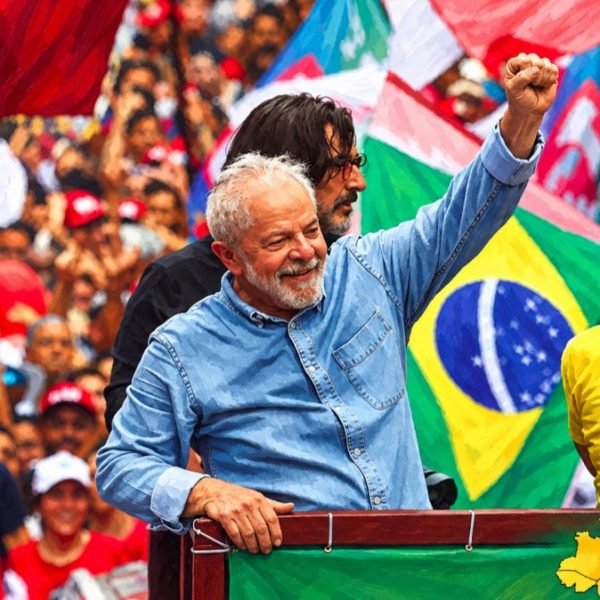
And in this case, it is interesting to note that on the Bolsonaro side - from which one might expect the nationalist proposal - this does not happen, or happens only residually, because even when it does, the attempt is unmasked by the excessive support that American social networks give to Bolsonaro's candidacy, or by the constant interference of Trump and his cronies in the Brazilian electoral process. However much the right wished to present itself as the defender of the nation and its independence, the effusive support of the US for the candidacy in question would bring the mask down, for the US - and Israel - would never support so vehemently and so openly anyone who was not subservient to them. Lula's absence from Silicon Valley's algorithmic command posts ends up giving away which of the two candidates is more subservient to US interests.
On Lula da Silva's side, by contrast, the more clearly drawn proposals on the defense of sovereignty have in fact emerged - even if some of that intensity may later collide with the pragmatic dictates of realpolitik, imposed by the need to strike deals with a notoriously pro-imperialist "centrão." Either way, this dividing line exists, and it seems scarcely credible to me that anyone in full possession of their mental faculties could choose a protégé of Trump to defend Brazil's sovereign interests, rather than an experienced conciliator, even if not a revolutionary one.
Knowing how important this question is, afterward, for the sovereign management and use of endogenous resources and for their allocation to an independent development plan, the choice of Bolsonaro seems to me hard to defend, should the sovereign question weigh in that choice. As in the EU, the sovereignists have not found the best practices on the right either - perhaps with the exception of Viktor Orbán, who governed Hungary for sixteen years, until the April 2026 elections - but more out of a need to align with Russia and China, as a consequence of the EU's energy and industrial choices, than out of any need to build a genuinely sovereign national project. Moreover, if further proof were needed, Orbán's total alignment with Zionism allowed us to see that his disagreement with the EU was merely tactical, not a matter of principle or of defending national sovereignty. Orbán never for a moment renounced NATO or distanced himself from Israel and Zionism - factors he used as platforms of support against the Brussels bureaucracy. His submission to Trump, for that matter, was also explicit, and voiced with the fervor of one who saw in him "an envoy of God"!
In the case of Meloni, Babiš, and others, the question is the same: much talk, but in the end, the same alignment - which foreshadows where parties like the AfD will later turn. Faced with the fundamental questions, they too will fall in line, either with submission to Brussels or with direct submission to Zionism and US imperialism. Others, like Meloni, manage a middle path that, in the end, has the same social consequences. Where it really counts, young people keep running into unemployment, cannot find a home, watch infrastructure decay, see labor rights under relentless attack, and see their wages rapidly losing value against the brutal rise in the cost of living. There is no place where this "new right" is entrenched and seated in the halls of power where this does not happen.
Hence another important parallel persists between the Brazilian elections and what goes on in Europe and the West in general: whether in Brazil, the US, or Europe, this "new right" also uses the identity agenda as its dividing line against the left. Supposedly, the "left" - liberal, I would add - would be responsible for a decadence of customs and of cultural and religious values, for the social and moral decay of the defenders of this "woke" drift.
Now, this demarcation has served as a justification for many who once presented themselves as critics of Zionism, defenders of multipolarity, anti-imperialists, and defenders of Global South sovereignties, and who now use this supposed "wokeness" of the left to justify electing a representative of submission to imperialism like Bolsonaro. This demarcation has one problem: the only thing more "woke" than the "woke" is the one who makes wokeness the most important thing in politics, whether one is for it or against it.
On the left, many are unable to identify, in the excessively identitarian agendas, an individualistic, divisive agenda that fragments the working classes - one originating in the US itself, whose mass-manipulation services turned being "woke" (alert to social injustices) into a kind of identitarian pamphleteering. They stripped the "woke" movement of the class-based dimension and the just redistribution of wealth it once had, and gave it a panoply of identities in exchange - turning the concern with equality, social justice, and freedom, a materialist and universalist concern, into a tribalistic, individualistic concern, and, above all, one disconnected from the material dimension, that is, from the dimension of the just redistribution of the wealth produced by labor.
But on the right, when this tribalistic and individualistic drift is used as a dividing line, what genuinely distinguishes left from right is also denied. For in the historical matrix that separates left from right lies wealth: who dominates it, and how it is shared. On one side, those who hold that property and wealth must not be the measure of freedom and political initiative, and that all human beings are entitled to a life of dignity (universalism); on the other - on the right - plutocratic physiocracy: the idea that freedom and the capacity for political intervention should be measured by the wealth one has. Hence the liberal suffrages rested on a census-based - that is, identitarian - logic, in which what counted was the wealth one had, being a man, and knowing how to read and write; and were it not for the struggle, notably that of the suffragettes, to achieve what we today call "universal suffrage," we would still be there. I suspect they, too, were accused of being "woke," in the terms in vogue at the time!
Thus, from then on - that is, since the founding moment of the "left-right" dichotomy of the French Revolution - the right has committed itself more to the preservation of property in the hands of those who hold it, and the left more to real democracy, to economic, social, and cultural democracy, rejecting the idea that the rich must remain rich and the poor must remain poor. In a manner of speaking, this is what we call universalist progressivism, as opposed to individualist progressivism, which leans above all toward questions of individual identity.
So when this right embarks on the anti-woke logic, making this agenda the most important aspect of the political discussion - as if what really mattered were not the things that allow us to live, to sustain, feed, and enjoy our body and spirit - it does so with only one intention: to divert attention to a superficial issue, so that what is most precious to it does not enter the proposals under discussion: the just redistribution of wealth and economic, social, and cultural democracy. Thus, what matters most to it remains beyond debate, and elections turn into a carnival of little flags for and against. Whoever chooses where to vote because of someone else's wokeness is every bit as woke as they are.
But the similarities do not end here. Another is the question of security and fighting crime: on the right, the idea is spread that crime is fought with brutal violence; on the left, it is argued that as long as there is poverty, crime cannot be eradicated. Now, it does not take much intelligence to see that the first proposal fails precisely where it is most talked about: the US. No country has more common prisoners - and few will have more political prisoners; no country spends so much on supposed crime-fighting; no developed country has so much crime. Because in the US, the breeding grounds of common crime - the Black and Latino ghettos, where desperate populations live, deprived of basic conditions of employment, education, and essential public services - remain overcrowded and ever more impoverished. But that is only the crime of the desperate, the kind that shows up on television.
Another form of crime - which also features in the right/left agenda - is the question of corruption. If this "new right" waves the banner of corruption and the left barely speaks of it, it is equally true that, once elected, this "new right" does everything except end corruption. One need look no further than Trump to find a case of incorrigible corruption. And those who remembered Bolsonarismo and expected the end of corruption were also left cursing in the desert: the Bolsonaro government was, itself, a den of corruption. Perhaps the discussion should start with the point that, to end corruption, one must end what originates it: the immense disparity in the distribution of wealth, which allows some to use their immense economic power to obtain from political power what they lack in electoral legitimacy. This crime - white-collar crime - being even more insidious and giving rise to the deep causes of the other, does not show up as often on television.
On immigration, we have perhaps the only one of the great differences between the elections in Latin America, in Brazil, and in the countries of advanced capitalism. But immigration also shows up as a form of shallow identitarianism of the right. The more the "new right" talks about "excessive immigration," the more it forgets that those who employ these immigrants are the very same who finance and support it; that immigrants come to work in the economic sectors with the lowest wages, exploited by the most backward and conservative bosses - the social base of the radical right; and that employers only turn to immigration as a last resort, because their anti-labor agenda has left workers today unable to project a future with stability; because the young, victims of the transformation of housing into real-estate speculation, can no longer plan a future as a family; and because mothers and fathers, victims of the deregulated work schedules imposed by employers and enshrined in law by the right, have no time for their families.
Worst of all, the more they deny the necessary material conditions, the more they claim to defend the family and its values. A clear display of hypocrisy and cynicism, which denies the deep causes of the problem - a problem that affects the entire West. As they have done, it is easier to deny that the fertility crisis is intrinsically bound up with the prevailing system. Know where there was no fertility crisis ? In the socialist countries of the East. Industrialized, literate, and well-fed countries, which doubled their populations in 70 years. Today, taken over by capitalism, they find themselves caught up in the same old tune of the advanced-capitalist countries. They will not get out of it until the fundamental features of an economic system change - one that not only leaves women no time to have children but also destroys family cohesion through the deregulation of work and, consequently, of life.
Now, what is most interesting about this political debate is that those who, a few years ago - those who said there was no left or right, that politicians were all the same - are now the ones telling us that salvation lies in this "new right," and they are the ones who bristle when we tell them that this "new right" has nothing "new" about it and that, on the contrary, it reeks of classic fascism.
They are never fascists, but they submit to Zionism and the Anglo-Zionist empire; they are not fascists, but they resort to the demagogy and easy rhetoric used by classic fascism; they are not fascists, but they wave mass banners as classic fascism did; they are not fascists, but they use religion and the supposed degradation of customs to divert attention from what is essential, as classic fascism did; they are not fascists, but once in power they privatize, attack labor rights, and shut down essential public services, as classic fascism did; they are not fascists, but they attack knowledge and devalue study and individual effort, as classic fascism did; they are not fascists, but they dismiss political experience, individual and collective track records, as classic fascism did, in order to dismiss institutions; they are not fascists, but they adopt a racialist, xenophobic, supremacist, and ultra-individualist discourse, as classic fascism did; they are not fascists, but they are all anti-communist, anti-socialist, and opposed to social progress, as classic fascism was; they are not fascists, but they are backed by the oligarchy and the most backward employers, as well as by imperialism, as classic fascism was.
They are not fascists, but they smell, fly, sing, and bellow like fascists...
Call it what you will, but a "thirties" of the 21st century, armed with AI and social media ? No, thank you ! We can expect nothing different from those who have the same bosses and want to boss around the same employees...
Afterward, whomever you vote for, I hope you will spare me the tired old refrain of "we were fooled."
SOURCES
Incarceration in the US - the US has the largest prison population in the world (about 2 million people) and the highest incarceration rate of any democracy; per capita (World Prison Brief / Prison Policy Initiative, 2026). eji.org
Jair Bolsonaro - convicted by the Supreme Federal Court (STF) to 27 years and 3 months in prison (September 11, 2025) for attempted coup d'état, armed criminal organization, and violent abolition of the democratic rule of law; serving his sentence since November 25, 2025. apublica.org ; checamos.afp.com
Donald Trump - convicted in May 2024 on 34 felony counts of falsifying business records; in January 2025 he received an unconditional discharge (no jail time or fine), with appeals still pending in 2026. bbc.co.uk ; axios.com
Viktor Orbán - Hungary is a NATO member, and Orbán was a close ally of Netanyahu and Israel; in the April 2026 elections, Péter Magyar put an end to Orbán's 16 years in government. apnews.com ; ynetnews.com
Suffrage - in Portugal, census-based suffrage was only abolished in 1968; women obtained a limited right to vote in 1931 and full equality only with the 1976 Constitution. europeana.eu ; Cad04.pdf
Origin of the term "woke" - African American English, with records from the 1920s-1940s, popularized from 2014 onward by the Black Lives Matter movement. merriam-webster.com ; latimes.com
Origin of the terms "left" and "right" - the seating arrangement of deputies in the French National Constituent Assembly in 1789. observador.pt
Crime - the US homicide rate (≈6.4 per 100,000 inhabitants) GSH_2023_LAC_web.pdf