October 6, 2026
THE IRAN WAR IS BREAKING AMERICA'S GRIP ON OIL AND THE DOLLAR - w/ Prof. Michael Hudson,
Brandon Weichert: And we are back. I am Brandon Weichert, co-host of the Mario Nawfal program. Check out the YouTube page, like, subscribe, follow there, click the little bell—that'll let you know whenever we post new videos. I am joined now by Professor Michael Hudson. He's a Wall Street economist, and I love it, and a critic. Professor, thanks for doing this.
Prof. Michael Hudson: Good to be here.
Brandon Weichert: So, we're looking at a pretty bizarre situation wherein it seems like the markets are a little bit out of sync with the reality of what's going on in the Strait of Hormuz. It looks like we're running out of oil; the Strategic Petroleum Reserve is at its lowest—not just ours, it looks like a lot of them except China's. What's going on with the oil market, Professor?
Prof. Michael Hudson: There's an illusion somehow that as long as there could be a resumption in trade through Hormuz, that somehow everything is going to go back to normal. But it's not going to go back to normal, as almost all of the people who have actually been following it [know], because there's been an awful lot of destruction of oil. And all of that means that there's probably going to be a shortage of oil, and especially refined oil—diesel oil and airplane fuel—that is going to be lasting well into at least next year, 2027. Certainly by the end of this year, you're going to have prices going up.
So we're in a kind of interregnum, an intermediate period right now where the prices are being in the short term kept down by the fact that you just mentioned: the U.S. is releasing its petroleum reserve, and Trump has got European countries to begin to sell their petroleum reserves to the United States very largely over the next four-month period to help keep down diesel prices here.
Well, this is going to cause an immense hurt of the European balance of payments, because when the reserves are as low as they can go, you're going to have European countries replenishing their own petroleum reserves at much, much higher prices for the diesel oil. So foreign balance of payments are going to be squeezed very much.
And the United States also is going to find that payments for oil are squeezed, and this already has squeezed American agriculture. The prices of fertilizer that are made out of gas are going up, the price of diesel fuel that's used for harvesting machinery is up, so already you are having farmers saying, "Well, we're not going to be able to make a profit by planting crops for this coming year because of the oil crisis that we expect to continue for quite a while, increasing our costs."
So you're going to have American farm exports not be as strong as they were before, but of course other countries are in the same boat, so world agricultural prices are going to go up. Everything—costs and prices—are going to be going up together, and it's going to be almost a free-for-all between Europe, the United States, Asia, Global South countries as to who can maneuver as best they can to cope with this economic disaster that not only affects oil prices and the balance of payments, but interest rates, exchange rates, and the entire economic system is being thrown into disarray with all of this.
Brandon Weichert: It is a perfect storm that is brewing, and it was all brought on by a decision to start a non-popular war in February. At least, I think a lot of it was.
Let me just give a programming note here: the audience members in the subscription chat, feel free to put your questions for the Professor in. Lisa's going to pick the top questions, and in the last 10 minutes or so of the episode today, we'll ask the audience questions of the Professor so we can get his insight into what you're concerned about.
But let me just circle back to some of the breaking news coming out not of the Middle East right now (which there's a lot), but the last 24 hours in the Ukraine war. Professor, we've seen a major attack from Ukraine targeting one of Moscow's major refineries. It was an oil storage facility they blew up; they did not shut the refinery down completely, I think they damaged it. It's part of the Transneft network. And then there was also these attacks against grain shippers in the Sea of Azov with the drones. So how is that impacting the world?
Prof. Michael Hudson: This has been going on for quite a while. Trump and the U.S. CIA basically from Germany has been directing the Ukrainian missiles specifically against Russian oil refineries to prevent Russia from supplying diesel fuels to other countries. A centerpiece of American foreign policy for many decades now has been to control the oil trade and to control the currencies in which this trade is conducted by the United States.
In order to control world oil and to monopolize it, the United States has had to block other countries from buying oil and gas from Russia, from Iran, and from Venezuela in the past. So the centerpiece of American foreign policy is to use the oil trade as a choke point, so that Trump can then go to other countries, as he's just gone to Europe and said, "Now you notice that we've blocked off your ability to buy Russian diesel and Russian oil just in case you had any desire to do that. So you're going to be pretty much dependent on us, and if you're going to want us to help you later by exporting oil from ourselves, from Venezuela, or any of our allied countries, you'll have to support our American foreign policy, especially the war in Iran and our isolation of Russia, Iran, and Chinese economies."
All of this is part of Trump's attempt to isolate countries he designates as enemies. He wants to control the oil trade because it has been probably the single most remunerative element of the United States' balance of payments for the last century.
Brandon Weichert: So this is part of a—you're saying a concerted kind of covert strategy?
Prof. Michael Hudson: It's not random, it's been very overt. Very overt. Secretary of the Treasury Bessent a few months ago came out and said, right after the U.S. seizure of Venezuela, Bessent said, "Here's what we're going to do to Iran and even Russia: we're going to do to them what we did to Venezuela. Number one, we're going to either seize their oil, or if we can't control their oil, we will destroy their oil export capacity by bombing it. Once we gain control of their oil, number one, we're going to make sure that all this oil is priced in dollars—not Chinese currency, not foreign currency, but in dollars—with these dollars having to be recycled into the U.S. economy."
So the United States benefits not only from its own oil sector's exports of oil and its earnings on foreign oil, but from all the foreign countries—Venezuela, other countries that export oil—they're supposed to keep the savings from their oil and gas in the United States, coming right in. They price their oil and gas in dollars, and they keep all of the savings of their export sales in dollar investments.
Largely, if a government owns the oil, the government tends to buy U.S. Treasury securities, or leaves the money in U.S. banks, and invests in U.S. financial firms. That's what Saudi Arabia did, and all of that is what's being frozen right now by the oil war and the destruction of Saudi Arabia's oil export capacity.
Brandon Weichert: I hear what you're saying, and I've heard other guests say this as well, but to me it seems like this is going to backfire. China has significant refining capacity that they're not really using yet—it's something like 30% they're not using. We're at capacity; we couldn't absorb any excess even if we wanted to. Russia's having their refineries shut down because of the war. This plan of theirs, is it going to work, do you think?
Prof. Michael Hudson: Well, what is Bessent's response ? He said, "Well, if we find any Western firm sending payments to China for China's exports of refined oil—most of which it's buying from Iran right now—then we're going to impose financial sanctions against that country and freeze their dollar holdings." This is it. And so Trump and Bessent have in essence tried to isolate all the other countries from the U.S., and what he's done is isolate the United States economy from them. That's what you mean by backfired. He's isolating the United States by trying to isolate other countries.
And other countries cannot afford just to say, "We're going to give up if we can get oil and gas for one-seventh of the price from Russia that we have to pay you, why shouldn't we follow our economic self-interest in all this?" Well, Trump says, "Because we'll threaten you and we'll cut you off from access to the U.S. market, we'll cut you off from being able to use the dollar area, the whole international financial system that's conducted in dollars."
Well, the result is other countries have stopped accumulating their reserves in the form of U.S. dollars. What are they going to do ? They're largely holding foreign currencies—strong currencies like the Chinese RMB—or even buying gold, something that is not dollars. And so what Trump has done is killed America's free lunch of running a financial system that other countries were willing to save all of their balance-of-payments earnings.
Their net accumulation in their central bank reserves had been sent into the U.S. economy in government securities—not only Treasury securities, but federal agencies that paid a little bit more (Fannie Mae, etc.), or even U.S. private sector investments. All of that has been cut off. So what Trump has done is end America's free lunch of getting all of these dollars that are other countries' earnings on their exports of industrial goods, exports of whatever thing. They've made the dollar unsafe.
Brandon Weichert: So we went from "Make America Great Again" to "Make America Last."
Prof. Michael Hudson: That's pretty much it. And you've seen what's happened right now: America's strongest ally in the Persian Gulf was Saudi Arabia, and Saudi Arabia has paid the price of having a lot of its refinery facilities and U.S. investments there bombed by Iran, on the principle that Iran says, "If we can't export our oil, neither can Saudi Arabia or the United Arab Emirates or anyone else in the Persian Gulf."
And it's done this because it's trying to get the whole rest of the world of oil-importing countries to have a stake in opposing the oil war, and saying, "Look, we want to restore normalcy where we export oil and we use our oil export proceeds to develop our economy. If you join the United States in blocking us by bombing our oil refinery and oil production facilities and bombing our country, then you're going to have to suffer from the world depression that's going to be created by the interruption of all of these oil exports."
Brandon Weichert: Do you think we are heading toward a global depression?
Prof. Michael Hudson: Yes, there's no way around it. The prices of oil are going up so high that if you want to see a picture of what'll happen, look at what happened in Germany after February 2022. When Germany stopped importing Russian gas and oil, its gas and oil prices soared, and the result has been to make many German industries unprofitable. Especially the glass industry, for instance, used gas to melt the glass; the car makers, all the industrial sector of Germany uses power. And there's a direct connection in every country between energy use per worker and productivity per capita.
All of a sudden, this became so expensive to sustain that once they had to shift to America's liquefied natural gas instead of Russian gas through the one pipeline that was still working (not to mention the other pipelines and trade), the German economy could not compete. It's been shrinking steadily since 2022 and has been in a corresponding political crisis, as you're seeing today with how unpopular the pro-war party of Merz is in Germany.
Well, imagine that happening all over the world as oil prices go up, especially for the Global South countries of Africa, South America. In order to pay for the oil imports that they need to heat their homes, light their homes, and fuel their factories, they're going to have to pay more and they're going to have to provide subsidies. How are they going to do this ? They can't do this and also pay all of the foreign debts that they owe.
There's no overt discussion of this yet, but you can be sure that any balance-of-payments analyst is saying: how can you pay more for your oil imports and rising food import prices (as you pointed out), and still afford to pay all the debt service on your foreign bonds ? Well, the Global South and Global Majority countries can say, "The United States under not only Trump, but Biden before him, has started this oil war, and that war is what's prevented us from earning the dollars to pay the dollar payments on our foreign currency bonds. So we're going to have to have a moratorium on this."
The alternative to a moratorium is they're going to have to do what victims of the International Monetary Fund have to do: impose austerity. And the austerity will be, "Okay, we're going to impose a depression on ourselves in order to afford the food and the power of oil that we need, just in order to pay our foreign dollar debts." Countries are not going to do that and remain in power. They're all going to look like the German economy if they try to do that.
Brandon Weichert: Professor, I just got off talking with Mario in our session—you know, we do a daily session news wrap-up. Toward the end there, we were talking about France and Germany and what's going on in some of these European countries. My thesis to Mario—and he thought it was too extreme—I said, "We are in pre-revolutionary conditions in much of Europe." And I think also, by the way, there's some funny stuff happening in Canada with Alberta, I think there's some weird stuff happening here in the United States. Do you think that we are, because of this economic situation, in pre-revolutionary conditions in Europe?
Prof. Michael Hudson: You're basically correct. There's one thing missing from this pre-revolutionary condition, and that is: what's the alternative plan?
In order to have a revolution, you have to have a proposal for an alternative.
And the almost surprising thing is that while there is an impetus for a revolutionary condition, I don't see any proposals for an alternative really. There's nothing coming from the BRICS. The only workable alternative would be a full-scale break.
Countries are being forced to choose, either—as George W. Bush said—"Either you're with us or against us." Either you choose the U.S. market and all of the demands that Trump has imposed—the tariff demands he's imposed, the oil demands for tribute that he's imposed—or they're going to turn towards the more rapidly growing economies mainly of Asia: China, Russia, and potentially Iran.
The normal expectation is, well, ultimately countries are going to act in their own self-interest. But that isn't what's been happening, because what is their self-interest ? If their self-interest says we're going to have to create an alternative to the International Monetary Fund, to some institution overseeing how much foreign debt can be paid You've had speeches by President Putin of Russia and by China and also by other countries saying, "Well, the United Nations is supposed to prevent the kind of thing that's happening today, but it's been paralyzed by the U.S. control of the United Nations, and the United Nations doesn't have any means of enforcing these violations of the Charter, the violation of national sovereignty." Where every country is supposed to be able to trade with whoever it wants—free trade, buy your oil from whoever you want (Russia, Iran), sell it to whoever you want (China, other countries)—all that's blocked.
The law of the sea is being blocked by the U.S. and NATO bombing Russian tankers in the Baltic, Russian tankers elsewhere, Iranian tankers. The law of war is being violated—attacking countries without pre-warning, attacking civilians, and in fact focusing on attacking civilians hoping that somehow this will demoralize their populations and convince the Iranians, "Maybe we need a regime change and appoint the Shah or some other pro-U.S. ruler so America will stop bombing our schools and our children." Well, that's not reality. Obviously, it's galvanized all of their mutual support.
So how are countries going to create a whole alternative set of institutions to what exists today ? That's what is so daunting to the revolution that you're seeing the seeds being planted for.
Brandon Weichert: I wonder if the real revolution will be in the form of these countries breaking with the so-called Western consensus and saying, "We're going to do business with Eurasia, because that's where the future is." You're already even seeing, by the way, the Russians are making their own Pacific pivot. I know that they're bogged down in Ukraine, but you look at the Russian interest in developing their Far East and their closeness with China—that looks like a pivot away from the West itself on their own.
I wouldn't be surprised, by the way, Professor, if in 10 years the United States is doing more deals with China, and we're bringing in Chinese BYD cars and whatnot because we can't compete anymore in these industries.
Before we wrap up, I want to spend the next 10 or 15 minutes—we got some great audience questions. Lisa, our producer, is saying we're going to open up to the audience. Lisa, why don't you throw up that first question there, please, from the audience, and I'll read it out to the Professor.
Okay, this is from returning viewer ASFQ:
"Do you guys think that the Iran-Venezuela war was the attempt by the U.S. to control world oil and use that to bargain with China on rare earth minerals ? Do you think that is the case, Professor?"
Prof. Michael Hudson: Silly as it seems, yes. Obviously, America doesn't have a strong bargaining thing. I want to say one thing: I agree with what you've said about the break from the West. That's what I've been writing about on my website, on all of the articles that I've been writing—that's exactly what is happening. Other countries cannot afford to remain in a West that is controlled by the United States, with Europe being basically reduced to the position of being economic satellites, not having their own agency.
Brandon Weichert: Professor, most Americans can't afford to stay in the West either. I mean, it's—you know.
Prof. Michael Hudson: Yes, and by the way, I've often said I don't even know what the West is anymore. I don't even think America is a Western country, but that's another discussion for another day.
Brandon Weichert: Lisa, what's the next viewer question for the Professor?
Okay, this is from ULALA. Thanks for sending this in:
"Greetings from Romania. Do you, Professor, think those currently leading Europe will succeed in federalizing the European Union?"
Prof. Michael Hudson: No chance of it. The European Union is, if anything, breaking up, because the three major leaders—Merz, and Macron in France, and whoever the revolving-door British Labour Prime Minister is—is all in favor of confrontation with Russia, and is willing to sacrifice their own industry, their own agriculture, to serve the United States' war on the rest of the world. And that's crazy.
You're having opinion polls oppose all of the existing governments, and it's as if they're having to wait the next year, maybe two years, until finally there's an election where they can vote the Christian Democrats out of power in Germany, Macron's so-called socialists out of power in France, and have it just bounce back and forth between Britain's Labour and Conservative parties for whoever isn't [in power], without really having an idea of what can be a federal Europe that everybody agrees on putting its own growth first.
The one thing that European leaders want is: America's growth comes first, our careers come first, our careers have been promoted by the United States, and its NGOs have been nurturing us since their talent agents found us as opportunists when we were in college, and we're going to go for where our bread is buttered. Europe doesn't seem to have any real leaders with an economic platform of what a different Europe is going to be all about.
So we're back in your revolutionary situation. It should be a revolutionary situation waiting for not only a leader, but for a set of ideas and institutions for what the revolution will be all about.
Brandon Weichert: Yes, I agree, I agree. Do we have another question, Lisa?
Okay, this is from Aaron Webster 33. Thanks for the question, Aaron:
"How would you explain, Professor, the disconnect between current crack spreads, physical oil, and paper oil prices throughout the last two months?"
Prof. Michael Hudson: Short-term versus long-term. Traders live in the short term, and the prices that are quoted in the Wall Street Journal every day for Brent crude—these are for trading paper claims on oil, not for actually claiming, buying, and taking possession of the oil itself. There's a disconnect, as I think you began the whole show with, between the financial markets for trade short-term and what's looming for the long term.
The cost of trying to buy oil or diesel forward, the cost of having that option is so great that there's no real market in it. So there isn't a market reflecting the economic reality that you and I and most of the commentators on the internet have all seen coming very clearly.
Brandon Weichert: You know, it's funny, we're living in a media environment where commentators on the internet are the ones setting and breaking the news cycle. It's kind of fun to see. Do we have another question for the Professor, Lisa?
Brandon Weichert: We do. This is from ASXOGZ. Thank you for your question:
"What economic impact, Professor, will artificial intelligence have on people's 401(k)s in the near future?"
Prof. Michael Hudson: That all depends on how they've invested their 401(k). There's a lot of investment thinking that artificial intelligence has got to make a lot of money because it already has borrowed, I think, $6 trillion of costs of developing research and development. But there's not a market price. There's a value for all of this if they actually spent the cost, but there's no market price reflecting this value. How are they going to recognize it?
In practice, we don't see the returns yet, the profits yet. And how on earth can they make a profit if they're not able to build the huge computer camps around cities that there's already plans of large-scale public opposition to ? It would take me 15 minutes to explain why this is a fantasy, but I'll just say one thing: there's a whole different philosophy of investing in technology today than there was when I was a futurist 50 years ago back in the '70s.
Just about everybody saw there was going to be a rising role of government for new technologies. They were thinking of outer space largely and atomic technology, but the same thing goes for technology leading today. The costs of research and development are so large that it can't be done by private corporations, because private corporations have to make a profit, and they use their profits to pay dividends to stockholders or stock buybacks to support their stock prices. If private corporations have to spend it on R&D, well, why have they all been cutting it back since the 1980s ? Thatcher, Reagan—the whole neoliberal idea that corporations should be run for stockholders is based on living in the short run supporting stock. How are they going to supply R&D?
What's unique about all of this information technology and artificial intelligence is they've actually borrowed corporate money to make this R&D without any sense of balance that the costs of R&D are often larger than the volume of profits that can be made. That's why corporations for a century have asked the government to take the lead in setting up think tanks and R&D—like developed the atomic bomb, like developed outer space—because private corporations can't do it. The government should develop a technology, and once it's able to be commercialized, turn it over to the companies to commercialize and make a profit.
Instead, they put the research before all of this, and all of a sudden they're saying: how on earth can all of this debt from these companies be paid ? Where are they going to get the money unless they charge such huge monopoly prices for artificial intelligence that there's no way they can compete with, say, China's open-source systems that it's providing the whole world freely ? So talk about the world breaking away from the West—it's a whole different philosophy of investing in technology.
Brandon Weichert: Well, I should say the Chinese model—we'll have to wrap it up now, but the Chinese model is very similar to the old model the Americans used in the '40s and '50s to build out the telecoms. It was a partnership between private and public, the old Bell Labs model, if you will. There's a great book by Mariana Mazzucato, I recommend everybody get The Entrepreneurial State. Really a phenomenal book; I don't agree with her on everything, but I thought that was a great book.
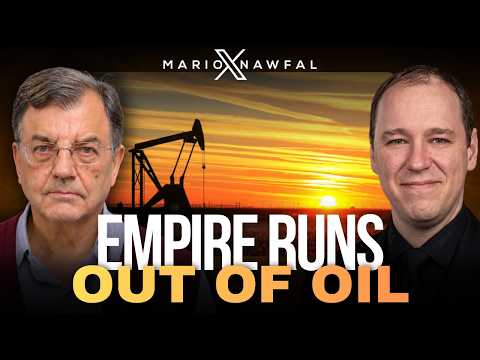
And I should also say you have a great website out under your name: michael-hudson.com. That was a phenomenal essay the team sent me which this segment was based on: Empires Run Out of Oil.
Professor, thank you so much for your time. I'm sorry this was a truncated episode, I have to go pick up my kids from school, though. So we will definitely have you back on with me soon to have a longer discussion about revolution.
I should also say, Professor, for your interest: it looks like the AfD in Saxony has been elevated to the presidency, I'm seeing this breaking news here. Tobias Rausch has been elected speaker of the Saxony-Anhalt legislature with 48 votes, nine more than the AfD's 39 seats. So they've secured the presidency of a state parliament is what the news is.
All right, well thank you, Professor. He is Professor Michael Hudson, Wall Street economist and critic. We'll have him back on with me for a longer discussion, I promise you that. I'm Brandon Weichert—the Brandon Twitter/X, The Weichert Report on Substack. Thank you so much, and I'll see you in an hour. Bye-bye!