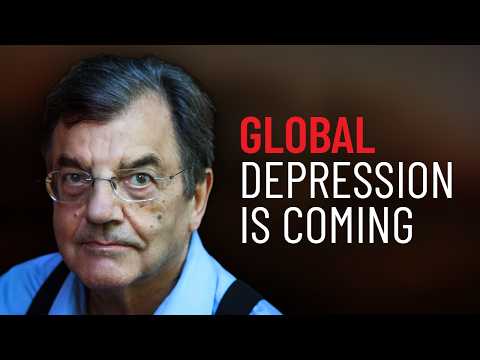
Robinson's Podcast • Episode 294, September 18, 2026
Michael Hudson in conversation with Robinson Erhardt, edited.
Energy prices and the risk of a world depression
Robinson Erhardt: Michael, I woke up to a fresh paper that you sent me—or maybe they were just some thoughts of yours, but they were coherent enough to be a paper. You make an extraordinary prediction: the Iran war is going to create a world depression by the end of this year. Why is that?
Michael Hudson: Because oil and gas prices are going up. That means fertilizer prices are going to go up. The fuel crisis thus will coincide with a food crisis. Grain exports are being blocked from Ukraine and Russia as a result of the American-NATO war against Russia, where the United States is directing Ukraine which ships to bomb in the Black Sea and the Sea of Azov, and Russia has retaliated by blocking Ukrainian shipping.
What this is going to do is twofold. In terms of prices alone, it is going to push the balance of payments of oil-deficit and food-deficit countries further into deficit. How can they afford it, with already strained balances and limited resources?
They are going to have to make a choice. They also have a lot of debt service coming due. Their biggest foreign-currency obligations are to bondholders, bankers, and the IMF, whose claims on them are all set in U.S. dollars.
Are these countries going to put their own economies first by paying for the higher-priced oil, gas, and food imports they need, and say, "We demand a moratorium. We cannot pay these debts. We are going to have to put our own economy first" ? Or are they going to do what they have done in the past and have their treasuries give priority to paying their foreign debts?
I think that to the extent that they are democratic and subject to domestic political pressure, they are going to pay the higher import prices and provide subsidies. These will enable their wage earners and populations to heat and light their homes, and their businesses to remain in operation. If they do not, they are going to look like Germany did after February 9, 2022, when the United States told it to stop importing Russian gas. Germany went cold turkey and had to pay six times as much for U.S. liquefied natural gas as it had been paying Russia.
Germany had enough money to pay this, and most companies had enough money to pay it. But Germany, and most of Europe, had to begin providing subsidies to the population. This pushed Europe's national fiscal policies into deficit. The arbitrary European Union rule long limited budget deficits to just 3% of GDP, recently raised to 5% in practice in response to U.S. demands on Germany and Europe to pay 5% of their GDP just to go to war with Russia, to arm themselves for an imminent attack from Russia." The fantasy is that somehow Russia is going to expend a third of its population by invading Europe.
Obviously this is ridiculous, and voters have recognized it as such. You can see how unpopular Merz is in Germany, Macron in France, and Britain's Labour Party. The United States is insisting that its allies devote almost all their GDP growth—and 5% is much more than their GDP growth—to supporting Trump's wars against Russia, Iran, and any other designated enemy.
This is forcing other countries to use the following argument. The global majority can say: "The money we owe is in U.S. dollars. But the United States itself has created the war that has increased the cost of our energy and food, and prevented us from paying these debts if we are to keep our own businesses and population solvent. So we are putting our own economy and population first."
This would force a break from the U.S. order. There really is not much choice. It is leading to a political crisis throughout the world. There must be an alternative to this U.S. order that is threatening to drive countries into a depression.
If industries find it unprofitable to use energy—oil and gas—at current prices and still make a profit, there will be unemployment, just as occurred in Germany's auto, steel, and glass industries. Farmers will say: "If we have to pay higher prices for fertilizer and diesel for our tractors, just as American farmers have found, then we cannot afford to plant our crops this year in the hope of making a profit at the prices being offered by the banks and purchasing agents who are going to be our customers."
Many farms and industries will be unable to pay their debts. This will cause a wave of financial insolvencies and breakdowns, a domino effect right down the line. It will also blow back on the U.S. economy itself, which is the most highly debt-leveraged economy in the world, as it was in 1929.
The United States became the major victim of the pro-creditor policies it had imposed after World War I. Those policies led to a moratorium on the inter-Allied debts and German reparations in 1931, when the whole world realized that countries could not afford to pay their debt overhead - mainly in U.S. dollars - and still get out of the depression that engulfed the 1930s.
That is the choice facing the world today if countries break away and say, "We need a moratorium now." The problem is not simply the Trump administration's policies in going to war with Iran, or continuing the Biden administration's war with Russia and the long-term neocon policies of the United States. It goes far beyond that, to the whole way the post-1945 world economic system was designed by the United States to represent its own interests as the world's major industrial nation and creditor.
It imposed pro-creditor rules and austerity on countries that could not pay their debts, while imposing free-trade rules that drove Britain most notably, and its former colonies and ultimately what was called the Third World—the Global South—into debt. The result has been unequal exchange ever since 1945.
There is a recognition that this exchange is unfair. That moral principle—what is fair—is coming to the fore now. All that remains is to spell out how we go about creating a different system.
Elections and the continuity of foreign policy
Robinson Erhardt: You have described a political crisis throughout the world, with countries having to choose between paying much higher oil prices and paying down foreign debts. We are having this conversation a month or a month and a half before major elections in the United States, and in a sense we are in their shadow. Do these elections have any bearing on the crisis, or would it be a presidential election where this would really matter?
Michael Hudson: Neither these midterm elections nor the presidential election have any bearing on how this crisis will unfold. Both the Republican and Democratic parties favor the Cold War, the war against Iran, the war against Russia and the whole U.S.-centered order. Trump is simply following President Biden's Democratic policy, with emphasis.
Congress is very much in the hands of the major campaign donors, as is the U.S. Senate. When both back the same idea, the Democrats may say, "Let's have Trumpism without Trump
I think you and I had this conversation in 2024, when I was an adviser to Jill Stein of the Green Party. Her position in Michigan, Minnesota and the Midwest with their large Muslim populations was that the Democrats were, and always had been, the pro-war party. There was no way you could vote for Biden's successor, another Democratic president who was going to follow exactly this policy.
It was the antiwar vote in the North, by a fairly narrow but significant enough margin that nobody could call it a stolen election, that turned the election in Trump's favor. Just as he won the first election because he was not Hillary, he won the second because he was not Biden or Biden's designated successor. People were disgusted with the Democrats, and I think they simply did not vote.
A few months ago, before the war in Iran really heated up and the oil crisis began with the closure of the Strait of Hormuz, I thought the rest of the country might see that there is really only one party here. It is dominated by the neocons, the billionaires supporting them, and AIPAC, financed largely by billionaires, not only by Israel. I thought there might be a very low turnout.
It turns out that Trump is behaving in such a corrupt, despicable way, especially saying he is going to tear down the Kennedy Center if he cannot put his name on it. Things like this violate the moral ethic. People want to send a message: "We want to remove Trump. We want to remove the Republicans who have not broken with him but seem to be mysteriously under his almost hypnotic control. So we are going to hold our noses and vote for the Democrats."
That is what it looks like will happen. But it will not change the policy at all: backing this world order. Last December's U.S. National Security Strategy said that the world order we established in 1945 was no longer serving the United States either. We are no longer an industrial power. We have deindustrialized as we have financialized. We are no longer a net world creditor.
We have run up a huge government debt to foreign countries, now that we no longer give them our gold. Instead of using their dollar inflows to buy gold, they were forced for many years to buy U.S. Treasury notes, bonds, and other securities—various IOUs. But they are not doing that any more.
All we have left is to demand tribute. We have to use economic and political force, create choke points in the world economy and weaponize the dollarized financial system to make money. That is what Trump has said, in effect: "I am going to impose my tariff policy. I have threatened to create chaos in foreign countries by abruptly stopping their ability to export industrial goods to the U.S. market if they do not make policy concessions by joining our war policies against Russia and Iran." He followed that up by escalating the war against Iran.
The United States can maintain the affluence it is no longer producing at home only by obtaining it from abroad. But there is no way to obtain it through foreign trade, or even through a creditor system anymore, now that it has weaponized the credit system. It literally is unsafe for other countries to make loans in U.S. dollars, lend to the U.S. Treasury or even keep their gold in the United States. As you have seen in the last week, even Holland has asked for its gold back.
Countries are preparing to decouple their economies from the United States. That is the crisis. What we do not know is how it will be resolved and what will take its place.
Robinson Erhardt: I would like to return to the details of the war on Iran and its ramifications for the global economy, but first I want to clarify something about these upcoming elections.
This might sound unrelated, but I am very pessimistic about AI right now. I am also pessimistic that, even though we ostensibly live in a democracy, anything an individual voter can do will avert the impending crisis. Another analogy is our support of Israel. If somebody opposes that support, I do not think there was any way they could have voted in the last presidential election that would have affected our policies.
Am I correct that, going into this election, there is nothing a voter can really do that will affect what is happening in Iran and its potential implications for the economy?
Michael Hudson: You have talked about three different arenas, so let me address each. I do not think there is anything voters can do about AI in America. I am very curious about what voters in South Korea will be able to do. In the last few days, Trump has told South Korea: "In addition to paying us $350 billion for access to the American market and a reduction in our tariffs from 25% to 15%, we want you to stop buying Chinese AI. We want you to use the American monopoly system. We want you to pay ten times as much to lock yourselves into permanent dependence on U.S. AI monopolies under our control, so that we can use that as a choke point to destroy your economy at any point, when we have a kill switch on you."
That is a deal-breaker for Korea, and it must create some sort of panic. We can talk about that later. The only election I see that may have something to do with AI is in Korea, and perhaps Japan. I am sure the United States is putting pressure on its closest allies, the only countries it can affect, not to use Chinese AI, chips or the computer and information technology that China has developed at a much lower price and apparently greater efficiency. It is provided freely as an open system throughout much of the world, which is why it is being adopted in Africa and many other regions.
The second question was about the Iran war—or, no, Israel. I think that in many states the fight between Republicans and Democrats will be over Israel. Democratic candidates for Congress, and perhaps the Senate too, although none come to mind right now, will say: "I won the Democratic primary by saying that I do not accept AIPAC money. My Republican opponent does. Who are you going to vote for ? Are you going to vote for AIPAC, or for the principle that all humans are equal and you cannot kill people because they are a different ethnicity and your religion says God tells you to kill everyone who is not one of them?"
In those cases I think Democrats will win, and it will specifically be an anti-AIPAC vote. But AIPAC will still give huge amounts of money, or there will be AIPAC-like vehicles through which the donor class can contribute to candidates in the future.
Where AIPAC and Israel are not specific issues, I think Democrats may simply stay home and Republicans will turn out. If President Trump is able to have ICE police at all the voting booths, immigrants, even naturalized citizens, will fear showing up in case they are arrested and checked for records—for going through a traffic light or something like that—to deport them. There is going to be the beginning of a reign of terror at the voting booths, and that may certainly help Republicans.
Regarding the war with Iran, Trump has made it appear that the huge supplies of bombs he has sent to Israel are intended to be dropped on Iran. Who else would they be dropped on ? We are talking about bombs larger than those dropped on Japan and Germany in World War II.
These are not to be used against the West Bank and Gaza, which are already decimated. They are obviously intended for Iran. The question is whether Iran will have Russian, perhaps Chinese, support in shooting down the bombers, or whether the military itself will reject this policy, as its leaders apparently rejected Trump's attempt or desire to use an atom bomb, or many bombs, against Iran.
I think the question will be military in character. Congress no longer has any voice in declaring war. It does not matter who is elected to Congress, because Congress has no role to play in any of this.
Petroleum reserves and the price of fuel
Robinson Erhardt: That probably answers my question, which was not worded very well. I was asking whether, for voters in Michigan or Texas or wherever, if they are sick of gas prices or simply do not want us involved in Iran anymore, it matters which way they vote. It sounds like the answer is no.
Michael Hudson: I think they are concerned. The question is how many are reading the news.
There is a reason gas prices have not gone up more: the United States, like other countries, is emptying its national petroleum reserves. The oil we are not getting from the Persian Gulf is being piped out of the U.S. salt caverns where the reserves are kept. Do people realize that as the reserves get low and run out, suddenly that supply will not be there?
The political issue will be: while America is running short of diesel, gas, and oil, it has been exporting oil to Europe and its allies. Of course it has. As prices have gone up in the United States and the world, the oil industry is making a killing. Prices are being set at the world margin, determined by the fact that the war in Iran has closed the Persian Gulf. But the cost of producing American oil and gas has not gone up. Suddenly the margin between the market price and U.S. production costs has widened, causing a bonanza for the oil and gas companies.
The oil industry has been among the largest campaign contributors for the last century. I think it has more power than anyone else. You can expect feel-good reassurance from oil companies and their lobbyists to put voters at ease: "Soon it will all be over. We are negotiating a way out of the blockage of the Strait of Hormuz."
There is no way of knowing whether America can actually open the strait before the election, or what it has to offer. Certainly Iran itself is not going to be doing anything to anger Trump if it fears American interference. You also have the Yemenis moving rapidly against Saudi Arabia, and a civil war going on in Yemen. The whole area is so unstable that you simply do not know.
I think voters will be quiescent over the oil issue. They will follow headline personal issues more than their own pocketbooks, surprising as that may seem. Republicans may be more concerned about their pocketbooks, especially truckers and the working class.
If Trump has to empty the national petroleum reserve, even if it leads to the collapse or pollution of the salt caverns, he will do anything to keep gas, diesel, and aviation fuel prices low. Diesel prices are rising though, increasing the cost of food, crops and other products shipped by truck or rail. People may say, "We are only concerned with our cars, not that." And urban populations may not be as concerned as rural populations. This may have more effect in the western states than in the East and South.
What GDP and employment figures measure
Robinson Erhardt: Returning to the claim we began with, that we might be entering a depression in 2026, there is an obvious objection. The current numbers in the American economy do not look like those of an economy about to enter a depression. I think unemployment is 4.1%, jobs are still being created, and GDP grew in the second quarter of this year. Why do you think these numbers give us a misleading picture of where we are—
Michael Hudson: Because GDP is not the economy. What is a product ? The United States counts an enormous amount—maybe 40%, maybe 50%—that is not a product at all. For instance, interest is counted as GDP. When interest rates go up, this is treated as GDP. When people fall behind on credit-card payments, they are charged penalty rates. Penalties as high as the interest rates, pushing everything over 30%, are classified by the Commerce Department as providing financial services. Financial services are not products; they are economic rent.
When housing prices go up, homeowners are asked by the Census Bureau or Bureau of Labor Statistics, "What would you have to pay if you had to rent your apartment?" They say: "Now that I see rents going up all around me, perhaps in my condo or building, I can see my rent would go up to such-and-such a rate." That is counted as an increase in GDP.
Almost all the growth in financial wealth since 2008 has been financial in character: stock-market gains, bond-market gains. The services, payments and rewards to the rentier class, the banking class and the private-capital class are counted as GDP. We are back to the famous quote by Goldman Sachs head Lloyd Blankfein to the effect that "Our partners make the largest contribution to GDP of any company in America. Look at how much we pay them."
Such a payment, a gross national cost, is the cost of doing business, the cost of running an economy. That includes land rent, housing prices, financial prices and monopoly rents. All of this is a cost, but it is not a product.
The American economy is de-industrializing. As for employment, almost all recent employment has been in medical care, by far the largest category. Why is that ? Many undocumented immigrants were home-care workers; that was one of the jobs they could get. They are being deported, or are afraid to show up anymore.
Does medical care for the retired or sick population contribute to GDP ? It is a stretch, but you could say it may. Yet medical care is almost 20% of America's GDP. Why is it so much more expensive here than in countries with public medicine, or at least countries that have avoided the medical insurance companies we have as a result of Obamacare ? Is all of that really productivity?
What is lost is the question of what productivity is, and what a product is. Industrial employment has fallen. When President Trump wanted Korea to build a plant here, the companies could not find American workers skilled in the technical requirements for building it. Then some of the Korean workers were arrested and driven back to Korea.
The same thing happened with the Taiwanese. They agreed to move chipmaking to a western state and said, "We just cannot find American labor." Trump then asked China about shipbuilding. America does not have shipbuilding yards or labor trained in this. It does not have the labor force to perform the industrial tasks that originally made it such a dominant world power in the century after World War I. It has lost all of that.
I do not think the employment or GDP picture is more than an indication of how rich the rentier class is growing. According to the Federal Reserve, 40% of the population have no savings at all. They are living paycheck to paycheck and falling deeper into debt.
For most Americans, living standards and what they [are able to] buy have not gone up. All this growth has gone to the wealthiest financial class: call it the 10%, the 1% or the 0.1%. It has been so highly concentrated that it is a distorted kind of growth that most societies do not find fair. Most people think growth should be shared equitably throughout society. That is not happening, because we are now in an oligarchy, not a democracy.
Robinson Erhardt: I hear what you are saying about GDP and employment numbers. Are there better publicly available metrics that indicate the economy's trajectory more faithfully for you?
Michael Hudson: No. The government has fought that as much as possible, because if you had those metrics, the United States would look much less promising than other countries.
There has been a whole ideological fight against the role of government in the economy. This is Thatcherism and Reaganomics. [It says that] there is no such thing as economic rent; everybody earns whatever income they make; all income is earned; there is no unearned income. This has been a highly subsidized economic ideology. You have Nobel Prizes given for not criticizing it [but accepting it].
No vested interest has tried to ask: "What if we calculated GDP, or national production, in the same way China does ? How do we compare under that definition?" There is no discussion of what a product is, what national product is, because there is no history of economic thought. Students and managers from global-majority countries, China itself, and all over the world are sent to the United States for economics degrees, hoping that will teach them about [how] economies [work]. It has not really worked that way.
Two weeks ago I had lunch with a professor of philosophy and history from Tennessee who visited me in New York. He said one of his students had just got a job with a big U.S. venture-capital firm—I forget which one. The firm said: "We are glad you have a degree in philosophy, in the humanities. We do not hire economists; they are not very helpful." I have heard other investment bankers say, "You do not really need an education. All you need is greed."
Those who come here for economics degrees do not study Adam Smith, John Stuart Mill, Marx or the tradition of classical political economy. What was it about ? How did it conceive of a product ? How was it the guiding spirit of industrial capitalism?
It was political: getting rid of the landlord class and monopolies, lowering the cost of doing business and the cost of living to make Britain the workshop of the world, and then Germany and the United States. What made them so successful then ? Why are we not successful today ? What are we doing differently?
That is not discussed. That is not what economics is about. It is not about history or how the real economy works.
Artificial intelligence and the costs shifted onto consumers
Robinson Erhardt: Granted that you have explained why you do not find these numbers very helpful, I want to ask a little more about employment. You mentioned its connection to immigration, ICE and medical workers.
I recently had a conversation that I found compelling. My guest said he believes tech billionaires like Elon Musk are so vocal about immigration and anti-immigration because they want to distract from the coming job losses due to AI, in which they are heavily invested. Do you think AI will drastically increase unemployment in the near future, in skilled office jobs or other kinds of work?
Michael Hudson: In theory. That is the employers' hope: "We can cut our labor force, fire them all, and use a computer to do the job more easily than a living human being." I do not think that is reasonable.
We already have to deal with AI whenever we have a complaint to make to a company. We get the AI runaround. It is very hard to get a human being on the phone. The other day, I lost a call from someone because there had been an AI update on their phone, and they had to decide whether to accept the call instead of simply picking it up and saying hello.
Is AI really going to work in saving jobs ? Apparently, many companies had hoped it would, had hoped for a bloodbath in their labor force. But they find that AI causes new problems. It is much simpler to go to a human being, assuming that person has worked there for more than a few months.
When my wife calls a company to ask about a product, or calls a health provider, she almost always gets someone recently hired who does not really know what is happening. She almost always has to ask for a supervisor. The supervisor can do things very clearly. There is a race to the bottom among employers. It involves hiring the lowest-priced labor without regard for competence or productivity. The lowest-priced employee turns out to be a machine, and it gives the consumer the runaround.
Already in the late 1970s, the futurist Alvin Toffler was writing about this. A lot of the work businesses used to do in dealing with clients and customers is pushed onto the customer: self-checkout instead of a person at the checkout counter.
My wife often says at the checkout: "Wait a minute. This is what you are charging for the broccoli, but the price on the shelf is this. You are obliged to charge the shelf price, not the computer price." They say, "I guess they have not put the sale price in." She is always having to say, "Get a manager over here." That is her personality.
Imagine dealing with an AI machine. Sometimes it is very hard to get a manager. The machine gives a mechanical answer, and it is the wrong price or the wrong answer. It says: "Do you want help ? Here is the help menu. Go all the way through it." You have to do all this work. It is going to be a real hassle for a lot of people, and I think there is a revulsion.
Then there is the big question: AI uses two things. It uses enormous amounts of electricity, which will raise electricity prices for most people, and enormous amounts of water. Where are you going to locate the AI call centers?
They thought they could solve this by putting them in the United Arab Emirates and Saudi Arabia, and then Iran bombed them. It does not look as though the United States can move data centers and cloud centers to where energy is cheapest, in the Persian Gulf area. Nor do the western states look like viable locations because of water shortages. Most rural areas also have limited electrical capacity, and it takes five years to create new electricity utilities, given the regulatory problems.
There are so many problems with the technology itself, quite apart from the question of how well it will work. Like you, I am not a fan of AI. It is not my department, but people's hopes and promises are running ahead of the problems it will cause.
People want jobs, and you have to employ labor. The proposed solution is: "Let's not employ labor." The solution to every problem causes a new problem. I am waiting to see what problems the AI solution will cause for the economy.
Oil and the dollar system
Robinson Erhardt: Thank you for these digressions about AI and unemployment numbers. Returning to your original prediction, do you think the war with Iran is fundamentally about Iran and the United States ? Or is Iran one theater in a much larger struggle over oil, the dollar, China, Russia, and who controls the world economy?
Michael Hudson: Of course it is over oil. I have long articles on my website and for the Democracy Collaborative about this. The United States wants to exert coercive economic control over other countries by creating choke points in the world economy.
An early choke point was its agricultural export capacity. It tried to block food exports to China after the revolution; Canada broke the blockade. The United States thought that, along with Britain and Holland—Dutch oil—it could threaten to turn off the power, the lights, the fertilizer, and the chemical industries of countries that did not submit to U.S. power, by monopolizing control of the world oil industry.
Oil has probably always been the most profitable industry in the United States, and certainly the most politically powerful. The policy was that no country outside the control of the United States, its companies, proxies, or satellites could be permitted to export oil.
That is why Mossadegh's Iranian government was overthrown in the 1950s and replaced with the brutal dictatorship of the Shah, until he was finally overthrown in 1979. The United States declared war against Iran because the whole neocon plan for conquering West Asia—the Middle East—was based on an arc from North Africa and Libya through the Persian Gulf to Iran.
Iran was always viewed as the strongest nation in the region, as it had been for centuries, indeed a few thousand years. It was the first enemy. Then Russia was designated an enemy as NATO tried to expand. The aim was not only to destroy the Soviet Union but to destroy Russia and preferably carve it up.
The American dream was to bring in the neoliberals and turn over the property: give the heads of each company control of its resources. Voters were given vouchers, but what were they going to do with them ? They usually sold them for the price of vodka, as the saying went. The oil and mining industries were privatized. But after Putin became president, Russia began to reconsolidate.
The United States dreamed of carving Russia into component regions. It had already planned to break up Iran when I was working for the Hudson Institute in 1972, 1973, and 1974. Herman Kahn outlined plans to the military: "We can break it into its ethnic divisions." Persia is a multiethnic state. He thought the Baluchi in Balochistan, [on the border of] Iran and Pakistan, might be encouraged to revolt.
Then the United States turned to the Kurds and promised them Kurdistan if they would attack Iran. The whole point was: "We cannot have any power strong enough to be independent of the United States. If it is strong, we'll break it into many states and let them fight among themselves."
Iran was to be the first model, but it never took off. Then came Russia: "We broke up the Soviet Union; now let's break up Russia." That never came off. Finally, as soon as Venezuela voted in a socialist, it was isolated along lines similar to those used against Cuba. So of course the Iran war is part of the whole U.S. drive to control the international oil industry. Treasury Secretary [Bessent] spelled it out explicitly in a speech after America invaded Venezuela and seized control of its oil.
He said that we are not only going to seize Venezuela's oil. The problem is that Venezuela was not only receiving the benefits of its oil, which we want; it was pricing its oil in currencies other than dollars, in Chinese currency. It was trading with China and countries outside U.S. control, countries the United States regarded as ultimate existential enemies.
Bessent said that we are going to do the same thing with Russia and Iran. We are going to take Iran's oil, price it in dollars, and determine which countries Iran can trade its oil with. I give the actual quotations from this speech in articles on my website and the Democracy Collaborative website. It was very explicit policy.
Bessent was not embarrassed to say that when we conquer Iran, all its oil proceeds will be paid into a U.S. Treasury account in our name. We will decide how to spend it after reimbursing ourselves for the cost of conquering Iran.
Venezuela's oil proceeds are paid into a U.S. Treasury account that Donald Trump says he personally controls. He decides how much [payment] will actually be given to Venezuela, and how much he will charge for defeating it. Other countries have to reimburse us for the cost of seizing their oil and defending them.
Back in 2018, he said he thought that OPEC countries should pay for the cost of our protecting them. Earlier this year, he said that we cannot let Iran have reparations or toll payments in the Strait of Hormuz because we want the tolls. We want 20% of all OPEC oil proceeds for our cost of defending them.
This "defense" is simply a protection racket. The United States was unable to protect Saudi Arabia, Bahrain or the Emirates from having their oil, natural gas, and helium facilities destroyed by Iran.
The United States is acting as if it were the last world colonial power, treating all oil-producing countries as defeated colonies, part of its empire. It confiscated Iraq's gold reserves. It apparently took Venezuela's gold reserves, or had Britain transfer control of the reserves Venezuela held in London to the U.S. Treasury. The Treasury wants to do the same with Iranian gold reserves. Russia's foreign-exchange reserves were confiscated by the Euroclear bank in Brussels at U.S. request.
Weaponizing the oil trade has led to weaponizing the financial system through which oil payments are made. It has turned not only the oil market but the whole financial system into an unstable source of chaos. The dollarized financial system people depended on is no longer viewed as a safe haven.
Maritime choke points and the Arctic
Robinson Erhardt: At the beginning of your last response, you mentioned strategic choke points. One literal choke point that is very much under contention is the Strait of Hormuz. We have seen how it has affected global energy markets, but despite all the discussion, a lot of people do not really know why it matters. Why is control over oil flows specifically through the Strait of Hormuz so important to American financial and military power?
Michael Hudson: It is not the Strait of Hormuz alone; it is the law of the sea. The United States has weaponized the law of the sea in violation of international law and the United Nations [Charter]. Trump has tried to weaponize control of the Arctic. Immediately upon taking office, he said he wanted to annex Greenland as part of the Western Hemisphere. Then he said that in addition to Greenland, he wants to go all the way to Iceland. One Republican close to him said that if Greenland were the 51st state, Iceland could be the 52nd.
Why is he doing that ? Imagine a line from the United States through Canada and Greenland to Iceland, and then from Iceland to Britain. By controlling these islands, Trump and the military can block access to it from Latin America, Europe, the Global South and Asia.
Russia has announced that it hopes to develop its Siberian oil trade. It is called the Vostok group, I guess, from Vladivostok. The Vostok pipeline will deliver oil to ships going up through the Arctic and around, I guess through the Aleutian Islands between Alaska and Russia, down to the East Coast.
This will be much easier than using the Panama Canal. The United States has insisted on China's removal from the canal because it wants to control it as a choke point. It wants to control every choke point it can. That was why it started the Panama Canal. It is why Britain was so insistent on gaining control of the Suez Canal by foreclosing on loans Egypt could not pay in the nineteenth century.
Trump's otherwise unexplainable desire for Greenland as the 51st state, and Iceland as the 52nd, is basically an attempt to close off other countries' access to Russian oil through the Arctic. The United States is trying to get NATO support for militarizing and weaponizing the Arctic against Russia through Norway and NATO's Nordic members. This is by no means limited to the Strait of Hormuz.
Which countries face the greatest pressure
Robinson Erhardt: Returning to your original forecast, suppose oil or refined-fuel prices remain elevated for another six months, taking us well through the end of the year. Which countries do you see breaking first, and what does that break look like?
Michael Hudson: The natural tendency is to say Global South countries, but also Korea and Japan. As long as Iran controls which ships are permitted to export oil through the Strait of Hormuz, and also on the western side of Saudi Arabia through the Red Sea, it will say: "We are going to give priority to our fellow BRICS countries."
China, Russia and Iran are forming a triad that is really the dominant force in determining the shape of an alternative to the dollar standard and dollarized area. They will say that U.S. satellites are at the bottom of the list.
Many countries will need oil. It is not simply a question of price. There will be a common world price, but there will also be an outright oil shortage, with oil unavailable at any price because it is not being produced, or because the shipping system is not in place. It will take time to restore the export, refining, and production systems.
Korea, Japan, and probably NATO Europe will be in a secondary position, so they will feel the worst of the crunch. That is what American allies are for: to bear the crunch. America will happily supply them with American oil at the expense of American consumers but to the great profit of American gas companies. Global South countries will face an equally serious financial crisis.
Robinson Erhardt: You mentioned South Korea and Japan again. Earlier, you mentioned pressure on them over their use of Chinese technology, and perhaps Russian energy. Why have we singled out those two countries when others, such as India, are surely heavily reliant on Russian oil and Chinese technology?
Michael Hudson: Because we defeated them all in war. There has never been a peace treaty resolving the Korean War. Korea is an occupied country: U.S. forces are there, and the United States has maneuvered to impose a pro-U.S. government, which is becoming less and less pro-U.S.
The United States has viewed first Japan, then Korea, as rivals to its automobile, electronics, and other industries. It wants to prevent any other country from becoming a rival. Japan and Korea are natural rivals.
If their supply chains and markets shift away from the United States toward the rest of Asia, including China, they could make a deal with China. They could say: "We have to pay $350 billion in tribute. Trump says we have to give him the money, and he will invest it in companies of his choosing, with his accounting. If there are profits, we get a small portion. But with Hollywood accounting, Trump-style, there may never be any profits, given the affiliates and everything else."
They may say: "The handwriting is on the wall. We may have to give up the American market. Can we make an accommodation with you, merging our industry, our computer industry ? We know you would like to monopolize this trade, but if you can absorb Korea and Japan into the Asian order, you will not have to worry about the instability the United States is trying to stir up against you."
"We are willing to give up the United States because we cannot meet Donald Trump's demands. He has made it uneconomic. All the profits from our industry are to be turned over to the United States. That is intolerable. We will be voted out of office, and not even the notorious American election interference can protect us from voters as they become aware of how demanding the United States has become."
That is one option for Korea. Korea and Japan would no longer be rivals to America in its own market, because they would have given up that market thanks to Trump's tariffs. But they would become rivals to American exports to its allies in Europe and elsewhere. China could say: "Why not compete in those other markets ? We will support you. We will supply the rare earths and raw materials you need, which we are blocking from the United States and its NATO allies, so you have what you need for high technology. You can sell your Hyundai products, electric cars, computers, and other goods on the world market, and sell some to us too. We can come to an arrangement."
That is the kind of world reorganization it is conceivable to have diplomats discussing.
Tribute and the retreat from the United States
Robinson Erhardt: Throughout this conversation, you have described a relationship the United States has, or would like to have, with other countries in which they pay us some kind of tribute. You have discussed Japan and Korea, and Middle Eastern countries that seek our protection. We have also discussed wanting Canada or Greenland as the 51st and 52nd states, and Venezuela, whose oil we now substantially control.
Are there other countries particularly worth discussing where the United States is seeking to establish this tribute model?
Michael Hudson: The whole world is viewed as potential tributaries. That is U.S. policy. It cannot offer a win-win situation as China can. It cannot say, "We have good industrial technology, especially computer technology, that we can sell you more efficiently and at a lower price than other countries."
America has priced itself out of the market because it is a financialized economy. As I said, its GDP is cost without a product, cost unrelated to the actual cost of production. The only thing the United States can do is threaten to cut countries off, sanction them, and isolate them.
The end result of imposing sanctions on everyone is that it has isolated itself. That is the logical culmination of Trump's policy: Fortress America. We have to be self-sufficient. But how can we be self-sufficient without an industrial labor force, plant and equipment, factories, an educational system to train workers, or a population willing to do industrial labor, even at its higher wages compared with office work?
It is as if Donald Trump has decided that the military has convinced him that he cannot conquer the world. He wanted to go down as the modern Napoleon, [but in his mind he may say] "I guess I cannot. If I cannot go down as the president who created the American Empire, at least I can go down as the president who destroyed it."
It is as if he wants history to say: "This great American experience, from 1776 to 2026 or 2028 or whatever, ended with me. I am the last Roman emperor. After me, everything changed. I was the turning point in history." Maybe that is what he is thinking, because it is the result of what he is doing.
He is so narcissistic and egotistical that he will not permit disagreement or a realistic voice of reason saying: "Mr. President, this will backfire. There will be blowback." He is convinced that he can ride out anything.
Once he leads other countries to protect their own sovereignty, they will decide who to trade with, which currencies to use, and how to hold their international savings: gold, renminbi, in China ? How will they transact their business?
Once an alternative to the dollar institutionalizes itself, it develops its own force of inertia. There is no way the United States can be trusted again, quite apart from the moral revulsion the world feels at America's military policy, its bombing, and the instability it has created while losing one war after another. There is a generational revulsion that is irreversible.
China and an alternative international financial order
Robinson Erhardt: You began by saying China can offer other countries a win-win relationship that the United States cannot match. When I was growing up, and I am sure when most of us were growing up, we were taught that China and Russia were the villains, particularly China, and the United States were the good guys.
The picture of the United States as the good guys has become increasingly difficult, even impossible, to swallow as I have grown up. How do you think about China ? Is it actually one of the protagonists in the world order, and have we been misled by American propaganda into thinking it is such a villainous land?
Michael Hudson: I gave a speech on this at the Vladivostok meetings on September 1, where all this was discussed. I think the prototype for the discussion now is the argument between John Maynard Keynes of the British Treasury and the United States in 1944 when they were planning the postwar economic order. As I said earlier, Britain recognized that, because of the deal it had to make for the British loan, it would have to dissolve Empire Preference. Britain would be a debtor country and America a creditor country.
Keynes said [in effect]: "This is exactly what happened after World War I. America was the great creditor. It insisted on the inter-Allied debts, so the Allies insisted that Germany pay reparations to them, so they could pay the United States for arms bought before America entered the war." All that broke down by 1931 and had to be forgiven.
Keynes asked how we could avoid this again. He proposed an international bank, although he said it was not really a bank but a clearing union: a financial regulatory and bookkeeping institution. It would track the balance-of-payments surpluses of countries headed, as everyone expected, by the United States, and the deficits of countries headed, in Keynes's view, by Britain. The latter would also include what was called the Third World: South America, Africa, the raw-material and food exporters to the Western industrial core.
Keynes said that at a certain point countries would reach the position Europe finally recognized in 1931: if we do not write down the debts, there will be a depression.
There is an alternative. When countries are so successful that they accumulate wealth in the form of creditor claims on chronic debtor countries, we should count those debts as bad loans if they cannot be paid without forcing the debtor into chronic depression and sacrificing its ability to grow.
The international clearing union would cancel the financial claims of chronic creditor countries and the corresponding debts of chronic debtor countries: for instance, America's claims on Britain, and by extension, its claims on Global South countries.
I think this is a valid and logical principle. Suppose it is discussed by the Shanghai Cooperation Organization, which is really the core of BRICS in terms of implementing an international institution. The United States has sponsored fears [along the lines of] "What if China ends up doing exactly what the United States did ? It is the leading industrial power, and now a financial power. What if it becomes the new financial monster, trying to control other countries?"
China could be asked: "Will you agree to join the kind of international clearing union that Keynes proposed?" I described this in my Vladivostok speech and in Super Imperialism.
Other countries could point out: "You will not retain these financial claims on other countries. On the other hand, you will have a thriving Asian market, alongside the whole global-majority market of BRICS countries, perhaps eventually European countries, and even America's allies in Asia.
"You will gain peaceful prosperity without the military overhead or the threat of constant war the United States is preparing [unclear]. You will have everyone on your side because you will say: 'Our loans are not like those the United States and Western nations have made. We are not extending credit as a lever to seize control of your natural resources, land, and public infrastructure, saying, "Sell it to our investors to pay your debt."'"
China, starting with its Belt and Road Initiative and other investments, would make productive loans. The forecast would be: can the loan be repaid from the economic surplus it creates for the recipient ? If it finances ports, railroads, infrastructure, or factories, will productivity rise enough to pay the nominal interest charge and repay the principal?
If we make an overly optimistic forecast and the loan cannot be repaid, if the country says it cannot pay without cutting employment or selling assets, then the international clearing union, of which China would be a member, would say: "We have to forgive this debt. It did not work out for both sides." That would be the guiding moral philosophy.
Here is something that takes the place of the technological determinism supposed to guide history for the last century. In addition to the materialism that says history will be shaped by the most productive, efficient, low-cost economies, where is the moral element?
If the leading industrial economies reach the top by impoverishing the rest of the world, the rest of the world will not go along. Countries will say: "The polarizing effect of the technological determinism Western nations promote is not viable for us. It deprives us of national economic, political, and fiscal sovereignty. These are the terms on which we will join your group."
Creditor countries such as China would have to [focus on productive loans.] Iran and Russia could say: "We cannot lend you money to build infrastructure, but we can supply the oil, food, and raw materials you need to grow."
The gain for the world would be peace. It would avoid not only the military expenditure on armaments, to which the whole West is devoting its GDP growth, but the threat of war and outright economic destruction posed by the belligerence of the Biden and Trump administrations, and presumably whoever replaces them in the near future.
Strong states and the prevention of oligarchy
Robinson Erhardt: I am guessing you might not consider China a role model when it comes to suppressing free speech, protests, and some of its more totalitarian elements. But at least in this respect, it offers a model, a foil to the U.S. belligerence you described, that could help bring world peace.
Michael Hudson: China is under the same threat the Soviet Union faced after its revolution. The United States immediately tried covert destabilization. Europe had the same constant fight involving internal false-flag operations, Operation Gladio. Much of what is called totalitarian is defense.
But there is something far beyond that. The Western idea of totalitarianism misses what distinguishes Western from Asian civilization. Western civilization broke away in the eighth century BC, after the Dark Age ended.
[The Mesopotamian Bronze Age innovations formed the core of what] led to Greece, Rome, and ultimately Europe and America. But Western civilizations never had a central emperor, pharaoh, or divine king like those of Babylonia, Egypt, and China. Western civilization has always been run by an oligarchy.
Before the first millennium BC, the takeoff of civilization was similar across countries: there was a guiding ruler whose task was to restore order when things became unbalanced. The Babylonians, Egyptians, and Chinese recognized that every country needs credit to operate. But one person's credit is another person's debt. There is always some interruption that prevents repayment: drought, flood, or war. In China, under Confucianism, the emperor's job was to keep the population satisfied and prevent revolt. If people revolted, they might run away to another territory. A revolt meant the emperor had failed in his duty.
It was very clear in Babylonia, as we have discussed in earlier shows about the Babylonian takeoff. Kings began their reigns saying: "There has been disorder in the last reign. Debts have built up. There has been inequality. Some people have fallen into bondage, and other families have lost their land. We are going to cancel everything and restore a well-balanced economy."
The whole economy has to be balanced, but every economy tends to get out of balance. There is no such thing as market forces automatically assuring economic balance. Market forces ensure polarization through credit, monopoly, land appropriation and other developments. Rulers recognized that they had to prevent a domestic oligarchy from taking control of policy in Babylonia, Mesopotamia, and the rest of the Middle East, or in China, which had the same kind of debt cancellations and subordinated oligarchy and wealth-seeking to the public good.
The ethic of archaic society, as anthropologists such as David Graeber have shown, is mutual aid. You had to prevent families from falling into dependency and bondage to a predatory oligarchy subject to what the Greeks recognized as wealth addiction. Once people began gaining money, a kind of money-love developed. Classical Greece developed a whole vocabulary recognizing money-love and addiction as a problem. The ruler's job, whether emperor, pharaoh, or divine king, was to prevent an oligarchy from developing.
In addition to a king supposed to rule on behalf of, say, the sun god of justice, there was Nemesis, protector of the weak and poor, punishing arrogance. Arrogance means abusing power and wealth against the nonwealthy, turning clients or borrowers into dependents and bondservants. [The need for protection against] that was the ethic throughout Asia.
Today, the United States says that China's strong state, which prevents monopolies and a private financial and banking sector from taking over the economy—as the Americans had hoped to play a role in doing—is an autocracy. That "autocracy" is doing exactly what industrial capitalism hoped a strong state would do: regulate; use progressive income taxes to prevent oligarchy; enforce antitrust rules; tax away land rent and other monopoly rent; and keep natural monopolies in the public domain as utilities benefiting the whole economy, not private owners.
That is different from what happened under Margaret Thatcher, who pretty much destroyed the English economy, although Tony Blair of the Labour Party one-upped her. There is a different ethic in Western civilization compared with Asian civilization and archaic societies.
Primitive societies could not afford a wealthy, wealth-addicted oligarchy impoverishing everyone else, or citizens would simply run away. Runaways were recognized as a universal problem. You had to keep the population happy.
The Western oligarchy has tried to prevent democratic pressure from preserving a state strong enough to block its abusive power. Other countries have created such a regulatory framework, as China has, and as the whole nineteenth century seemed to be moving toward socialism before it became a bad term. You are now seeing that cultural difference express itself as a geopolitical break.
Automation and political coercion
Robinson Erhardt: One of your comments struck me: the emperor's job was once to prevent revolt. Today, we only have to think back to January 6, when our emperor was perhaps encouraging revolt rather than preventing it.
I was thinking about how prevalent drones are now. Suppose there were a major uprising in New York or Chicago. All it would take—and I am sure this is already possible—would be to send out a few American protection drones that shot a few protesters from the sky. The whole rebellion would be quelled immediately, and everybody would run home, terrified.
What happens in today's world when somebody like Donald Trump, Xi, or Putin no longer has to placate the population?
Michael Hudson: You are saying artificial intelligence or drones would do what General MacArthur wanted to do to the Bonus Marchers who came to Washington during the Depression for their army bonuses. MacArthur wanted to turn machine guns on them and kill them.
You will never have difficulty finding armed forces willing to use such tactics. I do not know what the population would do. Many people would probably leave the country. America was settled by immigrants who fled the fight for freedom in their own countries because they did not want to die for it. Many Americans might think, "Where am I on the list?"
Robinson Erhardt: I suppose I am asking how economic policies would change if, for instance, Donald Trump did not have to worry about unemployment numbers.
Michael Hudson: You would have crime as the solution to unemployment. Crime has gone way up in New York. It is very hard to get on the subway; homeless people are sleeping and taking up the seats. It is already making some inner cities unlivable in the United States. Most cities do not permit homeless camps. All I can imagine is robbery, attacks, people going crazy.
Avoiding a new form of dependence
Robinson Erhardt: That is one of the points: if drones can police the streets and shoot people committing crimes, that is blocked too.
But in the paper you sent me, you also raised a crucial danger connected to China as a model. If other countries escape American creditor dominance and become dependent on China, what prevents China from using that dominance against them?
Michael Hudson: How would that dominance be expressed ? No democracy or representative government can afford a military takeover of other countries. That requires a land army. You can bomb and destroy a country, but you cannot take control of it that way. Venezuela is still up for grabs, and I think it is hoping for some resolution.
What would Europe be afraid of ? Almost any country can be dependent on a basic input: a raw material, computer program, oil, or food. But food-deficit countries can say: "We want to shift our land away from plantation agriculture and tropical export crops to growing our own grain, soybeans, and food supply. We will no longer be dependent on food imports."
That dependence was a product of U.S. domination through the World Bank, blocking countries from developing family farming along the lines the United States itself followed, with its Agricultural Protection Act and Roosevelt's policies strengthening federal support for American farmers. Other countries can finally begin land reform and similar measures. Industry is another problem. Countries can say: "We want facilities in our own countries so that, in an emergency, we always have a Plan B, a capacity of our own to fall back on, rather than depending on one country."
For the foreseeable future, China will obviously be the dominant provider of rare earths, gallium, especially the heavy rare earths, and many other minerals, metals, and products other countries do not want to refine. [But it needs markets, and that requires mutual prosperity.]
The great issue we have not discussed is global warming. Again, the oil industry runs America's policy. Trump has supported oil and coal against solar and wind energy. If America continues to be a major environmental polluter, including through its incessant bombing and military activity, the rest of the world can join in isolating it. There is plenty of room for other countries to pick up what the United States has lost in agriculture, industry, and technology, and the United States will resist.
As long as America remains a world outlaw in aggravating global warming and extreme weather, other countries will have a lever to develop their own Plan B: "We will not depend on America for this or that product—cars, clothing, whatever we buy. We can make these things ourselves."
I think there will be an accelerating displacement of imports from the United States. Other countries will never again want to subject themselves to the dependence uniquely imposed by the United States and the West.
I do not think any civilization outside the West has imposed this kind of economic dependency. Even Europe has never weaponized world trade, transportation and the monetary system to anything like the degree the United States has. At a certain point, quantity becomes quality. The United States has entered a situation that I think is morally [unclear] for the rest of the world and for the whole principle of civilization.
Where civilization goes from here
Robinson Erhardt: We are getting close to the end of our conversation, and I want to finish on a particular note. The paper you sent me was titled "Where Does Civilization Go from Here?" Let me ask that literally. If the Iran war, the debt crisis, and the rise of China are breaking apart the post-1945 world order, what replaces it ? What comes next?
Michael Hudson: That is what is to be decided. When you ask what will replace it, you are really asking where history goes from here.
For the last two centuries, I think everyone thought of history as the West. The West was the future. First it was Europe in the nineteenth century, as industrial capitalism took off, and then the United States for a century after World War I. Its population had the highest living standards, was the wealthiest and best housed, and that seemed to be the model.
What was left out was this: How can the United States or Europe be a model for another country to emulate when what made them prosperous was empire, their dominance over subject protectorates?
America did not have an empire as explicit as Europe's, but it had a financial empire. It ruled financially, controlling governments and turning them and their tax systems into collection agents for a cosmopolitan banking and financial class.
People realized: "This model of where history is leading has brought us to a dead end. We have seen where it leads: polarization." Not every country can have an empire, because an empire requires dependencies arrayed around it.
What seemed to be the force of materialism, almost Darwinian natural selection determining which economies would be richest, is finally giving way to a return to a moral context. In the nineteenth century I think it was called a religious awakening, or a Great Awakening. It had a religious context.
We are not in a very religious world anymore, except for religions that want to kill everyone outside their religion. We are in a secular world, but there are moral principles: civilization should treat all humans [as equal and of the same species], and all countries as sovereign countries free from interference. If there are wars, there must be rules of war. You cannot bomb civilians or indulge in the gratuitous sadism we see regularly in news footage, especially on the internet, from many parts of the world.
There is a moral awakening asking whether getting rich is everything. This happened in antiquity; it helped bring an end to the Roman Empire. There was a revulsion against wealth, not only in Christianity, which said we must support and elevate the poor, but also in Islam. In Persia, too, there was a religious revulsion against conspicuous consumption and wealth. Suddenly it became déclassé to be an aristocrat, wealthy, a creditor, to indulge in usury or commerce. That revulsion can find its counterpart today in revulsion against wealthy countries and what they have done to make a travesty of the direction of history.
The direction of history did not lead to Donald Trump or the Biden administration. Trump did not [change the direction of] Biden. Trump, Obam, and the Clintons were all part of a long trajectory. It has been a false model, diverging from the promise of industrial capitalism when it was revolutionary.
That promise was that everyone should be productive, without the false, needless costs imposed by a rent-seeking rentier class. That was the essence of classical economics. A free market meant a market free from economic rent, not one for rent extractors, landlords, creditors, and monopolists to make as much money as possible.
The idea of a good society will not be the kind that academic economists describe. There is something beyond economics: the moral context. I think that is what discussions and politics in much of the world will be about. I would expect the same politics to spread to the United States, and even Western Europe, uncivilized as it is.
There is an alternative to the detour Western civilization took away from civilization's beginnings in Asia, before it became oligarchic and militarized in the West. History has gone off track, but we can restore it by bringing back this moral element: support the whole population; make every citizen self-supporting; and if disease, injury, loss of family members, or anything else prevents that, it is society's job to support everyone. Mutual aid.
That was what Ibn Khaldun wrote about, I think in the fourteenth century. He was very influential on eighteenth-century Scottish anthropologists, David Hume and others. We are returning economics to the context of social analysis.
This happened in the late nineteenth century in the United States, when most American economists had trained in Germany. They came back to teach, especially in business schools and state universities, and realized that the free-trade liberal economics taught at prestigious universities—Harvard, Yale, Princeton—was not the economics of reality.
They joined together and left the American Economic Association to create the American Sociological Association. Unfortunately, antigovernment, free-market libertarians did to sociology what the Chicago School did to economics: made it little more than an analysis of status.
The same happened in anthropology. They trivialized it, avoiding how civilization developed and instead discussing isolated communities and localities left behind by that development. This was a Westernized view, now being seen as provincial compared with what the best writers of antiquity, Plato and Aristotle, and the leading Asian religions recognized.
New institutions and the choices ahead
Robinson Erhardt: You said that where civilization goes from here is still to be decided. Let us finish with this: what are the most probable trajectories you see for the United States in particular?
Michael Hudson: It is almost inevitable that [many] countries will be unable to pay their dollar debts while avoiding economic depression, unemployment, and the shutdown of industry as the energy and food crises peak toward the end of this year. Whatever happens in Iran in the interim, there has to be a break from the world order.
Countries are pulling back their gold. When nations and central banks gain international wealth, they are no longer using it to buy U.S. Treasury IOUs. They are buying gold or investing in one another's currencies.
The end result will be to institutionalize this. They will need a replacement for the IMF, recognizing that imposing austerity and depression on debtors is unworkable. That is bad economics. We need a different international financial institution along the lines Keynes supported. The World Bank, so often run by American military leaders, must be replaced by an international banking organization. I think there is already a BRICS bank designed to promote countries' economic self-sufficiency and self-reliance, rather than dependence on the United States and its client satellites.
Ultimately, the United Nations itself must be transformed, given powers it never received in 1945 to enforce its Charter. It has no army. America and its satellites have veto power over UN action, and the power to block the World Trade Organization from penalizing the United States for flagrant violations of international trade law.
There is no way to punish the United States. No international court has rulings that oblige other countries to impose economic and other sanctions on it for participation in genocide, illegal wars, illegal trade policies, and violations of the UN Charter.
This will certainly require moving the United Nations out of New York, because the United States is not letting delegates attend the coming meetings next week if it dislikes their politics. Trump has ended the United Nations. The UN head forecast earlier this year that the organization in New York would go bankrupt in August because the United States was not paying its dues, because it disliked many members.
Obviously the UN did not go bankrupt. But this threat, I think, is forcing its removal from the United States and, for the same reason, from the Western Hemisphere. I am not sure where it will go. There will be a restructuring of the institutions that shape world civilization, largely along the lines the UN Charter set out as the ideal developed by Western civilization since the Peace of Westphalia in 1648: every country has a right to national sovereignty.
That entails economic self-reliance and sovereignty, the freedom to trade with whom you want and invest your savings with whom you want without fear of military attack. If there is an attack, it must be subject to rules of war that spare civilians.
Stating these principles in law was not enough, because the law and courts are not obeyed. There needs to be an active political alliance saying: "This is the direction in which we believe civilization should move." These are moral principles above all. Technology—information technology, energy technology, and war-making—should be subject to this higher moral principle guiding civilization.
That is what other countries will call for. Leaders in every country will have to call for it. Somehow, they always seem to arise when needed.
Robinson Erhardt: Michael, as always, it has been an immense pleasure talking to you. I look forward to doing it again soon, and I am sure we will.
Michael Hudson: Thank you very much for having me, Robinson.