By David Stockman
David Stockman's Contra Corner
October 3, 2026
Black Monday's 23% collapse of the stock market came on October 19, 1987.
We happen to recall this event vividly because when the market was experiencing its sizzling morning plunge on that day, we were speaking to a large auditorium of Salomon Brothers clients; and it was during the days before cell phones, at that.
Yet we had barely gotten wound up with dire talk of the fiscal disaster we had left behind in Washington when the room was soon abuzz; then it was roaring with desperate conversation; and finally, it just emptied itself in droves. By the time we realized it wasn't us alone that had generated this eruption, the market had lost nearly one-fifth of its accumulated value since it opened on the curbs of lower Manhattan in 1792.
As it happened, Greenspan was not about to be the Roy A. Young of 1987 (i.e. the Fed chairman in October 1929). So it was off to the races from that moment forward. Greenspan and his heirs and assigns never looked back.
If you don't think we've had total monetary regime failure since Greenspan and his heirs and assigns took over the Fed in Q3 1987, then riddle us this: what was so defective about an economy perking along at 5% economic growth as of 1985-1987 that required a drastic and permanent acceleration of the Fed's printing presses?
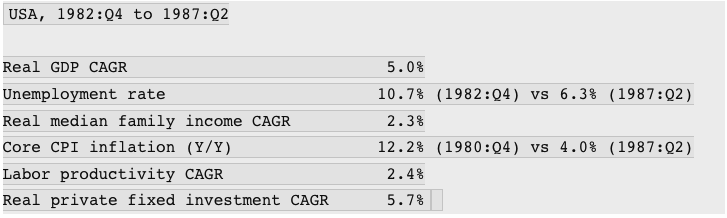
That is to say, at the end of his second term in June 1987, Tall Paul Volcker was still leaning into the residual inflation that had carried over from the printing press breakout of the 1970s. Accordingly, core CPI inflation was down from what had been the virulent 12.2% year-over-year (Y/Y) rate in Q4 1980 to 4.0% by Q2 1987 and was trending lower still.
Yet that adherence to monetary discipline was not proving to be any roadblock at all to solid real economic growth, plentiful jobs, rising productivity and expanding real family incomes.
In fact, over this 3-4-year period, real GDP rose at a +5.0% annualized rate; the unemployment rate had marched steadily downhill, from 10.7% to 6.3%; real family income was up at a solid 2.3% annual rate; labor productivity growth had posted at a strong 2.4% per annum; and real fixed investment in the domestic economy had been expanding at a robust 5.7% per year.
So what was not to like about the US macro-economy ? What possibly justified the Fed's lurch under Greenspan and his successors into nearly four decades of money-printing that was off the charts compared with prior history?
You surely can't find a reason in the data summary below.
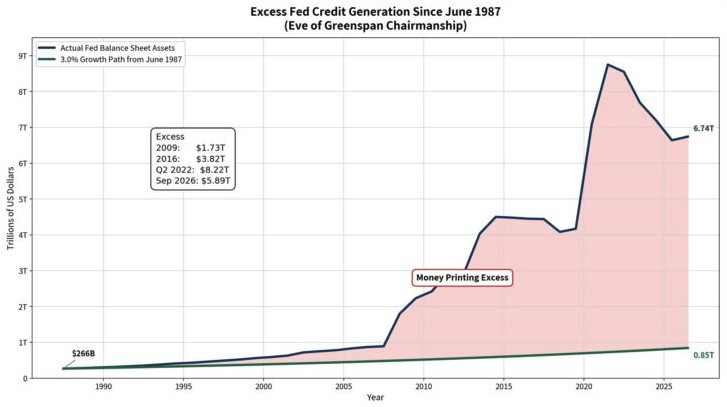
And, yes, we do mean that the Fed's printing presses went into hyper-drive under Greenspan et. al. Thus, its balance sheet had grown by just 2.3% per year in real terms during the Volcker era, but since Q2 1987 the Fed's real dollar balance sheet footings have accelerated to nearly triple that rate at 6% per annum.
In this context, we note that Milton Friedman was indeed right about one core matter-notwithstanding his pragmatism-based tolerance for fiat money in lieu of a proper gold standard. To wit, he held that a central bank should not run discretionary monetary policy of today's mongrelized Greenspanian/Keynesian mash, but instead adhere strictly to a fixed monetary growth rate that tracked the real output growth capacity of the aggregate economy.
In practical terms that meant Fed balance sheet growth of about 3% per year, assuming a constant money multiplier over time. In turn, that implied zero inflation on a trend basis, as well.
As it happened, of course, the Fed's footings growth entered a totally different zip code after Volcker's unfortunate departure from the Eccles Building. For the 35-year period through the peak in Q2 2022, the growth rate soared to10.7% per annum; and even after the modest QT shrinkage since then, the 39-year growth rate still clocks in at nearly9% per annum.
That's right. Alan Greenspan and his heirs have printed money for more than one-third of a century at a rate three times faster than even the pro-central bank monetarist from the University of Chicago had held to be prudent.
Needless to say, the adverse results with respect to the Main Street economy speak for themselves.
All of the Fed's fiddling with interest rates, open market buying and selling of government debt and other securities and various and sundry forms of "open mouth" policy guidance have simply generated unnatural and unnecessary financial and economic instability, rampant speculation in the financial markets and open-ended opportunities for unproductive arbitrage against the ever-changing views, clues and moods of the 12 wanna be monetary central planners who comprise the FOMC.
Reprinted with permission from David Stockman's Contra Corner