Lorenzo Maria Pacini
The American electorate has a short memory and an empty wallet - a combination that the peddlers of illusions know all too well.
Electoral financial mathematics, baby!
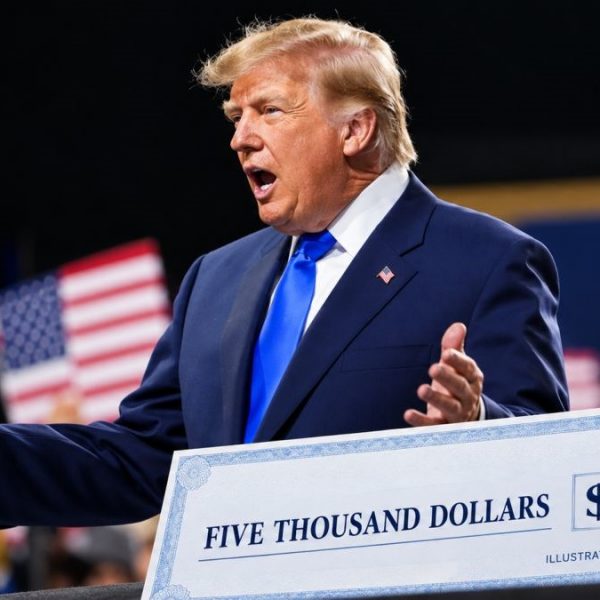
On September 9, on stage at the American Airlines Center in Dallas, Trump put forward a promise that not even a Democratic candidate would have dared to make. If Republicans retain control of the House and Senate in the November midterm elections, every adult U.S. citizen will receive a check for $5,000. He dubbed it the "Trump dividend" and, to illustrate the idea, compared it to the distribution of profits that a large corporation reserves for its shareholders.
A clarification is in order, because words matter. This is not $5,000 for every vote received, nor is it a bonus reserved for those who check the Republican box: the promise, as it was phrased, applies to all American adults. There is only one condition: the money must be spent at home. "We don't want you to go spend it in Canada, China, or Germany," the president explained, without clarifying what accounting feat would determine where a citizen spends their $5,000.
The detail that makes the scene memorable isn't the amount, but the signature. Proposing a direct cash transfer to voters - a measure the American imagination has always associated with the left - is a Republican president. And I'm not the one stretching the interpretation: Bob Good, a former Virginia congressman and a member of the party's right wing, called it "a socialist scheme to buy votes." When the most conservative wing of the Grand Old Party brings up the word "socialist" in reference to its own president's signature promise, the label ceases to be an insult and becomes a diagnosis. "If the Republicans win, you win too," Trump declared. The condition for the transfer is the election outcome. Is there a more straightforward definition of vote-buying?
Let's look at the numbers, which have the merit of not clapping. There are approximately 270 million adults in the United States. Two hundred seventy million times five thousand dollars equals 1,350 billion: 1.35 trillion. The most conservative estimates, based on a narrower pool of eligible voters - around 240 million - put the figure at just 1,200 billion. Either way, we're looking at around one and a half trillion dollars to be distributed all at once.
To understand what we're talking about, we need some points of comparison. 1.35 trillion is worth about 4.4 percent of the entire U.S. GDP for 2025, which stood at around 30,800 billion. That's more than Switzerland's entire annual gross domestic product. It is equivalent to about one and a half times the annual defense budget, set at 895 billion for 2025. And above all, it amounts to about three-quarters of the entire federal deficit for a single year, which reached 1,800 billion in fiscal year 2025 - nearly 6 percent of GDP.
There is one figure that sums up the situation better than any commentary. In August 2026, the U.S. public debt surpassed the $40,000 billion threshold and now stands at about one thousand billion short of the statutory debt ceiling of $41,100 billion set by the 2025 Reconciliation Act. Put simply, the proposal is this: to distribute, in a single transaction, a sum equal to an entire annual deficit, while the debt is already nearing its legal limit.
Where does this money come from?
Here, strangely enough, Trump has not presented a detailed financial plan. He must have forgotten, poor man. The only indication is that at least part of the dividend would come from tariff revenue. Too bad the numbers don't even come close to adding up. In fiscal year 2025, total tariff revenue amounted to about 195 billion, of which approximately 120 billion was attributable to the new tariffs.
And it gets worse. After the courts struck down the tariffs imposed under emergency powers, the administration has already had to refund businesses about 100 billion of the 166 owed, subsequently resorting to a different legal basis. Even if we assume that the entire net proceeds from the tariffs were diverted to the budget - without allocating a single cent to anything else - it would take well over a decade to cover 1.35 trillion. With one detail that cannot be overlooked: Trump had already promised those very same tariffs "to reduce the debt." The same dollar, committed twice over. It's a bit like announcing the purchase of a house in downtown Rome and financing it by selling cookies door-to-door on weekends. Ordinary cookies, at that.
I'll add the technical detail that campaign rallies don't like to mention. Tariff revenues end up in the general Treasury fund, along with income taxes: it's fungible money. There is no separate "dividend fund" to draw from. There is a single pot, and that pot is already well into the red.
And what about Congress?
There's also an obstacle that no amount of rhetoric can circumvent. The president cannot decide on his own to transfer 1.35 trillion to citizens. Barring future coronations, a distribution of this magnitude requires a law passed by Congress. Senator Bernie Moreno has already announced that he will introduce a bill "immediately after November 3." But resistance is coming from the Republican ranks themselves. Chip Roy has asked, figures in hand, how they intend to pay for "well over a trillion"; David Schweikert has promised to oppose it with all his might, because the measure would harm workers more than it helps them; Asa Hutchinson has called on the party to "be the adults in the room."
The real reason not to hold one's breath, however, is recent memory. In November 2025, Trump had already promised a tariff dividend "of at least $2,000 per person," later scheduled for mid-2026, with Treasury Secretary Bessent even clarifying that legislation would be required. That dividend never materialized. No plan was approved, no checks were mailed - just a White House that "was evaluating its options." Ten months later, it's still evaluating those options.
Viewed as a public finance measure, the proposal doesn't hold water for even a minute. Viewed as an electoral tool, however, it works perfectly. It's a conditional transfer that ties public funds to a partisan outcome, launched in the midst of a midterm campaign centered entirely on the cost of living, by a president with an approval rating below 50 percent, within a framework - the "midterm convention" - that simply didn't exist in recent history.
My assessment, with a high degree of confidence, is that the $5,000 dividend will not be paid as announced, and almost certainly not within the next twelve months. It would take only a few concrete signs to change my mind: a bill that has been approved and quantified, an operational mechanism from the Treasury, or a raising of the debt ceiling calibrated to accommodate the spending. Until these appear, we are dealing with an announcement, not a policy.
And here lies the paradox that gives these pages their title. The "American socialist dream" is not redistribution: it is a simulation of it. A fiscal state stuck at its debt ceiling that, no longer able to distribute, promises to distribute. Generosity reduced to a theatrical effect.
The American electorate has a short memory and an empty wallet - a combination that the peddlers of illusions know all too well.
Will we witness the greatest success of vacuum cleaner salesmen in history ? We'll find out in November.
In the meantime, the checks remain where they yield the most: in speeches.