Professor Michael Hudson interview with Lena Petrova (World Affairs in Context podcast)
Date: September 15, 2026
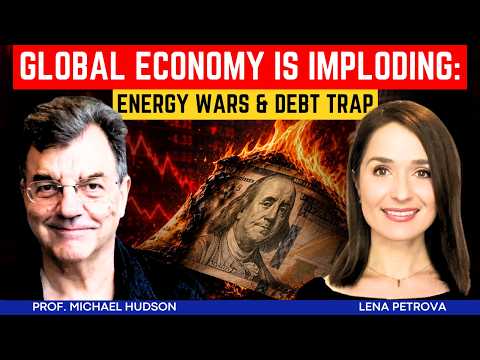
Michael Hudson (preview clip):
The United States is selling oil short, just as it has kept down the price of gold through financial manipulation, selling gold forward short for many years. China has taken the lead in creating a whole alternative to the SWIFT system.
The US economy is freezing up. And when it freezes up, that's the first stage toward a break in the chain of payments and defaults in major firms. And that's what the U.S. economy is faced with. And that's sort of the result of the crisis. An oil war that was started way before Trump. It was accelerated by Biden against Russia, and Trump extended it to a fatal degree against Iran.
Lena Petrova:
Welcome, everybody. Thank you so much for joining us today. I'm Lena Petrova with a new episode of World Affairs in Context. Today, I'm honored to welcome back a dear friend of our program, Professor Michael Hudson, a renowned economist and distinguished research professor of economics. Professor Hudson, welcome back. Thank you very much for taking the time.
Michael Hudson:
Well, thanks. It's a good day to be here.
Lena Petrova:
Absolutely. There's so much going on, and I'm thrilled to have an opportunity to dive into the specifics with you. Over the weekend, the BRICS summit in New Delhi took place on September 12th and 13th, and it was remarkable, with the backdrop of the US-Israel war against Iran, the proxy war against Russia via Ukraine, and, of course, President Trump's economic sanctions regime. And in my view, there were three major geopolitical shifts or geoeconomic shifts that I can point out, which are BRICS moving from a political forum toward practical economic coordination, the China-India thaw, and, of course, Russia's push for a more autonomous, multipolar economic system.
Michael, do you think that BRICS is finally evolving from a diplomatic grouping into a true alternative ? A true alternative economic architecture to the Western-led system.
Michael Hudson:
I think to put the BRICS meeting in perspective, you have to realize that it's the third meeting of something that's been going on for the last three weeks. And the core of BRICS is Russia, China, and Iran. They're the core for a number of reasons. First of all, you had the meeting in Kyrgyzstan of the Shanghai Cooperation Organization. That's where everything that happened over the last weekend was sort of basically ironed out between Russia and its fellow members, China, and their fellow members of the Shanghai Cooperation Organization, including Iran.
Then Putin and the Russians moved to the Pacific coast of Russia in Vladivostok for the Eastern Economic Meetings. And there they discussed primarily what the financial arrangements are going to be between the US and its allies in Europe, Japan, and Korea on the one hand, and the global majority and the global south on the other. And these meetings were actually the most important. I have my own speech at Vladivostok on my website, and it's very clear that they're talking about how to handle not only the monetary system and the financial system, but what to do as the world depression that's going to be created by the end of the year as a result of rising oil prices is going to lead to a political break of basically Asia and the global south away from the dollar standard.
Well, then all of that led to the BRICS meeting, and one of the advantages of the BRICS meeting is, all right, now Russia, China, and Iran can meet with the Asian countries, African countries, Global South countries, with which they do most of their dealings, and try to see how common a front we can create. What can we agree on ? And the one thing they can agree on so far is limited very largely to finance. And also, how is the world oil trade going to be evolving in the face of all of the US war against Iran?
Well, when we scheduled this meeting, Lana, as you know, I thought, well, on Monday, there's going to be the results of the meeting between Iran, Saudi Arabia, the Emirates, and their Persian Gulf allies as to what we are going to agree on for how much money and the terms on which Iran is going to permit. And Iran and Oman, they're both working together now. How are they going to design the flow of oil through the Strait of Hormuz ? What can they agree on ? What will the payments be ? What ships are going to be permitted through there ? What ships are going to be blocked?
Well, it turns out that the Emirates and Saudi Arabia are still sort of holding out, and they have historically joined the U.S. opposition to Iran, and they've been part of America's war in Iran, and are squeezed in the middle. I think we've discussed before: Saudi Arabia and Kuwait told the United States, " You cannot use our airfields way back in February, when the war against Iran began, you know, your bases are no longer protecting us. They're making us the objects of Iranian responses. And that's indeed what happened. When Iran, as we've all discussed, bombed the U.S. bases all around the Persian Gulf region and the U.S. investments in these regions, especially the Emirates, well, there's still a standoff there.
So, how did this all result in the last few days' meetings with the BRICS ? Well, there was a 45-page BRICS Announcement of the principles at the very beginning of the meeting. And that was very nice and strong in general terms. But the question is, how are they going to confront the most specific problem ? And that's basically what you and I have been discussing for the last few months. And there's going to be a world where not only will there be a depression, but oil prices are going to go up, which is going to squeeze many of the Global South countries. They can't afford both to pay the higher prices for their oil imports and their food imports as the food prices go up, and also afford to pay the foreign debts that they have to the bondholders; something has to give. And that's one of the things in which all of them are agreed upon.
And they're talking about, well, at some point, either they're going to have to sacrifice their domestic economy and say, I'm sorry, we're going to have to do to our economy what Germany did to its economy after it couldn't import Russian oil and gas anymore. Well, the German economy, basically the GDP, has been going down. All of Europe has sacrificed its economic growth, employment, and industry to remain dependent on the United States for oil, which has been the great beneficiary. Well, we're seeing that even more today. Oil prices are going up, especially diesel prices that are used for transportation by railroads and trucking.
And so the question is, how are they going to deal with this ? How do they avoid imposing austerity on their own countries ? Well, the only way they can do it is to get credit, either from countries that have the foreign exchange, like China, or from the oil-exporting countries, mainly Russia and Iran, that are currently blocked by the US sanctions.
So, if you say, you know, who's really in charge of planning OPEC ? Well, I'm sorry, who's in charge of planning the BRICS ? The whole BRICS strategy is designed and coordinated by one person, Donald Trump. He has isolated them. He has realized that the way to maximize America's gains from the oil war is to keep the Strait of Hormuz closed and prevent Saudi Arabia from exporting oil from its West Coast. Because of the AnsarAllah attacks from Yemen, the United States oil industry is thriving, and especially not only from the stoppage of crude oil, but from the diesel oil.
And Trump gave a speech over the weekend saying the whole key is diesel, refined diesel fuel. And the United States has guided Iranian missiles to focus on blowing up Russia's refineries that Russia refines its oil into diesel fuel. And it's been focusing also on Iran. So that's where, quite apart from the supply of oil and gas, which the United States is in a position to supply, but also the diesel fuels. So you have a wonderful speech by Trump saying, " We told Zelensky, don't bomb the Russian diesel fuels; that's going to push up the price. Shedding crocodile tears, he said, and America is going to be the great beneficiary. He didn't really say that, but that's it. And his statements that, " Oh, if only Zelensky wouldn't follow the American, and if you look at maps to know exactly just where to bomb which Russian oil refineries that are making diesel oil, this is like saying, gee, I told Israel and Netanyahu really to be gentle when it's bombing Gaza and the East Bank. Well, all of this is purely for show.
And it's obvious the United States has put such sanctions on the trade of the rest of the world with buying Iranian and Russian oil. That China has taken the lead in creating a whole alternative to the SWIFT system. Already under President Biden, the United States kept threatening to cut other countries off from the SWIFT system; it's a bank messaging system for how much money should be transferred from one bank to another. And the CHIPS system, where the money is actually transferred, is the Clearing House International Payments System. Well, China created its SIP system; it's a combination. The BRICS countries, at the very beginning, said, well, we've already moved 65% of our payments. We're shifting everything that we can over to the Chinese system. We're being driven out of using the dollar by Donald Trump and declaring war on us. I don't think the rest of the world, the other countries that we're talking about in the global majority, would have had this withdrawal by their own, certainly not so rapidly at this time, were it not for Trump's actions.
And so the only joint demand that you've had come out of the BRICS meeting is for very modest, well, we want to reform the IMF. But what does it really mean ? They just said, well, we want a larger voice. So as the IMF imposes austerity on our economies and sacrifices them, we can have a voice in establishing this austerity, wrecking our economies. And we'd also like more women appointed. This is obviously nonsense.
Nothing was really done officially, but all of these statements about the actual plans and the details- the nitty-gritty were all worked out. It's a Shanghai Cooperation Organization meeting and the Vladivostok meeting. And so this is being coordinated by the three leaders, China, Russia, and Iran, because they have the money, they have the oil, they have the only resources that other countries need in order to get through the coming months. Finally, you're having the United States, Europe, and other countries doing everything they can to keep market prices down for oil by emptying out the National Petroleum Reserves. And so, all right, we're not getting oil. From the Persian Gulf, we're going to just empty out the government reserves. That's keeping the oil price down.
And it's obvious that looking at the Wall Street Journal's daily reports of the oil prices, it's the United States. United States is selling oil short, just like it's kept down the price of gold by financial manipulation, selling gold forward short for many years, keeping the price down. It's keeping the price of oil down. And I think the Iranian leader stated over the weekend, well, when you look at the official Brent price, even though it's just gone a little over $100 Try to get that in the market. The market's paying a reported $160 a barrel or so and much, much higher for diesel oil. So the official market prices are for trading prices. They're not for actually trading physical oil. It's for almost, you could say, betting on the official market. The price of oil has very little relationship to the actual market price that buyers and users of oil have to pay to the suppliers of oil in practice.
Lena Petrova:
Michael, you mentioned that there are three pillars of the BRICS alliance, which are China, Russia, and Iran. And, of course, it makes sense because they're sort of- they've been- well, Western states try to isolate them financially, economically, politically. And it makes sense that those three actors are the main drivers of this push toward an alternative not only economic framework, but also political and social framework where the Global South, the global majority, has a voice in international affairs.
What I found interesting was what appears to be a thaw between China and India. What are your thoughts on Narendra Modi's policies, on his posture at this time, now that Washington has definitely Tried to manipulate his own policies as well. So Modi appears to be leaning toward China at the moment. But where do you think he truly stands ? What is India's position right now?
Michael Hudson:
Well, statements by politicians, and I think especially by Modi, are very largely always for political show, but here's the problem with Modi. When it comes to the resumption of oil trade, how are the oil suppliers going to be paid for the oil ? Now that China and its allies have created a means of payment beyond the ability of the United States to block by blocking payments in dollars, what are they going to pay in ? Well, Russia has accumulated a large quantity of Indian rupees for its oil. But it's promised not to spend these rupees except in India. Well, the rupee has been declining in value. So the question is, how is India going to get the resources to buy more oil ? Russia doesn't want any more rupees. China doesn't want rupees because the Indian economy is in a state of balance-of-payments plunge.
President Trump, as I said, he's trying to integrate India with China and the rest of the countries to make sure he wants to integrate the whole world against the United States to isolate it by sanctioning the entire rest of the world, leaving the United States by itself, along with Latin America or the Western Hemisphere from Greenland to Iceland, as he's expressed it. But the question is what's India going to do ? The United States has imposed strong tariffs. On India's trade with the United States, and yet India, the wealthy classes of India, have linked their financial fortunes with the United States and with trade with the United States market. So India, for the last few years, especially the last year, has been trying to get both sides at once, both with the United States, especially in Modi's trip to Israel, supporting it very strongly. And on the other hand, with Iran, Russia, and China.
Well, Modi knows that. I remember 50 years ago, there was a fight in the Himalayas between India and China. And China could have walked right through India at the time. I gave a speech at the United Nations on that. I remember there was general agreement that India realized that it could not fight against the Chinese army. And that's still the case now. Plus, you have India's problems with Pakistan. Well, on the other hand, Pakistan, along with Turkey, has reached an agreement with Saudi Arabia to defend it. But when Saudi Arabia, a week ago, said, well, aren't you going to help us fight the Houthis and bomb Yemen ? You know, we're under attack. Pakistan said, well, we promised that if you come under a new attack in a new war, we will, of course, protect you, meaning from the United States. But this is an old war, and we never said we would be a part of the old war that you've been fighting for decades against the Yemeni and the Ansar Allah. That's an old war, and that's so prior to the agreement. So Saudi Arabia has been left on its own. The Emirates have been left on their own. And that's the context in which the weak position in terms they're trying to hold out to say, well, please, please, Iran, let us export our oil without paying you anything for the Persian Gulf.
Well, now back to your question about India. Trump has been saying for many years, for over a decade, and he's been repeating it. He said, any country that agrees to price it to transact its import or export of oil To pay for oil in non-US dollars, we're going to impose 100% tariffs on. He's taken a very anti-Indian stance here, and, of course, as you know, there's a huge Indian immigration of skilled labor, especially for the IT industry, but professional. Professional Indians in the United States. If you look at it by ethnicity, what's the highest family income by ethnicity in the United States ? It's the Indians because the whole family is working, sometimes at more than one job. This is really the center, and there's an enormous amount of money sent by Indian immigrants back to India. So, India has one foot in the US economy. On the other hand, it needs oil and not only oil for its refineries, mainly from Iran, but also from Russia- diesel oil, refined oil, and others. Needs food right now.
And you've had the food trade interrupted by Trump's direction to Ukraine. Make sure that you don't let any Russian food exports be exported. Here's the largest agricultural food exporter in the world, Russia. Don't let anything through the Black Sea. Russia retaliated by bombing the port of Odesa, saying, all right, as long as Ukraine is trying to blow up our transport ships for food. We're going to close down the Black Sea transport. And so this has created a food crisis over and above. This is part of the whole tension that is breaking the world into a split right now.
How is India going to maneuver this ? Well, it realizes that: What's the United States going to do ? It's not going to treat the Indians like Trump has been treating the Hispanics in the United States. They're not going to be ICE agents going to the leading Indian doctors and IT professionals and export them because that would hurt American industry. So he's going to leave the Indians in America making He's not going to help the Indian economy itself for Indians who live in India. That's where Modi realizes he has to turn to China, Russia, and Iran together for the oil, for the money, and for the stabilization. Well, how can India stop the decline of its rupee ? Because there's a general agreement that is what is going to replace the dollar. It's going to be a combination of gold and domestic currencies. What do we do about a currency that is steadily depreciating and a country that's in a chronic balance of payments deficit position vis-à-vis payment-surplus countries, which are going to be China, Russia, and Iran?
Well, this is exactly the same problem that John Maynard Keynes discussed for the British Treasury in 1944. And this is what I focused on in Vladivostok. Britain said, well, how is the post-1945 order going to be designed ? Well, the United States wants a pro-creditor order of free trade that it's going to dominate because it's the leading industrial supplier and also the leading supplier. We in Britain have had to agree to dismantle our imperial preference currency area, where India and other countries had to give up the imperial preference requirement that India and other countries keep their international savings in Stirling in London and by Exports from Britain and its sterling area members, that had to give it all up and let free trade, free capital movements, and they said Britain's going to fall into a deficit country.
So Keynes's position: he proposed an international relationship that I think is going to be the only way in which the BRICS countries are going to come out with a workable relationship. And that is, if there is an international agreement made, and there's just a new currency area, we realize that some countries are going to be creditors, and other countries are still going to be debtors for a while. But we're not going to do what the United States has done. We're not going to have a pro-creditor relationship that is going to let, say, China use its creditor position against other countries like India, to exploit it and to demand compliance and to demand political control of its tax system and impose austerity. We have to preserve the sovereignty of every country in putting its own economic growth first. Over and above its foreign creditors, Keynes' design for his international bank was that when a country at that time, like the United States, accumulates a very large monetary gold or IOUs surplus of claims on other countries and against the most indebted countries like Britain, We're going to have to wipe out these claims.
Well, the United States had obviously rejected everything that Keynes proposed and imposed the creditor relationships that have governed the world until today, forcing better countries to impose austerity on their own economies. That's what India wants to avoid, and it's what the global south countries want to avoid. And why would China be willing to agree to such an arrangement, given the fact that it's emerging as the major creditor of all of these countries in its currency area?
Well, the answer is, as President Xi has expressed, including at the BRICS conference, well, we're willing to give up. The accumulation of financial claims on better countries, because what we're getting in exchange for doing that is the creation of a win-win trade relationship. Our Belt and Road Initiative and our other investment in foreign port development and foreign economies are going to help the economies grow. They're not investments that are extractive investments like We want you to pay your debts by selling off your natural resources, selling off your public utilities to foreign investors. We're not going to do that. We're going to help governments take the lead in creating the infrastructure and the development and the loans that we make. The credit that we're extending to other BRICS members is going to be to help them earn productive credit that will help them earn the money to make the exports and the domestic production to create economic growth that will enable them To pay the debts with the interest so that if we follow a productive credit system instead of a predatory rent-seeking, rent-extracting system like the United States and the West has done against the global South ever since the 19th century and the whole colonial epoch, then the returns to Chinese industry and development and investors is going to be worth the fact that, well, some countries are going to take longer to stabilize than others and we're not going to impose austerity on them because it's worth paying that price to create an alternative world system that President Trump has helped isolate us and protect us from the dollar From U.S. political interference so that we can create a system in which we, along with Russia and Iran, will emerge as the major geopolitical world powers.
Lena Petrova:
You mentioned that the global majority nations cannot afford to pay both the higher oil prices and food import prices on top of making payments for their dollarized debts. And as a response to this challenge, the only way to avoid chronic austerity and economic depression would be to suspend payments. And I would be curious to see your perspective on whether the suspension of payments would have any meaningful or significant impact on the economies of the creditors.
Michael Hudson:
Well, as the prices of oil and food go up, there are going to be a lot of Companies and industries that can't make a profit in remaining in business. Germany is the model here. The German glassblowing industry was dependent on Russia's natural gas to heat the ovens that melted the glass to make German glass products; they had to close down. German industries have been dismantling it, trying to move out to other countries, including China. Many of these industries can't afford to pay their debts, especially in the United States.
Remember, after World War I, when there was the whole series of bankruptcies and the financial collapse, the United States was the most deeply affected country of all in 1929. And that's because it was the most highly debt-leveraged economy. Well, it's even more debt-leveraged today. America is still the most highly debt-leveraged economy, especially in the private capital sector. And that's what all of the U.S., the Wall Street Journal, the Financial Times, and the media are talking about. Leading banks have lent enormous sums of money to Blackstone and all sorts of industries to essentially buy them very deeply on credit with very little equity, all financed by debt.
Well, as their profits, the profits, the oil crisis is going to shrink the market because Americans probably late by, let's say, November, by December, when they're having to pay much more money for their gas, their oil, their electricity, their food, as their prices go up for these, they're going to have less money to buy the products of American industry. So you're going to have America's industrial production. The companies that have been bought out by private capital, they're going to shrink, and they're not going to make the profits and the cash flow that's going to enable them to pay the debts. So there are going to be many defaults, not only by the companies that are bought out, because that's the strategy. The strategy of making a fortune in today's world is you buy a company, you loot it, you sell its real estate into a separate company that you have, you essentially drive it into debt to repay you for the investment that you've made in these countries to pay the bankers that have lent you the money to buy them and to post-industrialize these companies.
Well, all of this is just so tightly balanced now that just a little bit of a downturn is going to bring the whole system down in a domino effect. That's what it looks like is going to happen. And there is no way of knowing in advance exactly where the break in the chain of payments is going to begin, but it's obvious that you're having default rates for every kind of debt rising throughout the economy. The interest rates are going up now; I think today they finally hit 5%. For the 10-year Treasury bonds. Well, this means that it's even higher; it's about 5.6% for the 30-year bonds. Well, this is the standard that banks look at when they're making mortgages, the traditional 30-year mortgage. Well, right now, if you have to pay 7% for A new home mortgage, number one, you can't find buyers who can afford the debt service to buy your house on credit. And so that means that existing homeowners are locked into their houses. They can't sell it. But also, investors like Blackstone in real estate cannot sell off the real estate to meet withdrawal demands for investment. So there's a freeze of payments to investors that want to. The U.S. economy is freezing up. And as it freezes up, that's the first stage towards a break in the chain of payments: defaults in major firms. And that's what the U.S. economy is faced with. And that's sort of the result of the crisis. An oil war that was started way before Trump. It was accelerated by Biden against Russia, and Trump extended it to a fatal degree against Iran. Bringing down the whole OPEC Middle Eastern countries.
The war economy has been blocking it all, and you're already seeing the fight in the United States. How is the federal budget going to respond to all of these needs ? Is the United States going to, what Britain and Germany have had to do, somehow subsidize homeowners and renters who can't afford the electricity to heat and light their homes ? Well, Trump says no; he's not going to do that. He's not going to give any kind of subsidy to the public except for his $5,000 for every American if the Republicans somehow win the November elections. This is going to be a textbook example of an economic collapse for the ages.
Lena Petrova:
It's absolutely fascinating. He promised $5,000 effectively for a vote. And that's, of course, after he sends out the tariff checks and other things that he had already promised. So it is quite fascinating and just so, so surprising just to see that being a normal sort of decision. Rhetoric in US politics today.
But you mentioned that the BRICS Alliance is not just an organization, not just a multilateral entity, but what it represents is an existential civilizational fight, effectively, if you will, against US-centered financial colonialism. Would you mind expanding on this argument and helping us understand sort of the broader geopolitical backdrop against which the summit took place and against which the events that you just described are unfolding?
Michael Hudson:
Well, you're referring to the BRICS, right?
Lena Petrova:
Yes.
Michael Hudson:
Well, the BRICS are really an amorphous group because the BRICS include- it's a whole bell-shaped curve. From genuinely poor countries to client oligarchies and military dictatorships. They're all over the place. And the foreign debt of many BRICS countries- the dollarized debt- who owns their foreign debt ? Well, I found out long ago when I managed the first third world bond fund in 1990 for Scudder Stevens, most Argentinian and Brazilian dollar debt was owned by Brazilians and Argentinians. The president's family, the family of the central bankers, the wealthy oligarchy. Americans wouldn't buy Brazilian and Argentinian debt. Europeans wouldn't. Scudder tried to sell, you know, when we organized the fund, and this is when dollar debts were paying 45% interest per year, both from Brazil and Argentina, more than doubling every two years. So it was obviously unstable, and the fund was an offshore fund in the Dutch West Indies, and the main buyers were Brazilians and Argentinians using it to launder money and move it offshore. The IMF was very helpful in lending an enormous amount to Argentina. So that they could support the Argentine peso at a rate that enabled the oligarchy to buy as many dollars as possible to buy the dollarized debt. I mean, it was a total IMF oligarchic ripoff of their societies.
So these are still BRICS. BRICS members, and that sort of tied the hands of the Brazilian president Lula. Obviously, you have a crazy right-wing neoliberal running Argentina. BRICS doesn't have any agency by itself. The core system is the payment system that China has developed, and Russia has a similar system to make payments that is immune to China. The U.S. oversight and Iran are linking themselves to the Chinese and Russian system to provide the core of the financial relationships of the BRICS. And for the time being, the only political and legal moves that can be made by BRICS are by this triad. That's really the core of everything that's been discussed at the meeting.
There's not really a plan to create an alternative to the IMF, an alternative to the World Bank. And while they've criticized the United Nations, there's no plan to say, look, either we expel the United States and its satellites from the United Nations so they cannot veto any attempt to actually implement the United Nations Charter, which says that every country should have its own sovereignty. Either we stop the Western territorial control of the United Nations and weaponize the United Nations administration by creating a new United Nations, withdrawing from the old, moving the center out of New York to somewhere else. Or there's nothing that can be done internationally except through our own triad-centered group. So there's not really a plan for an alternative dollar system except for the monetary means of payment, and there's still going to be the discussion over the cane. Points like the International Bank: how are the oil exporters in China going to denominate their financial claims on other countries ? Gold is obviously going to have a role again, but it's not going to be, as it was after World War I and World War II, it's not going to be a proxy for the US dollar this time, and it's not going to be part of a pro-creditor system. As it was under the dollar convertibility into gold. It's now going to be part of a broader package of currencies and an artificial currency, such as Keynes' support provided for the bank orgs. And that means there's not going to be a new BRICS currency. That is impossible in principle. You cannot have a single currency issued without a political unity over who's going to be able to issue the currency. And when you issue the currency, which is debt or else just fiat, Equity capital, who's going to be the beneficiary ? You're going to have to have a whole world government to do that. And the BRICS are too wide a bill-shaped curve between client dictatorships, military dictatorships, Africa, South America, global South countries, and Asia to be able to afford this right now. So it can only be done On members of this International Payments Union, which Donald Trump will help consolidate by immediately isolating it from U.S. interference, very helpfully.
Lena Petrova:
This is so fascinating. And, of course, you pointed out that the BRICS alliance is composed of a very diverse group of states that are very politically different, economically different, socially different. And it would probably be quite naive to think that those differences could be somehow aligned. In a way that would form a cohesive policy toward, for example, issuing a currency, a single currency. So they will have to have a platform for indirect investments, for trade settlements, and for a variety of transactions that would address their very unique needs and unique political systems and regulatory frameworks. What do you see as the biggest challenge before you go on?
Michael Hudson:
There won't be a single currency. As I said, that's impossible. What there will be is a bookkeeping arrangement, a balance sheet arrangement of credits and debts. And this bookkeeping arrangement is only going to be among governments at the level of government treasuries and central banks. It will not be a currency that you and I can buy or that speculators can buy or that banks or anyone else can buy. It will only be a bookkeeping accounting system to denominate debts and credits among different countries. No currency. There's not going to be the unit that people were talking about at all because that's like Bitcoin. Anybody can be it. It's not going to be anything like a brick Bitcoin type arrangement.
Lena Petrova:
Sure. Thank you for clarifying that. Absolutely. And so once that unit emerges, what happens to the economic power of the US dollar ? Do you see that, you know, do you see the US dollar still retaining its Position as one of the main currencies of the world ? Will its role diminish ? Will it remain the same ? What are your views on the US dollar and its role as a global reserve currency, let's say in the next five years or 10 years?
Michael Hudson:
Well, Trump has driven other countries away from the U.S. currency. Look at what happened a few weeks ago when Holland said, " We want to move all of the gold reserves that we and other European countries have to the United States. In the early 1930s, it was obvious that World War II was looming, and there was capital flight to the United States. And then after World War II, when the United States dollar was as good as gold, and this was basically where you wanted to keep your gold for safekeeping, and still a time of turmoil. Well, now, Holland said explicitly, there's so much political instability, meaning Trump has gone crazy. He's a gangster. We don't want to leave our money in a United States Federal Reserve or Treasury that is a world gangster. We've seen what America and Europe did in confiscation. We've seen America tell the Bank of England to confiscate Venezuela's gold supply and assign it to our person whom we've designated. The Democratic leader. And Trump said, I guess at the time, even if Trump wasn't in office, he said, well, we're the democracy, and we appoint the leader of Venezuela. That's what a Democratic leader of a Global South country is. So, Colin said, you know, we see the game is up.
Well, Germany, for the last five years, has been asking for its gold. It accumulated it along with General De Gaulle during the 1970s, the 60s during the Vietnam War. It accumulated huge amounts of gold because of its trade surplus, and it asked for it back. And America said, " Look, Germany, we defeated you. We appointed your leaders. We've protected them and supported them through our NGOs for the last few decades. They're going to do what we tell them to. You're not going to get your gold. Don't try to be uppity again. And so Germany, oh, I'm sorry, we didn't mean to offend you by asking for our gold back. Yes, of course, we'll keep it in New York.
Well, other countries are not as supine, and no one else is going to act like Germany and say, yes, you want us to sacrifice our economy by shifting to your gas and paying four times as much, and sacrificing our industry for you ? Okay, that's what we owe NATO. Germany is just a model for what other countries want to avoid and what would happen to them, what American demands would be made on them if they ever had as pro-American a government as Germany did. Germany is now looked at as poison to them by its own electorate, as you've seen in the recent elections. So the question is, how long can the German government act as proxies for the Trump administration or whoever the administration of the United States is instead of their own people ? Well, that's the same choice that every global majority, every southern hemisphere country is going to have to be deciding for itself.
Lena Petrova:
Now that China is taking over the chairmanship for the following year of the BRICS bloc, and there are so many competing interests, so many conflicts, so much volatility in the global markets, what do you expect to be the main challenges from a political perspective, from the economic perspective, financial perspective for the global majority ? And where do you see the biggest opportunity?
Michael Hudson:
President Xi is coming to New York next week to address the General Assembly. It will be very interesting to see whether he even meets with Trump. He's already told Trump, I'm not going to go to Washington if you're going to continue to sell arms to Taiwan. You know, you're trying to create what we view as a civil war in China. You know, and if we break with you, then get your damn Navy out of our waters. We're not going to let you near our waters any more than Iran is going to let you near the West Asian Persian Gulf area. So I can answer your question much more in another after the next few weeks, and now we see what happens then.
But obviously the United States wants to say, you know, Trump's policy is: How can we make China the world center and drive the United States broke as quickly as possible ? I've got to isolate China. I've got to convince China that you have to stop supporting and providing critical minerals for us, not only rare earths, but gallium, tungsten, and other things. You've got to actually bankrupt us in order for me to go down in history as the famous president who's destroyed American world power and ushered in the new century. That seems to be his dream.
Lena Petrova:
Professor Michael Hudson, thank you so much for such an incredible conversation, for the insights that you shared. I always enjoy these interviews with you because you bring up so many different aspects and so many different pieces to the puzzle that help us understand what's going on right now and the broader geopolitical and geoeconomic landscape. Thank you very much for being so generous with your time and I look forward to the new episode.
Michael Hudson:
Well, thanks for having me on this wonderful day right after all the important meetings ended. Thank you.