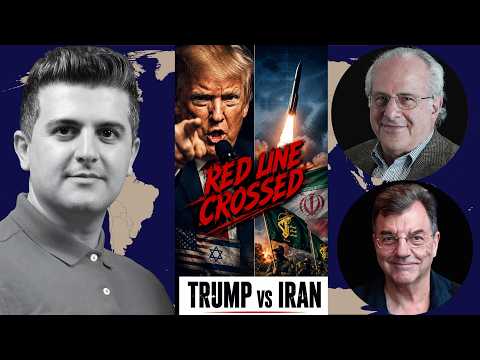
Nima Alkhorshid: Hi, everybody. Today is Thursday, August 13, 2026, and our dear friends, Richard Wolf and Michael Hudson, are here with us. Welcome back.
Let me start with just briefing what's going on between Iran and the United States. At this particular moment, what we've learned from the Trump administration, it seems that they're somehow planning to bankrupt Iran.
And that's why one of the main reasons is, with this blockade putting a lot of pressure on the Iranian economy. That's the main objective, which was mentioned by Mike Huckabee, the American ambassador to Israel. He said that Donald Trump is somehow shifting from the military, sort of used to the use of the economy or putting pressure economically on Iran. This is one part.
The other point is it seems that, while we have this sort of understanding, they're thinking of having some sort of invasion in the southern part of Iran as well, in the Kharg Ireland, which they say this is the heart of the Iranian economy because the whole export of oil, you know, Iranian export of oil comes from that island. This is one part.
The other part would be if the United States decides to continue the war, they need to replace all those interceptors and missiles. I don't know if you saw the talk I had with Professor Ted Postol. He mentioned that the Patriot system so far has proven something like 2 to 5% efficiency or capability to intercept missiles from Iran. And this is one part.
The other guest on this podcast, Andrei Martyanov, our friend of this podcast, he mentioned it's going to be something like 20%, 30%, which is not significant. This is the Patriot system.
The offensive part, we had two reports: one on Reuters. I'm talking about Reuters and Wall Street Journal all together. They're mentioning the offensive missiles are low. The stockpile is suffering from the shortages.
And the other point is: if the United States decides to replace those missiles, they have to improve the relationship between the United States and China. It means that they need these rare earth minerals or magnets from China to produce those weapons, which is not the case as we talk. We don't know what will happen in September because Xi Jinping is going to be in the United States talking with Donald Trump. If they reach some sort of, you know, if they reach the same conclusion they had before during Trump's visit to China, it means that they're not going to achieve that much.
And the other point is the way, the case of the Strait of Hormuz. The Strait of Hormuz is the biggest problem as we talk. And we had Scott Bessent talking about it in the next two years. They're going to resolve that issue, which is what Scott Bessent said.
[clip start]
Reporter (clip): The strait will never go back to being the way it was before. What would you say?
Scott Bessent (clip): I would say I would take, I think they're saying that in a doomsday, sort of way. I would say it in another way. The strait is never going back to the way it was because the Iranians have used or tried to use it as a choke point. What we are going to see over the next two years, the strait's going to become irrelevant. It is going to become just another body of water. And I would say that more than 50 or 70 percent of the energy that moves through the strait now is going to go through underground pipelines.
[clip end]
Nima Alkhorshid: Yeah, you've heard, Richard, one strategy is going to be, you know, shifting all these exports using the pipelines because they want to make the Strait of Hormuz irrelevant. And the other point is to put into bankruptcy Iranian economy. Go ahead and [provide] your take on what's going on.
Richard Wolff: Okay. Well, the first thing that strikes me about all of this is this remarkable moment in which all the bluster and all the military activity have come largely to a halt. That's because Israel and the United States have stopped the onslaught that they did.
And it's an onslaught of three parts. One part was, in June of last year, the so-called 12-day war. The second part was the opening again of the war on the 28th of February of this year. And then, after a ceasefire, sort of, a resumption. So we've had three periods lasting from days to weeks to months of bombardment by the United States, using its Navy, using its air power.
And that effort, that military effort, has been, and I think this is extremely important, a big fat failure. It didn't achieve regime change; it didn't have any impact that we can ascertain on nuclear refining of uranium. It closed the Strait of Hormuz and was unable to reopen it. A total, I mean, worse than a failure.
You are in worse shape now than when you were to begin this. Israel has been badly damaged by a wave of missiles. The American military bases in that part of the world have been badly damaged, or in some cases, apparently destroyed beyond repair. So, by all reasonable calculations of gains and losses, this is a loss. It's a defeat. And so, I interpret what we're doing now as the recognition, painful for the President of the United States, painful for the Secretary of War, Mr. Hegseth, that they lost all of that.
But of course, America being a land of advertising, you never, ever miss an opportunity to spin whatever is happening to your advantage. That's simply something you do. There is no loyalty to anything remotely like an idea of the truth. That would be stupid. What you do is you spin it.
So, we have Mr. Bessent, who has become a painfully silly sort of mouthpiece for the president. He had some respect in Wall Street, Mr. Bessent. He did. That's why he was picked. But he's blown it all away by talking the way he does. So he gives the BS: We have shifted from a strategy of military to as if we're in charge, as if this wasn't a loss, this was a strategic shift that the President undertook in his great wisdom.
Nonsense. It's the best lame coverage for a loss. All right. Now, let's say, what does that leave us with ? Where does that point ? Well, there is some truth to what Mr. Bessent says. The longer the Strait of Hormuz is closed, the greater the incentive, other things equal, to find ways around it, whether that be rerouting the ships or shifting to pipelines.
But I want people to understand that all of those have problems and all of those have risks. You put something in a pipeline, you can bomb the pipeline. If you're going to put it so far below the surface that the bombs can't get there, you're talking about an immensely larger project than most people want to spend the money on or could justify given all the risks.
And sabotage of a pipeline is not that difficult. I want to remind people how much our history was changed by what was done to the Nord Stream pipeline a few years ago, which changed the whole dynamic of the Russian, European, and Ukrainian struggles and is still having those effects.
You can do terrible damage to pipelines. And if you have a war and if you have missiles, and if they're powerful and they are apparently becoming more powerful literally week by week in half a dozen countries, Western Europe, Russia for sure, China for sure, the United States for sure, and my guess is Iran as well developing its skills in that area.
So then we're left with the impact on the global oil and fertilizer businesses. Those are long-term effects. In other words, they're very uneven. These effects happen soon in some places. I'm going to get to that in a minute, but they take much longer. For example, inflation here in the United States, excuse me, assuming that the government numbers are not fudged, and that's an assumption I'm not so sure is true, but assume it for the moment.
It's not going as fast as it otherwise was feared it might. So that relieves a bit of the pressure on the president, who's worried about gas prices and all of that. It's stretched out, but it isn't stretched out in Asia. So, for example, we had these remarkable actions by Mr. Bessent again, bailing out countries in the Gulf and bailing out the Japanese. Japan is the third-largest economy in the world. The Japanese yen, the relative value of that in relation to other currencies, is very important, including to the American economy, which competes with Japan.
And we would see dangerous results if the yen kept dropping, as it has for quite a while now, and reaching new lows in recent weeks and months. So the president of the United States had to bail out that process, slow the decline of the yen, and tried to do it with a big chunk, I think 20 or something billion dollars. I don't remember the amount, but roughly that. And that didn't work very well for very long. Within a few days, the gain from this maneuver was mostly gone.
[We have] noticed that the impact of high oil prices on a place like Japan or South Korea, which depend on imported energy, has been very severe. And that's going to play itself out in ways we can't control or can't even know in advance. What are all the adjustments that the Koreans and the Japanese and the Philippines and the others in that part of the world are going to have to make ? How are they going to handle that situation?
What is going to happen to the play between electric automobiles and gas-guzzling automobiles, as these industries react to the higher price of oil when there was already the other pollution and other reasons to make this shift ? China is absolutely dominant in the electric vehicle business. And therefore, many of these shifts are also affecting the competition between the United States and China for dominance in the world.
In other words, it's hurting the United States. It gives opportunities to the Chinese. They proved their capacity to basically ride across the crisis of oil because they had stored enough oil, they didn't need it, and they had developed enough non-oil energy sources. I mean, the presence of the Chinese, they're not only growing faster than the United States, but they're managing the green quality of their growth, et cetera, way ahead of what the United States and the rest of the world are capable of doing.
So, here's my point: it's almost valid to say that this moment in which the United States and Iran no longer shoot missiles at each other, at least in the main, this moment when there's a kind of stasis, I'm sure it won't last very long, but it is almost as destabilizing to the world in its non-activity as it was before when the rockets were flying.
Michael Hudson: I think that's exactly the right way to frame today's discussion. The news is that there's no news really from the West. There's no disruption. The stock market has hardly moved. The bond market has hardly moved. And there's no forecast of the disruption that has to begin occurring this autumn, certainly by October and November, if not by September, when the Strategic National Reserve runs out and oil prices are going to begin to soar, causing the kinds of closedowns and unemployment that we've talked about.
Everything is quiet, and it's as if the Western countries are standing by waiting for, as Mr. Bessent said, things to get back to normal and, at least, there's not going to be a big disruption. And the West can wait out Iran. And that's what you were saying at the beginning, Nima. Can the West really wait out Iran?
Well, the countries by the West, that really means the United States, which is making the decision about what to do. And other countries are not taking a proactive role in this. Asian countries, even European countries, seem not to be preparing for the crisis that's going to come.
So, what we should be seeing is a discussion of what kind of system, what kind of world trade and financial payments arrangement is going to replace the current U.S. policy of creating chaos and choke points and just going to war with countries who do not follow American foreign policy but go their own way by exerting their own solvency.
So, I think the West is going to face a much greater squeeze than Iran because Iran's been feeling this squeeze since 1979. The sanctions have already been on it for 45 years or so. So, there's no reason to believe that all of a sudden things are going to get in a financial crisis because there haven't been many loans to Iranian businesses or families because the economy's been dealing with a minimum of credit, certainly a minimum of foreign debt, because no one's been lending to it, and no one really can afford to borrow without having the markets.
The only financial change that we've seen was after the Memorandum of Understanding, Iran was able to start exporting its oil again. And it made it an enormous amount of money, able to replenish its reserves to stabilize the exchange rate of its currency, the rial, so that it didn't collapse.
Well, the pressure is all on the exchange rate of the West. And as Richard points out, not only has Japan's exchange rate fallen to the lowest level in 40 years, but the prime minister Takaichi has refused to raise interest rates to prevent the currency from falling further. So, what's happening?
Bessent said, "Well, don't sell your Treasury bond holdings, your $1.2 trillion worth of Treasury bonds and other securities, because that would push up our interest rate. So, instead of selling these bonds to push up our interest rates, why don't you just borrow the money from us ? You can, we'll make a swap." And it's the same kind of swap he made with the Emirates a month or so ago.
The United States will say, "Well, you know, do what American banks do: transfer your Treasury bonds into a deposit in the Federal Reserve account. We'll hold them for you, and we'll make a swap of an equal number of dollars. And you can dissipate these dollars by spending them under the foreign exchange markets and pushing it into supporting the currency."
So, Japan's currency did go up in the last few days of July from about 165 yen per dollar to 155 yen per dollar. Well, now that's all been dissipated. You spend the money to support it, and now it's been falling back down to about 160. It's all gone. But the Treasury still holds these yen on Japan, and it seems pretty obvious that as oil prices rise, Japan and other countries of the world, from Asia to the global south, are going to run a big balance of payments deficit, just like Japan has run.
But what are they going to do about it ? They're going to have to raise their interest rates or have their currency decline. And if their currency declines, that means that since world trade in manufactures, food, copper, everything, fertilizer, all set in dollars, they're going to have to pay much higher domestic prices. So there's going to be an overall price inflation as a result of the oil prices going up, not because of the economy overheating. And that's going to put a squeeze on them.
So who's really going to be squeezed from all this ? And how are they going to cope if they make swaps with the United States ? That gives the United States the same chokehold control over them, saying, "Well, we're going to make a swap of dollars for the currencies of our allied countries. But, you know, if African countries or Asian countries want to borrow, they're going to have to do what President Trump always asked for. What givebacks are you going to give us ? What are you going to pay us?" And all of this is making the U.S. market less and less desirable for other countries.
They may say, "Well, now that Trump has raised its tariffs on us and that we have to pay for access to the U.S. market, the fact is that the U.S. market's growing much more slowly than the Asian markets, and there's not that much benefit. And if we have to promise to shift investment to the United States, like Japan has promised $650 billion of investment in the United States, it's given back for America, not strangling it with new tariffs, like it strangled it before World War II by cutting off oil."
All of this leverage is at play. So for the rest of the world, it's as if the United States has become their adversary much more than Iran, and yet they're sitting by just somehow waiting for somebody to give up. And that somebody looks at a point like the United States, because when prices go up here, it's the United States that's the most heavily debt-leveraged economy in the world.
And so when Bessent talks about, "Well, Iran's going to go broke. It can't wait a long time without getting money." That's called projection. If Iran were the United States, it would go broke. But it's not the United States. And it can last along and get by longer than the United States can. And other countries are collateral damage in all of this.
And regarding the pipelines that Bessent talks about, you can send oil through pipelines. You can't send liquefied natural gas through pipelines. And the Persian Gulf supplies about one third of the world's liquefied natural gas. Pipelines won't solve that. You can't send helium through pipelines. You can't send all sorts of other things out through pipelines.
And the pipelines would probably have to be built above ground given the desert sands movement. It is just not realistic that there is a simple pipeline solution and nobody's going to need sea trade anymore.
The whole idea is a fantasy, and engineers have pointed this out. And there seems to be just no reaction because, confronting the fact that there isn't a solution to this except for the United States to go away and let Iran get what it's wanted all along, the conditions of the Memorandum of Understanding, until the U.S. goes away and stops interfering, we're on track for depression and financial collapse in the West.
And that I can't believe that this isn't going to lead other countries to say, "We've got to create a new system of international trade and investment and payments to handle the fact that some governments are running balance of payment surpluses, others are deficits."
We're way back in the discussion that occurred in 1944 between Keynes arguing for Britain, saying Britain's going to be an indebted country and running a deficit. America is going to be a payment surplus country because America has more than half of the world's GDP and it has three quarters of the world's monetary gold. We can't just let the economy polarize. Well, he developed a kind of an international bank that would just handle credits and debtors and debts among governments.
Well, I think you had mentioned, I think before we begin, Nima, can there be a BRICS bank ? Well, nobody's really discussed what a BRICS bank would be, but I don't think anyone's discussing it in the issues that Keynes was raising, the really important issues way back in 1944 and 1945. So the world's not prepared. We're in a move that I see just into anarchy. And people are not even thinking about it because it seems unthinkable given the limited tools that they have to treat as variables.
Richard Wolff: Yeah, if I could add, Nima, I think that Michael is more right even than he says. I think that there's not just a hiatus in the military clashes that we've been talking about, but there really is a hiatus in thinking at all about how this. There have been some statements, for example, from Iranian leaders that they now see this dead period as lasting until 2028, until Mr. Trump is out of office or completed his term. That's already amazing. That's a two, three year out notion that this stasis is going to be our condition, in their view.
And if that reflects their thinking—and no one objects by saying, "No, that's not how we see it"—then they must be making long-term plans again. As Michael pointed out, they've been doing so for years. What might those plans involve?
Well, just to give you an idea of how empty Mr. Bessent's brain seems to be these days, they're not the only one; the West is not the only one thinking of pipelines. Iran is a source of oil. If it can't get it out in boats, it can get it out in pipelines. Where would the pipelines go?
Well, they could go to various ports along the Caspian Sea and then be conveyed by ship to Russia, or the pipelines could go to Russia. We could have a whole new system in which Russia takes the oil that's in the East and sells it to Asia, which needs it, and takes care of its needs in the West by bringing in Iranian oil, and thereby all the payments get [figured out]. Those kinds of rearrangements are also possible. They will also change all of these equations.
But shutting down the Strait of Hormuz for a long time sets in motion adjustments all over the place. And Mr. Bessent's effort to say, "Well, that we win" in that situation is silly. He couldn't possibly know that because the decisions upon which that assessment depends are neither under his control nor are they known because of all the things Iran, among others, can do.
And if there's a massive shift out of the fossil fuel automobile to the electric [automobile], well, that'll change all the demand patterns for oil. And what are the Asian countries going to be doing now ? How is their attitude towards alternative energy sources going to change ? And these are rich economies. If Japan and South Korea decide to go massively into other energy sources to protect themselves, that's going to change everything yet again. Mr. Bessent won't be making those decisions, nor could he know what they are now, since nobody does. So this is a very interesting move.
Let me introduce another way of thinking about it. Maybe Mr. Trump has decided, despite what he says, that the polls are pretty unambiguous and that he's not going to be able to do very much after November. He's going to be a lame duck president. That's what it's called in American politics. And he's going to have one or maybe both houses of Congress much less friendly to him than they used to be. Okay?
And maybe he's decided the long run is no longer relevant to him. What's relevant to him is the amount of wealth he can draw into his family between now and November's election. And so the cryptocurrency games and the subsidy games Kushner's brother-in-law just purchased along the Los Angeles basketball team, and on and on and on and on. This is what the Germans would call Schweinerai, which in German means piggishness. And so he's not interested anymore. He's not going to make a war because that isn't working. He can't do it. And so he's going to babble about a strategic shift to economic pressure, making it look like, maybe have a little military shake up from time to time, to make himself look. But then it's over.
But this, he has, in fact, been defeated. He knows somewhere he's been defeated. He's out. I think there's a lot of evidence to suggest that. But it has a corollary. If the conventional Democrats, the Hakeem Jeffries people, the Democratic Committee, the Clintons, the Obamas, if all of them retain their power in the Democratic Party, and if they replace Mr. Trump with a Democrat, if the Iranians are smart, they will know that there's a very good chance that a Democrat in power will pursue more or less the same foreign policy towards Iran. Looking at the history, that would be the logical assumption. Okay?
They'll differ on the details, but not on the. So the question is: will the progressive wing of the Democratic Party, which has been doing very well, despite the loss earlier this week in Wisconsin, they have been doing very, very well. They're going to lose some of those, of course. If the progressives have the courage, here's an important point: if they have the courage to stand up and say, "This was the worst catastrophe imaginable, a waste of money, a waste of lives, a destruction of Iran. We are against it. We are the political force that the American people can vote for to stop. Unlike Trump, who said he would and then didn't, we will."
If they had the courage, and I'm not sure they do, and the commitment to do that, and if they could defeat the regular Democrats, then all of this will work out in a way that the whole world can look forward to. But if they don't, then this stasis is going to be with us for quite a while.
Michael Hudson: Well, there are a number of things you brought up that I want to comment on. Regarding the Iranian transportation of its oil, it already has a railroad going north and east. The idea was a railroad going up to Russia. That was already discussed in the late 19th century for a long time. For a long while, Iran was frightened of having close railway contact with Russia through Azerbaijan, et cetera, because there had been a war earlier in the century. But now it's different. So the railroad exists, and the Asian strategy of Iran and other Asian countries follows pretty much China's Belt and Road initiative. It's an overland strategy to avoid seaborne trade because we're seeing the United States no longer making the law of the seas mean anything because you see that it's already seizing Russian tankers, Iranian tankers, boarding them, stealing their oil, and engaging in outright piracy.
That's what occurred in the 18th century in Europe, when it wasn't called piracy, it was called "letters of marque." The government would go to essentially pirates and say, "We give you permission to grab the ships of our opponents, like Spain." And, you know, you can keep part of it, just pay us part of it. I think that's pretty much what we're seeing today with the U.S. blocking Iranian sea trade and Russian sea trade and this access to the Arctic if Trump manages to take over Greenland and access to the Panama Canal and other things. So we're already seeing moves by Iran to join with China and Russia to essentially create real transport through Central Asia as part of the connection to the Belt and Road Initiative. So that's a long-term plan that is going to make the Iranian economy quite prosperous.
Regarding the idea of politicians and the world waiting for Trump to leave office at the beginning of 2029 after the 2028 elections, I think we're talking about something more than two years away. And as we've discussed before in this program, China's block against exporting rare earths and other key metals is already stopping the United States from using this interim to rearm. Because, in order to rearm and make more Patriot missiles and other weaponry and fighter planes and bombers, it's going to need these raw materials that China produces. And China says, "Well, as long as you, the United States, who blocked the key exports to us, saying that almost anything can be construed as military in character, you know, we've imposed the same paperwork on you. We're not going to sell any of these vital raw materials to any company that is involved in any way with the Pentagon or with NATO Army to make arms for you to do what you said you want to do to fight against us."
And I think that the result is going to be, as we've been talking about, yet more economic reasons for economic collapse. And if you're a very large investor or a politician, there's much more money to be made in an economic collapse than there is in normal times. So I think we're going to see the next two years is a grab bag of a great transfer of property from debtors to creditors, from small businesses to large businesses, and essentially to the large financial institutions.
And the other point that Richards raised about the hope for progressive Democrats, I think the whole idea of a progressive Democrat is an oxymoron. The fact is that the Democratic Party is not run by its politicians, not run by its senators or its Republicans. It doesn't matter what the Senate or the House votes, because the Democratic Party, as the lawsuits of a few years showed, the Democratic Party is a corporation owned and managed by the Democratic National Committee.
And the National Committee members are absolutely committed against the so-called progressive Democrats. They would, just as in 2016, they preferred to lose with Hillary than win with Bernie, which they easily could have done. They prefer to lose this election rather than let a progressive Democrat win. That's what we saw in all of the fighting that Richard just mentioned in Michigan when the Democratic, not only did the Democratic centrists oppose the Democratic Socialist Party group members, but not even AOC or Bernie would campaign for Miss Francesca Hong.
So they just stood by, and I think that, ultimately, you'll see that Bernie and AOC are social democrats. They're going to go along with the party. And there's been talk, even in today's Wall Street Journal, is AOC going to run for president in 2028 ? Well, if she does, there's going to be a deal that she makes with the Democratic National Committee to say, "Okay, look, I'm a member of the party. I want to win, and I realize I have to work with all of you guys."
And she will be like all of the Social Democrats in the entire 20th century, always making a compromise. They're called centrists. And a centrist means you don't really change anything. A center, you don't have a new structure because that's not the center anymore. A structure is you actually make change. A centrist wants to just somehow maneuver within the existing status quo.
And so I don't have much hope for the Democrats, even in the coming election. Even in Michigan, you're going to see, essentially, the Michigan voters are going to be told just what they were told in the last presidential election, that "Don't vote Democratic Party." The Democrats are, as Richard said, just like the Republicans. They're just like Trump. They're going to follow the same pro-war policy. They're going to follow the same war against Russia, the same war being prepared against China. There's really not that much difference, and I don't see what difference even the progressive Democrats like Abdul El-Sayed have supported Ukraine, not Russia.
So I'm very dubious about the possibility of political change coming from the United States. It will have to come from other countries acting in their own self-interest to prevent any recurrence of any country trying to create world chaos in the way that the United States has created chaos with its oil war against Venezuela, Russia, China, and also Iraq, whose oil it has also seized and paid into a U.S. bank account. So all of these things, I'm not as optimistic as Richard is.
Richard Wolff: Yeah, I'm still hopeful that I don't disagree with anything Michael says, not even the stuff about the Democratic Party. I had noticed, I had gotten interested in El-Sayed and Michael's right. El-Sayed talks about the struggle in Europe between NATO and Russia in terms that do not distinguish him from the regular Democrats or from indeed most of the Republicans. And if you see the latest sanction bill against the Russians, the so-called bone-crushing sanction bill that Mr. Lindsey Graham sponsored before he died, and that was then passed by the Senate in honor of him after he died, you will see how much still unites the Republican and Democratic parties, particularly when it comes to foreign affairs, although not only for that.
On the other hand, there are pressures. The majority of Americans have been opposed to the war in Iran, complicated how it and why that's the, but it has been remarkably the case by polling consistently from the end of February to this time.
And that sentiment, that thinking, opens a space for which some political activists will have an appetite to go in there and talk about that and build support for that. And I also think that when Michael tells us correctly that what happens now depends on how lots of governments, large and small and in between, how they accommodate, adjust, and change to deal with the chaos of the United States' situation. That will have enormous effects, but it will also affect politics inside the United States, as that plays out in all kinds of complicated ways that are beyond the control of the Republican and Democratic parties.
Indeed, one of the crippling things for both of those parties is that we are in a new world. And the new world is, the United States doesn't have the maneuverability, it doesn't have the degrees of freedom, it does not have the ability it once had. And it is challenged by real powers, whether they be China as the new emerging dominant economy or Russia having kind of gone through trauma and returned to becoming a world power again and so on and so forth.
These are things the United States didn't have to cope with before. And it's not so well organized now. A couple of more comments on earlier points. As an illustration, Japan is, if I remember my numbers correctly, the most indebted country in the world. Now it's mostly indebted to its own people. It has sold its government securities to the Japanese, but it is off the chart when you compare it to other countries. So for them to try to sustain their currency by already being the most indebted government in the world, having to go into more debt now to the United States, it's a sign of desperation on their part.
I mean, look at where they are. And in its own obtuse way, it will teach Americans to think about the fact that our debt is growing out of control and that if Mr. Trump has his defense war budget for next year, it will spiral out of control even more. That there are long-term costs to this debt. That if it is true that we're going to have over a trillion dollars out of our budget next year going for interest payments more than any other outlay of our national budget, you know, then the lesson that had we taxed corporations and the rich, we wouldn't have had to borrow.
That, in fact, it's because we didn't tax them that we had to go back and borrow from them the money we didn't tax from them, which is the greatest "hustle" in the world of finance. And it's part of the reason why we have these debts, because they are a very useful substitute for corporations and the rich. Instead of paying the government a tax, let the government run a deficit, come back to you and borrow from you the money you can give them because they didn't tax you.
When this becomes an awareness of the American people, and it isn't now. They don't, I mean, economic literacy, as Michael and I have to have had to learn painfully year after year in class after class, the level of literacy is so low that none of these basic relationships are at all cognizant part of people's thinking, but they can become so, and very quickly under the kinds of disturbed international relations.
Our politicians are proceeding as if the levels of corruption that are now normal are okay and will not have costs that we have to worry about, that we can focus on the maneuvering of the Republicans and the Democrats, because all the larger issues will take care of themselves.
It is the kind of craziness that the market is some sort of efficiency institution. That mentality, that religious notion, that it attributes to the market what earlier generations attribute to God, who takes care of us, loves us, it will be okay. And we can focus on our little details of life because the big picture handles itself. The big picture is what's falling apart for the American people right now.
And Iran is a wonderful example of all of that. It symbolizes the end of the empire in advance of people being able to see the connection. It nonetheless takes the whole population several steps closer to recognizing that this Iran story is a story of a little relatively poor country blocking the United States, disturbing the United States, and disrupting the empire of the United States. And I don't think that's going to be missed, even if it remains semi-conscious in the population for a while. Even if they listen to Mr. Bessent or Mr. Trump spin the loss as a great change of strategy and don't interrogate the absurd reliance on assumptions that may come true, but may not, and have no basis for your spinning, it's all okay.
Michael Hudson: Well, Richard, you've touched most of the bases. When you talk about politics within the United States, what does that really mean ? As [someone] said, if voting really mattered, they wouldn't let you do it.
So I'm not sure how much it's going to matter when there is an election. And if there is a mixed Congress and some Democrats come into power and the Democratic Committee succeeds in making sure the Democrats lose the Senate election if there's any chance of a Democratic socialist being elected.
Regarding Japan, it's true that Japan has a very high domestic debt. A lot of these debts are by Japanese to buy U.S. bonds and make the arbitrage gain of interest, higher interest on U.S. bonds and the under 1% zero interest rate policy that Japan has followed.
So if they had just not borrowed from the United States and not made a swap, if they had just sold the bonds, their debts would go down too. They'd sell the bonds and they'd get back, because of the devaluation of the yen, they'd get back many more yen than they actually borrowed to buy the bonds.
So in addition to having made an arbitrage gain on the excess of U.S. interest rates over Japanese interest rates, they'd make a foreign exchange currency gain. And that would be beneficial for them.
Japan has sort of limped along with this debt and a lot of it has been just to debt leverage assets on the other side of the balance sheet. And to the extent that these assets are foreign assets, like American or other foreign bonds, they can be unwound without causing real distortions.
But the real point you make is, at the very end, the point that markets do not automatically stabilize, but all of the propaganda, all of the advertising for neoliberalism, all of the advertising academically on subsidy of the business schools and economics departments that we've experienced is that the government regulation is not necessary because markets automatically stabilize and are self-curing.
Well, the fact is, as you and I know, they become more and more unstable, more and more debt leveraged, and creating the kind of Ponzi scheme that explodes, that creates the kind of chaos where the really big financial institutions with the best political linkages all end up much richer than all of the losers from all of this. That's what I see happening not only in the United States, but in Europe's NATO economies as well.
Richard Wolff: Let me just add, Nima, in a moment: this is a very important conversation because what Michael is doing, he's beginning to look a little more deeply into these economic phenomena to begin to think through what they will mean. So let me do that one more step.
When Bessent lends money to the Japanese, look, and think for a minute. It now means the Japanese government borrowed $20, $30 billion. Well, they have to pay interest on that. So the government of Japan, to deal with its currency collapse, is having to go into greater debt than they already had, which is going to only postpone for another year or two, or not even. They have to come up with that money to pay the interest to the United States.
Now look at it from the United States. Why did Mr. Bessent do this ? He did it because, had the Japanese not borrowed the money, had they either, well, let's take the example, sold off the U.S. treasuries that they are the world's largest owner of. In order to do that, they would have had to sell them. They would have had to drop the price of those treasuries. Up goes the interest rate.
And Mr. Bessent, knowing what Michael told us at the beginning of today's show, that we are very close to a recession or a crash of our economy, the National Bureau of Economic Research says we have them every four to seven years. The last big one we had was in 2020. We're right on time to have the next one now. The market knows that. There are articles every other day in the Wall Street Journal about that by somebody saying it.
The last thing on earth Mr. Trump can afford is to have interest rates go up right before the election, where the trend down could be discernible. Whoa, of course he had to come up with that. Of course, he can handle the criticism, which we'll see whether the Democrats advise. He does not have the money to keep our schools open. He does not have the money to keep our medical care system going, but he bails out Japan for its currency. That's a good argument in a public arena for which the government has no excuse, not even any excuse at all.
But I'm not sure the Democrats even understand it. That's how close they are to being like the Republicans and agreeing with so much of what is done abroad because they've always done that for 70 years and it's worked so far. So they have that hesitancy. They don't see they're in a new situation. They don't want to. And so they become repeaters of what they've always done, no matter how bad the consequences are.
Michael Hudson: Well, Richard, every two weeks or so, President Obama's chief of staff, Rahm Emanuel, has an op-ed page in the Wall Street Journal saying that he wants to run for president in 2028, and he has the support of the centrists. And the number one thing that the Democrats have to do in this coming election is make sure that the progressive Democrats lose. So you have his "wonderful" editorials that, I think, speak on behalf of the Democratic National Committee.
Just a note of cold water on hopes that there may be somehow some kind of a socialist administration. America, as you and I both know, is pretty far away from socialism. We're in finance capitalism, not the kind of industrial capitalism we had in the late 19th century when Teddy Roosevelt said, "I don't want to be called a communist, but I'm in favor of public health spending and education and breaking up monopolies." We're not in that kind of a world anymore.
Richard Wolff: This morning I read a quote from Abraham Lincoln that I had seen before, but I was reminded. It's 1861, he's writing a note to the Congress, he's the president, and he explains that labor is prior to capital. And that if one has to choose, one has to understand that the priority in economics always has to go to labor, that capital itself is the product of labor.
Michael Hudson: That is exactly the quote that Teddy Roosevelt cited in his 1910 speech on new nationalism, and he was a Republican. So that was a bipartisan view at that time. It's no longer bipartisan or even held by either party.
Nima Alkhorshid: Great, great. You're wrapping up. So beautiful. Thank you. Thank you so much, Richard and Michael, for being with us today. Great pleasure, as always.
Richard Wolff: Take care.
Nima Alkhorshid: Thank you. See you soon.
Photo by Shahabudin Ibragimov on Unsplash