By David Stockman
David Stockman's Contra Corner
July 20, 2026
The implicit notion-extant on both ends of the Accela Corridor-that the present financing arrangements for the $31 trillion of publicly held US Treasuries represent the natural order of things in the financial markets is just damn nonsense.
And that's to say nothing of the brobdingnagian task ahead-finding a home for another $142 trillion of US Treasuries by mid-century at a sustainable yield that does not blow the bond pits to smithereens.
The fact is, the existing global market for USTs is a wholly artificial, jerry-built construct arising from the money-printing central banks of the world, led by the Fed. The latter have sired three forms of artificial demand for USTs that make all the difference in the world between today's ultra-low unsustainable government bond yields and the far, far higher levels that would otherwise prevail under a regime of sound money and honest supply and demand-based pricing.
These three sources of artificial demand for USTs include:
- The Fed's own bloated balance sheet.
- The central banks of mercantilist exporters and the GCC oil exporters.
- The massive holdings of global hedge funds and other relative value traders and speculators.
Before we delve into the details of these three fake demand factors and the role they have played in financing a nine-fold increase in the publicly held Federal debt, from $3.4 trillion as recently as 1995 to $31.3 trillion at present, it needs be reminded that the yields which have prevailed over this 30-year interval have been anything but natural, rational or sustainable.
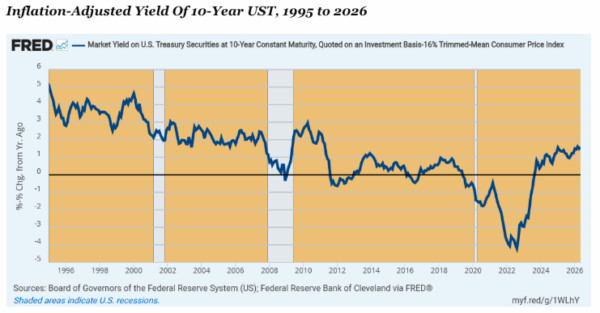
Indeed, the graph of the inflation-adjusted yield of the fulcrum US Treasury security-the 10-year note-speaks for itself. By the time the Fed had pushed the real yield on the single most important security in the entire global financial market to the absurd rock bottom level of -4.2% in August 2022, the real yield had been frog-marched downhill for the better part of three decades, falling by more than 900 basis points!
That's right. There is not a snowball's chance in the hot place that a 30-year collapse in inflation-adjusted bond yields like the one shown below could have happened in an honest supply and demand-driven market operating with sound gold-backed money.
Instead, this is the ultimate signature of Keynesian central banking. That is, the delusional model which presumes prosperity is enhanced by flooding the economy with easy money debt rather than bolstering the true foundations of prosperity and rising wealth-to wit, generation of more supply side work, capital, technology and enterprise.
We will get to the role of the Fed's own balance sheet in generating this unsustainable distortion of the bond markets, but first we review the role of international US Treasury holdings and the key role played by mercantilist exporters.
Even as late as 1995-when there were still ongoing battles for fiscal discipline and deficit reduction on Capitol Hill-US Treasury holdings by the two leading mercantilist exporters-China and Japan-didn't amount to a hill of beans. Their $205 billion of US Treasury holdings amounted to only 6.0% of the $3.4 trillion of Treasury debt outstanding.
Fast forward 20 years to 2015, however, and their combined holdings now occupied a wholly different zip code. The UST holdings of Japan and China stood at $1.250 trillion each, meaning that the $2.5 trillion total amounted to 18.4% of total Treasury debt held by the public on a worldwide basis.
Needless to say, on the margin that $2.23 trillion uptake of Uncle Sam's prodigious $10.2 trillion debt paper emissions during that 20-year period made a huge difference as to yields. That's because both Japan and China were not price-based buyers of US debt during this interval, nor are they even now.
To the contrary, they are both classic mercantilists willing to do anything and everything to promote exports and thereby their model of domestic prosperity. They ended up owing $2.5 trillion of Uncle Sam's debt by 2015, therefore, as a consolation prize from currency market interventions, not as a consequence of sagacious investment strategies. And it certainly wasn't because they worshiped the roaring success of the American economy and wanted a piece of the action-as argued by the deficits-don't-matter crowd.
During this period the Pacific Rim mercantilists were voracious buyers of dollars and sellers of their own currencies-even as the Fed was pumping out dollar liabilities like there was no tomorrow. To wit, between 1995 and 2015, the Fed's balance sheet grew by +$4 trillion, representing an increase of nearly 13% per annum.
All things equal, the currencies of huge trade surplus exporters like China and Japan would have appreciated strongly against the flood of US dollars and the associated explosion of the US balance of payments deficits. In turn, the dollar cost of Chinese and Japanese manufactures would have risen sharply, thereby reducing their competitive advantage on the shelves of Walmart, etc.
Except, in a world of fiat monies all around, the laws of economics can readily be over-ridden by central banks. In this case, the BOJ and PBOC bought US dollars hand-over-fist, thereby reducing the appreciation of their own currencies against the dollar. The result was blockage of what would have otherwise been the adverse weak dollar impact on their trade accounts. That is to say, in their wisdom (or not) they traded the sweat of their workers' brows and the genius of their manufacturers and entrepreneurs for a growing mountain of USTs.
Thus, in buying $2.3 trillion of Uncle Sam debt emissions during this two-decade period, they functioned not as willing price-based investors in USTs, but as wrong-headed mercantalists. So doing, they stuck their own countries with the dubious paper being emitted at growing rates by the UniParty pols on the banks of the Potomac.
GCC Oil Exporters
The GCC (Saudi Arabia, UAE, Kuwait, Qatar, etc.) stands out with a +$340 billion gain in USTs since 2008. Of this, Saudi Arabia and the UAE together account for roughly 60-65% (~$200-220 billion combined). In this case as well, export mercantilism provides the explanation.
Given the large trade surpluses of these oil exporters, their currencies would tend to appreciate sharply against the dollar, all things equal. Of course, they are not. In return for what the GCC nations thought was the military umbrella of Washington's bases and Fifth Fleet-well, at least until Trump blew up the arrangement by attacking Iran militarily and closing the SOH entirely-they bought dollars and accumulated Treasury bonds just like the Asian exporters of manufactured goods.
To be sure, this oil exporters' version of mercantilist policy was never sound economics-essentially the Gulf producers were exchanging the valuable gift of Mother Nature buried beneath their desert sands for Washington's dubious paper. But it did have the benefit of keeping the dollar price of oil lower than it would otherwise be, thereby retarding incentives for investment in oil provinces elsewhere on the planet or in alternative forms of energy.
At the end of the day, operators on both Wall Street and Washington seem to sleep well at night under the delusion that the current jerry-built global market for USTs is the sustainable natural order of markets. In fact, however, they should be scared shitless by the prospect of $142 trillion of additional USTs pouring in on top of the house of cards they already inhabit.
Reprinted with permission from David Stockman's Contra Corner.