Raphael Machado
Skepticism toward accelerationism, wariness of transhumanism-and a call for distinct civilizational futures, not Western tech inevitability. Russia charts its own path.
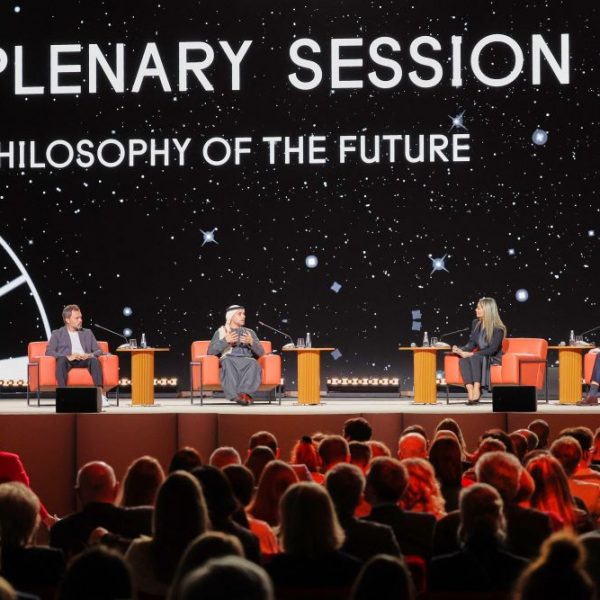
I had the honor of being invited to speak at the Congress "Philosophy of the Future: Ideas and Meanings," which was organized by Lomonosov Moscow State University on June 26 and 27.
The general thematic axis of the Congress - "the future" - was sufficiently open to allow for a certain wide margin of approaches and orientations, but I think no one will be surprised to learn that most of the speeches concerned new technologies and their relationships with humanity, with a pronounced focus on the topic of AI.
First of all, it should be said that this event was not just any international philosophical event. This is not merely a case where parliamentarians approve specific budgets at the request of "experts." More than that, President Vladimir Putin himself forwarded a message for the Congress's opening through Sergey Kiriyenko, who is Deputy Chief of Staff of the Presidential Administration. There were also interventions by Dmitri Chernyshenko, Deputy Prime Minister, and Konstantin Kosachev, Vice-President of the Duma.
It seems relevant to me to draw attention to the speech sent by Putin because it does not seem commonplace either for a President to have considerations to make about the importance of philosophy, or for there to be such a specific impetus on the part of a contemporary State for philosophers to philosophize about the great contemporary questions. What Putin does, therefore, is to ask philosophers to dwell on the possibilities of a future - and this call to pause in wonder and concern, in the era of unreflective acceleration, is itself a philosophical stance assumed, consciously or not, by Vladimir Putin.
The only other event in the last 100 years to present this approximation between philosophy and politics in the context of an assembly of philosophers invited by a political leader to philosophize about the pressing issues of their era was the First National Congress of Philosophy, held in Argentina in 1949, under the government of Juan Domingo Perón, who, incidentally, was present to read a speech and present his political-philosophical conception of the "organized community." This philosophical congress was attended by the greatest Argentine thinkers of the time, such as Nimio de Anquín, Leonardo Castellani, and Julio Meinvielle, but also attracted names from around the world, such as Werner Jaeger, Karl Löwith, Jacques Maritain, Martin Heidegger, Hans-Georg Gadamer, Vicente Ferreira da Silva, José Vasconcelos, Benedetto Croce, Ugo Spirito, Ludwig Klages, and others.
Returning to the Congress "Philosophy of the Future," it featured some of the main contemporary Russian philosophers, intellectuals, and academics, such as Alexander Dugin, Alexei Kozyrev, Alexander Pavlov, Boris Mezhuev, Alexander Filippov, Alexei Chadayev, Vladimir Varava, Egor Kholmogorov, etc. It also featured representatives from more than 30 nations, although the fact that we live in a much less open era than 1949, when the Cold War had barely begun, limited the presence of representatives from Europe and North America. It is necessary to understand that, for many countries, traveling to Russia presents the possibility of loss of career and positions, especially for those with formal government and academic connections. Nevertheless, important figures were present, such as Zhang Weiwei and Fei Haiting from China, Franklin Nyamsi from Mali, Muhammet Nur Dogan from Turkey, Florin Platon from Romania, Gorazd Hladnik from Slovenia, Enrique Refoyo from Spain, Jahangir Karami from Iran, Stephen Baskerville from the USA, Richard Sakwa from the United Kingdom, Cristian Lamesa from Argentina, and other thinkers representing their nations.
Thematically, it would be quite difficult to detail all the specific approaches and topics developed at the Congress, not least because several of its sections ran simultaneously. But it is possible to specify some general patterns that are relevant.
Firstly, although, as already mentioned, the theme was open and there was a variation of topics addressed, the debates revolved around the axis of AI and technological accelerationism. But I find it interesting how it was possible to see some approaches to other themes, not directly correlated with technology, such as some reflections on the mental framework of U.S. geopolitics, the historical-ontological role of Russia in sustaining a defensive position against the cosmopolitan avalanche, the non-universality of time (that is, the situated and subjective character of temporality), and so on. There were also interesting reflections on the role of the State, as well as on possible future configurations of the State, with considerable attention given to the idea of the Civilization-State as an overcoming of the nation-state.
All these themes, however, dialogue to some degree with the technological theme. And as for this, properly speaking, it would be possible to define some specific fields.
Techno-enthusiasts and techno-conformists were present, through the participation of some representatives from the technology industry itself and related areas. Their discourse was based on a logic of the "inevitability of the rise of AI," and on the need to apply it in all fields due, for example, to the fact that members of Generation Alpha only consume and learn through technological apparatuses. Interestingly, some foreign representatives from Third World countries adopted a similar stance.
There was also the presence of the "cautious optimists," among whom the Chinese stood out in particular. The position of the cautious optimists had certain subtleties. They considered that AI represented an irreversible and dangerous phenomenon, but they believed in the possibility of shaping, conducting, and "domesticating" AI with the help of the values of the Chinese tradition itself. It is, perhaps, the vision of an AI performing a function limited by the possibility of its alignment with China's own identity, objectives, and destiny. It is interesting how this vision aligns with the dominant view of the Chinese State itself, which aims to promote technological development, but ensures, through regulations, the leading role of the State in this process and the submission of the technological process to national values and the common good. Exactly the opposite of the preaching of Western figures like Alex Karp and Peter Thiel, who wave the specter of a Chinese technological threat to defend the deregulation of AI in the USA.
The majority of those present, however, seemed to fall into the categories of skeptics, pessimists, or traditionalists.
Generally speaking, several participants presented the negative effects of the technological avalanche and the rise of AI in various social spheres, ranging from political technocracy to the crisis of art, passing through the harmful effects on human identity and its sense of self. Along the same lines, some critiques of transhumanism and its impacts on medicine and a series of other areas unfolded, warning of the risk of commodification of the human body. An analysis was also advanced critiquing object-oriented ontology, as one of the perspectives most compatible with technological accelerationism and, therefore, providing the hermeneutic framework for the possible replacement of man as the central being in the world.
In several of the speeches, science fiction was also worked with, and its role not so much in "predicting" possible futures, but in offering futurological "projects" and "maps" that inspire visionaries of all kinds, who strive to transform these utopian and dystopian visions into reality.
Returning, however, to the discourse on the non-universality of temporality, which was one of Alexander Dugin's focuses, the topic is interesting for opening up possible reflections on different modes of temporality defined according to national or civilizational contours. The topic was already touched upon years ago by the Argentine philosopher Alberto Buela, who in some of his articles, and in the work Hispano-America against the West, distinguishes "time is money" and "laissez faire" as conceptions of time, from Ibero-American time as the "delay of the future," in light of the classic gaucho Martín Fierro.
And these types of conceptions allow us to think, as seemed to be one of the objectives of the Congress's organizers, a "Russian philosophy" and, even more importantly, a "Russian future" that is its own and distinct from all other possible futures.
Naturally, the same reflections should inspire the construction, by us, of a "Brazilian future," as well as the same for all other colleagues in relation to their peoples and civilizations.