
04.25
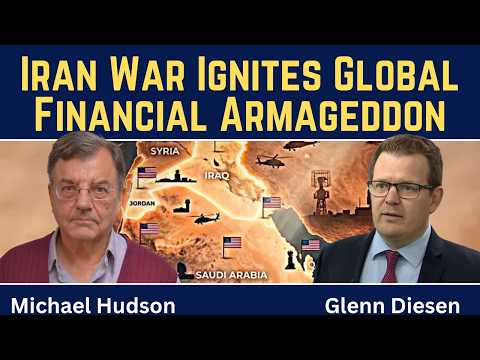
Glenn Diesen: Welcome back. We are joined today by Professor Michael Hudson to discuss the devastating global economic struggle which is resulting from the Iran war and also essentially what is becoming a competition for the economic world order that will follow this world order, whenever it comes to an end. So thank you as always, for coming back on the program.
Michael Hudson: It's always nice to be here because the questions you ask have to do with how the whole economy throughout the world is evolving.
Glenn Diesen: Yeah, and there's so much happening all at once. And these are really, again, historical times when we see the economic architecture from the past 80 years falling apart in front of our eyes. And we would like to know what might follow after this and also explain how the different actors behave. And you published very recently an excellent article with the name, Postponing the World's Financial Winter for How Long, which I would recommend everyone to read.
So I thought a good place to start would be the energy markets, because this is obviously a big hit for the world economy. The U.S. war on Iran essentially plunging all these international energy markets into crisis. I was wondering if you see a silver lining for the U.S. in terms of these energy problems.
Michael Hudson: Well, energy markets are just about everything. You have fertilizer, for instance, and fertilizer prices, I'm told, in India have already gone way up. Certainly, in America, they're going up to such an extent that farmers are saying if they pay for the fertilizer and for the equipment and for all the other inputs whose price is inflated, they're not going to be able to make money on their crops. Well, of course, crop prices may go up because all over the world there's going to be a crop shortage without fertilizer.
But farmers need to go to a bank and borrow before they can spend for the spring planning and the summer. And that usually entails selling the crop in advance for a guaranteed price. So the big companies that are the crop trading companies are going to make a big profit, not the farmers.
So they're really, really being screwed. And of course, they're the ones who are most loyal to Trump and the Republicans. So, of course, they can afford to screw the farmers because there is a base. But pharmaceuticals are also in there. That's made out of all this fertilizer and pharmaceuticals.
The helium has already stopped. So that interferes with the hospital scanning machinery as well as cryogenic freezing of computer chips. Then you have just the basic energy for transportation, especially the highly refined airplane fuels that have already led to huge cutbacks in the airline's planned flights for this summer for the tourist season. So energy is really the whole economy.
And you get the sort of simplistic economic analysis that says, well, energy is 10% of GDP, so GDP will go down 10%. But that's not very helpful because you have all sorts of things that you need to produce a product. And if you don't have the energy for it, then that means all the other things are not able to be employed either. And as a result, you have unemployment in the manufacturing industry.
Aluminum has already been cut back because aluminum is really made out of electricity to do the electrolytic refining of the bauxite. Right down the line, the effect will be more than 10%. And the genius of Iran's political stance is that if you, the rest of the world, do not stop the United States and Israel from destroying us, which is their explicit threat, they're going to blow up all of our bridges, they're going to destroy all of our refining capacity, they'll destroy all of our electricity, they'll bring about regime change and reimpose a police state like the Shah had that led us to have the revolution to overthrow them in 1979 to begin with.
If you're just going to sit by and let the world ignore all of the body of international law and the laws of war that the United Nations Charter was supposed to do, then we're not going to go down alone. We're going to take the other Arab oil producers with us. That's going to cause such a shortage that it's going to cause an international depression worse than the 1930s. And the reason why it's worse than the Great Depression is because that was really a financial depression.
But a cutback in energy and the tangible physical flow of goods are part of the production process itself that cannot be solved by writing down debts, cannot be solved by saying, let's have a war economy and military Keynesianism to pull us out of the depression. It's much more serious. So in terms of the world economy, it's all going to suffer if other countries do not restructure the way in which all of world trade and payments and finance and how countries save their international reserves is all reformed together.
It's sometimes easier to create a whole new institution, a new United Nations, rather than trying to fix something that is so broken by the United States interference and corruption, not only of the veto power that the United States has to prevent the United Nations from doing anything that they don't want, but also the corruption of the Atomic Energy Authority acting basically as a spy for Israeli terrorism against Iran, or for the fact that the United States is driving the United Nations bankrupt by refusing to pay its bills.
And the fact that the United States is blocking any kind of international movement to cope with global warming, and replace fossil fuels, oil and gas to begin with, with either atomic energy or solar energy or wind energy or alternatives. So the entire spectrum has to be changed as a system. It's not just, oh, let's just get the oil flowing again.
And that's why I don't understand why the stock markets are saying, well, maybe there can be a happy medium between global depression and total surrender of Iran with total control of the oil trade for the United States to weaponize, becoming basically the world dictator and able to do to the world what threatens to be the result of destroying OPEC trade today. Those are the choices. And they seem to be unthinkable as far as the large investors behind the stock and bond markets are concerned.
Glenn Diesen: What you're describing, though, is an economic mutually assured destruction. And I can see why, I think you used that word as well, by the way, in your article, but I can see why Iran is doing this because no one came to its aid, essentially. The U.S. and Israel attacked in a very savage way, destroying its infrastructure, targeting nuclear reactors, and talking about killing an entire civilization. You know, what I saw in European papers was, well, the Iranians will have the opportunity to free themselves now that they've been liberated from the dictatorship. And essentially every article, especially in the beginning, seemed to be about how to legitimize this. No one's talking about international law or pulling back. So again, if it's only them that is going to be destroyed, then, of course, they want to push back in this way.
But it does appear to be something that seems like a mutually assured destruction. If the U.S. doesn't want the international economic system to completely melt down, and it doesn't want to give up its dominance either, where do you see this going?
Michael Hudson: It would rather crash the whole economy, the world economy and itself than give up its dominance. It's willing to crash everything. And then you have the personality. Trump wants to be famous. And how can you be more famous than ending civilization and pushing and taking a thousand years to rebuild it from atomic war ? He will go down as the person that ended a whole historical epoch of civilization. He has a motivation for blowing up the world.
And he's appointed Hegseth as the head of the War Department, who is a Jesus freak who believes that, well, if you end civilization, Jesus will come and he'll save the Christians and send them all to heaven and everyone else to hell. You have crazy people in charge.
And so this is not a situation that you can handle according to all the rational models. It's an irrational model, as you've seen by all of the newspaper reports of the fights that are occurring within the situation room of the White House when the generals are simply refusing to give Trump the code for the atom bomb because they said he would have used it last Saturday. That's how crazy it is.
Glenn Diesen: You know, it's just incredible that it's actually gone to this distance, especially for someone like Trump, who ran on bringing back normalcy or ending the forever wars. And about the religious dynamic of this, I mean, it's quite strange. On one hand, you see them being overly religious in the way they justify war and try to mobilize the military and the public, except for when the Pope criticizes war, then suddenly there's zero respect for religious authority. I mean, it's quite extraordinary. It doesn't seem very genuine, to be honest.
But what do you make of the Iranian defense here, though ? Because, again, they're faced with an existential threat. They want to take down the opponent. How do you see their ability to withstand all of this economically?
Michael Hudson: Let's compare the Iranian and the U.S. ability. The U.S. used up most of its available missiles, its bombs, and its missile launchers. It's cut back its airplanes. It's afraid to move its navy within shooting distance of Iran. So the United States has lost its military power to compel.
That's why Trump said, well, I can't invade on land to grab Karg Island or to grab the uranium. We tried that and it failed. So if I can't have a military invasion like we had in such a nice operation in Venezuela, and if I can't just bomb them because they have their anti-aircraft radars that are going to shoot down our planes and the refuelers and we'll lose our aircraft, and it's not going to knock them out anyway, because Iran's defenses and Iran's whole administrative network is so decentralized, then we have only one solution: the atom bomb.
That's why he asked on Saturday for the atom bomb codes. I don't see why the rest of the world doesn't say where this is going to lead, because way back in the 1970s, when I worked with Herman Kahn at the Hudson Institute, it was all about working out what the sequence of political and military responses would be to an atom bomb. And it pretty much means that everybody's going to need one.
The joke is that, in trying to prevent the fiction using the pretense that Iran was trying to get an atom bomb, everybody now realizes: we need an atom bomb, and if we don't have our own, Israel can bomb us. Israel is the only country in the world that's permitted to have 200 atom bombs to use against whoever it wants. And we can't, so we all need them too.
This is the double standard that's occurred. And again, countries are not taking steps to isolate the United States and Israel and confront them if they are going to go down this route of threatening the atom bomb if they don't get control of the world's oil trade to weaponize it and use it as a choke point. And point out that they can't get oil unless they succumb to U.S. foreign policy and agree to shift their investment in major industries into the United States, and that they're going to force these countries into a depression by cutting them off from oil.
So the U.S. military doesn't have an ability to do anything to really conquer Iran. All it can do is bomb it. And the Iranian Navy is not destroyed, despite what Trump says. Maybe half of it is. Their aircraft are not destroyed. Maybe half as it is. The missile launchers are not destroyed. What was destroyed were the balloons that they bought from China and inflated to look like missile launchers, which were bombed when Trump said we've destroyed all of their missile launchers.
So Iran is in a much stronger military position defensively. And Iran's not an offensive power. The only countries that Iran can threaten are its Arab neighbors in West Asia. It's not going to be a world power in the sense that America, Russia, or China is a military power. It's not going to be an investment power itself because it's been stripped of its foreign means of investment. It's not even going to be a major trade power.
What is giving it all the power that it has is the moral power that it's got saying, we are not going to stand for letting the United States become the world's dictator and using oil trade, food trade, the dollar as weapons against other countries to maintain one-sided, exploitative control over them. We're not going to let that happen. And somebody has to draw the line. And it's Iran that has drawn the line. That's what its moral power is.
And other countries really don't have any choice except to either tell Iran, you're right, we have to make a change, we have to stop this aggression by the United States and Israel of saying, we will destroy your economy, either militarily or economically, if you don't do what we want, or they can isolate themselves from the United States and Israel by going their own way. And essentially, that means isolating the United States until it ends its military and financial attempt to weaponize everything that it does in every economic and social activity.
Glenn Diesen: It's interesting that the role fell on the Iranians to essentially check the U.S. on this because you and I have spoken before about how a confident hegemon, that is the British in the 19th century or the Americans in the 20th century, when they're confident, they have an interest in having an open, liberal international economic system. That is, everyone should have access to technologies and industries. There should be free access to international transportation corridors by sea or land. There should be free access to currencies, banks, etc.
But once the hegemon is in decline, it will seek to reverse its decline by essentially weaponizing all aspects of economic connectivity. So all the connectivity, which was previously a source for global growth, is now weaponized to restore the hegemonic power. Now, you know, we see this being used against China, I think, to a large extent, and also increasingly Russia.
But Iran looks like they're the one who put their foot down. But they also have the Strait of Hormuz. I think this is quite fascinating because, by stripping the U.S. of control of the Strait of Hormuz, I mean, they can do a lot of other things. I see now that they set some conditions.
They essentially set up a toll booth now. And they said, everyone has to pay a toll, especially the countries who attacked Iran or sanctioned them. They have to pay reparations, so that's an additional bonus on top. And also, they don't want dollars anymore. This is quite extraordinary.
Michael Hudson: Now it's not possible to have dollars. They had dollars, and the United States has confiscated them. If you have dollars, the United States will immediately steal them, as they stole Russia's $300 billion. The dollar is unusable by any country that wants its own national sovereignty.
I want to say, you use the word liberal, and this is a completely misused term in general. The takeoff of the industrial nations, Britain, Germany, and the United States was not liberal. The word liberal really means neoliberal. It means no government. Liberal means Margaret Thatcher, Ronald Reagan, in today's vocabulary.
And it means you have to dismantle all government subsidies of the economy instead of having the government run natural monopolies such as transportation and communications as well as providing free schooling and free health care. All that was the 19th century. It wasn't liberalism. The word they used was socialism in one form or another, or social democracy, perhaps.
But they did not use liberalism. They rejected the whole idea of free trade in order for governments to shape the markets so as to prevent rent-seeking, shape the markets to prevent real estate prices from going up by taxing away land rent,and to prevent monopolies from taking place, either by things like the Sherman Antitrust Act of 1890 in America and Teddy Roosevelt's trust busting. Or better yet, a government would take all of these natural monopolies into public hands, as was done the case from Europe to the United States, United States with the Erie Canal and on.
And there was a whole doctrine of looking at government capital formation. Public infrastructure investment was a factor of production, but unlike industrial capital or capitalist capital, private sector capital, and industry capital, the aim of government investment was not to make a profit. It was to provide its basic services for key sectors at subsidized rates or even freely, so that you lower the economy's overall cost of doing business.
And at the end of all of this, this government control was in finance achieved most clearly in Germany and Central Europe at the end of the 19th century, where the government and industry and the banks moved hand in hand to direct the financial system to provide credit not to make money financially for financial investors but to finance capital formation and industry, to build factories, largely in the arms-producing industries, of course, but to produce actual industry.
Well, this was what classical political economy was all about. The ideal of the whole political doctrine of industrial capitalism was to minimize economic rent. It was value theory. That's what Ricardo talked about: John Stuart Mill and Karl Marx. They were all talking about how do you keep prices in line with the actual cost of production and the value, and get rid of economic rent, which is the excess of market prices over value because of the special privileges that we inherited from medieval European society.
The privilege of absentee hereditary landownership by a landlord aristocracy, the monopolies that were created by international banks from the 14th century to enable kings to have revenue to carry their war debts, and general banking to provide credit for economic growth. After World War I, all of those plans for how to develop an industrial economy were essentially put aside and finance replaced industry as the focus of gaining wealth and making a fortune throughout the West.
And if you look at today, the most successful economy in terms of growth of production and living standards is China. And what it's done is exactly the same principle that made the United States wealthy and productive and so dominant in the 19th century. It kept natural monopolies in the public hand. Transportation is very inexpensive. It's subsidized. Healthcare and education are subsidized.
But most of all, China has kept banking in the hands of the government. So the People's Bank of China will create credit for actual tangible production. Unfortunately, a lot of this has gone into overproduction of real estate, but the idea is you're not going to make loans for financial speculators to borrow money, buy a corporation, and then essentially loot it and leave it, which is what's happening in the West.
All week long, and for instance, in the Financial Times and Wall Street Journal, there's a discussion about the major banks and major investment funds that have lent money for private capital formation to take over companies and finance their enshittification and their downsizing, essentially just looting these companies. They're saying, we're not letting pension funds cash in their holdings unless they take 50%, 80%. The whole American economy has become a bubble.
So when I talked about the effect of the energy stopping before, one of the effects is to bring down this whole highly leveraged financial sector, the whole debt-leveraged buyouts and the debt pyramid, mainly in the United States. As in the Depression, the United States was the most highly debt-leveraged economy. The whole financial sector will be coming down.
So what will be destroyed is not only physical output, it's the whole system of financialization that has led the United States to lag so far behind China, for instance, and countries that, instead of being liberal, say, well, the government has to play a positive role in providing for certain basic needs and to prevent exploitation. If you don't have a government strong enough to prevent a financial oligarchy from developing, then you're going to end up, like the United States, a failed economy. Or, like Germany and most of Western Europe, a failed economy as a result of their neoliberalism.
So I just wanted to be very careful about using that word liberalism. It's a term against government and against socialism specifically. That's what caused the whole reaction against industrial capitalism, because industrial capitalism itself was evolving into socialism, into government playing an increasing role in the economy by investing in infrastructure, by preventing monopolies, by taxing away or preventing land rent and monopoly rent and financial exploitation from occurring. So there's a whole ideological superstructure that has gone by the wayside along with the collapse of production. Ideology is the last thing to go, apparently.
Glenn Diesen: Yeah, no, that's a good point. Often the word liberal is used to refer to the openness of the system.
Michael Hudson: But it's not open.
Glenn Diesen: I agree.
Michael Hudson: And the United States says if we have open trade, then we can't control it. The United States says there cannot be open trade or investment. If everybody can use the dollar, then we can't grab it all from them and force them to do what we want.
And nothing's open. It's a closed system controlled centrally by the United States. Liberalism is central planning, but it's central planning not by government, but by the financial sector and by the political military sector. That's liberalism. You have to realize its central, centralized planning, not by the government, not by democracy, but by financial wealth and the military to protect its dominance.
Glenn Diesen: Yeah, that's where I was going, rent seeking, not just from the American public, but also from other countries as well. I think this is why there is that assumption that countries who break away from the U.S.-led economic system would only suffer. But we see, like in the Russian case, that they can actually have many benefits as well from not paying these rents.
But given that this is the U.S. situation, when it was a hegemon, it had certain privileges in terms of everyone using the dollar, everyone using the banks, everyone using its technologies. As the U.S. now struggles as a declining hegemon, it seems to be pursuing a very different approach. It has a very, I guess, extractive approach to trade.
Michael Hudson: It wants to maximize money.
Glenn Diesen: Maybe that's an older story. But who in this situation do you think wants to invest in the U.S. economy, given that it's kind of obvious what they're going for now?
Michael Hudson: Well, that's the fantasy of all this. Donald Trump says, well, we can go one of two ways. Either we will attack Iran to make one last stab to grab its oil, which is how we begin. That's nothing to do with Iran wanting an atom bomb. America wants its oil. Or in that case, there will be a world depression.
But if there's a world depression, Trump said, we'll come out ahead. Look at us. We have oil, we have gas, we don't need oil and gas. Other countries will suffer more, and that means we will suffer less than they do. And that's what winning is in a shrinking environment: to suffer less than your opposition. That's his fantasy.
But he doesn't realize that, although the United States has oil and gas, it doesn't have industry. It doesn't have any means today of producing industrial goods because it doesn't have an industrial labor force. And even in the construction labor force, most of the blue-collar work and the dirty work and the low-wage work were being done by immigrants. And Trump has cut that all off.
So you no longer have the restaurant and agricultural work along with other things that immigrants do, or the blue-collar labor working in factories because there aren't any factories now for them to work in. Immigrants have always done the hard work, just like the case in the Arab Emirates, where it's mostly an immigrant population. Same thing in Saudi Arabia. That's how countries recruit the labor force.
And the United States cannot compete industrially or agriculturally with other economies to say, well, we'll export something for you for what you need. And you sell us what we need, your other raw materials, whatever it is you produce. Because the cost of labor is so high in the United States, not because Americans' living standards are high.
The living standards of labor in America have gone down steadily ever since 2008, and really since 1980. Late 1979 was really the key for America's labor living standards. You could afford to buy housing there out of the wages that you had. But especially since Obama bailed out the banks and the chunk mortgage fraud that essentially wiped out a lot of low-income people. And since 2008, almost all the growth in wealth in America has been, as we've said, to the top wealthiest 10%. And it is wealth from the finance, insurance, and real estate sector, not the industrial economy at all.
So the American industrial economy has been essentially dissolved. You had America make a deal with Korea and also with Japan to build affiliates in the United States. And so Korea said, well, we came over here, we tried to hire American labor. We have to bring our own labor over. They're not good at construction labor. They're just too sloppy.
Same thing with Taiwan. They had a multi-billion dollar big plan to build a computer chip factory out west. And they found out, well, we have to use our own workers. We can't use American workers for it. There's essentially no one who wants to be a blue-collar worker in the United States. And the only people who were willing to do the blue-collar jobs are now being deported or under threat of deportation because they've immigrated. And doing a blue-collar job is how you get a foothold in this country.
This fantasy that somehow, if there is a world depression, America will come out the winner, will end up showing that America is actually hollow. It will be like John McCain calling Russia a gas station with atom bombs. Well, that's all that America would be left with under Donald Trump's alternative, bringing the rest of the world into depression.
We have oil and gas and we have the atom bomb. We don't have any industry and our agriculture's broke. So he's turned America into a gas station with atom bombs if he goes that route of forcing Iran to defend itself by saying, if we're going to be attacked and our economy destroyed, we're going to bring all of the world with us, which is going to force you to make an alternative or just to live in a permanent depression until you figure a way out of it that'll save us along with you. That's the political dynamic at work that I see.
Glenn Diesen: Yeah, this assumption that if the international system breaks down, somehow the U.S. will be able to float to the top may have some strength in terms of the U.S. having a lot of energy sovereignty. But the case is different than it was during World War II, when there was the emergence of big business. There was a lot of technological development. And overall, after the war was over, the U.S. was the world's factory. It was the world's bank.
These days, it outsources its industries. It's the largest debtor country in the world, in world history. So it's not as positioned as it was back then. So the idea that one can come out strong in a war like this doesn't make much sense.
But my last question was just on how the partners of the U.S. will deal with this. The U.S. is shifting towards extracting more economic concessions, as we see in Europe, where Trump can hand over the Europeans any trade deal, and they have to sign it, even if they would like not to. You see some suggesting that the Gulf states should repay the U.S. for the weapons it has spent in fighting Iran.
In East Asia, there have been comments that Taiwan and others should begin to shift their high-tech industries towards the United States. So, again, this is a very extractive economic approach. Nobody wants to do this. It appears that the main leverage the U.S. has is that it's the security dependence. The U.S. is a security guarantor.
But a declining hegemon often invites insecurity. It doesn't provide security to the same extent, as evident in both Europe and the Gulf states. So how durable do you think this is?
Michael Hudson: Well, that's just what the Emirates have just said. They had thought two things. They thought that when they bought U.S. weapons, they were going to work. And the weapons are only like having an expensive Rolls-Royce in the garage. It looks nice, but it's not really the most efficient car. The weapons are not to fight a war with. They're not to attack. They're not to defend. They're just to hold on the ground and to make America happy.
And second, they had thought that having a base would not end up being a threat. When America attacked Iran, Saudi Arabia and the Arab countries said, well, we weren't consulted. And the European countries said, wait a minute, Donald Trump now wants us to fight down to the last European in an attempt to invade Kharg Island and Iran so that we'll die when America's not willing to do so. The fact is that America is acting unilaterally by itself in its own interest.
And so having a U.S. military base there is essentially putting yourself as a bullseye to be destroyed because the United States military bases are there as a means of attack. They're not defensive, they're aggressive. And if they're aggressive against any enemy, the opponent is going to fight back and wipe them out, and they'll whip out the country that the military base is housed in. So, obviously, that's not safe.
But most of all, I'm glad you mentioned what Trump has said about Iran having to pay the U.S. for all the costs that the country has amounted for the war we waged to destroy them. And that we're going to capture the repayment for that by grabbing its oil. He said that explicitly, and he grabbed its oil. Obviously, he wants to do the same thing with the Arab OPEC countries.
His logic is, well, we defended you and now you have to pay us for the cost of defending you with our military-industrial complex of overpriced missiles and aircraft and missile launchers and everything else that didn't have anything close to the military effect that we told you it would have. It was a paper tiger, to use Mao's phrase.
And why on earth would any country want an American military base there to be a paper tiger that's not going to defend it, but just makes it a bullseye target of countries that America is trying to launch a war against?
Glenn Diesen: It seems like a strange time in world history to be banking on U.S. security guarantees. I'm very shocked when I look around the world and see how little adjustment there actually is to this new distribution of power. The assumption that we can still have the hegemonic policies of the 1990s and apply them to 2026, when the distribution of power clearly is now post-hegemonic and multipolar.
Michael Hudson: This security you're mentioning of about 70 or 80 years is now a fiction. It's the enabling fiction to say we will provide you with security in case Russia invades Europe. That's as if Russia is going to invade Europe. It's a fiction to think that Europe needs security against Russia.
Russia wants to be left alone by Europe and it's willing to fight Europe and to bomb Germany and England and France if they try to attack them, as they're doing, or provide Ukraine with missiles to attack Russian oil and refinery production, as they're doing. Russia has already turned its back on Europe and wants to go with the East because Europe is part of a failed civilization. It's going downhill, and Russia's not only rejecting Europe economically, but its social values and its rotten political system.
It's a system that says, if you say that you're against genocide, we're throwing you in jail. This is a democracy. We're in charge, and you cannot, in a democracy, say the Palestinians shouldn't be exterminated. That's against civilization. You go to jail. Germany said that, Britain said that, and France has said that, and they're arresting people that express outrage.
I mean, this is a despicable culture for the rest of the world. And they're seeing the whole nakedness of the fact that Europe is not a democracy at all, and that all of this talk of saying we're here to protect you, you have to pay us to protect you. It's really just you have to pay us to be able to put in place a military system to threaten you with destruction if you don't do what we want and follow trade policies that are unequal and benefit us, not you.
America has to win, as Donald Trump says, and you have to use the dollar that we can just print to buy up your industry, your raw materials, and other things. You have to pay the debts that you run up from running trade deficits as a result of following the pro-American investment policies that the World Bank and the IMF produce that say don't produce your own food, buy American. The whole system that was supposed to be keeping the world economy prosperous and free turned out to be making it more and more unequal, more and more polarized, less and less safe, and more or less prone to leading to exactly the culmination of this irrepressible conflict that we're seeing today.
Glenn Diesen: Yeah, I was interviewed two days ago by a German newspaper and I was making the point that if Europe wants to reverse its decline, it has to end the dividing lines. That is, end the conflict with Russia, remove Ukraine from the front lines of this new war.
And I was asked, well, to what extent is possible because our values are so different, because we have liberal democracy and the Russians are so authoritarian. I was like, look at Germany, where you protest against the genocide and they throw you in jail. It's quite extraordinary that this is still the very narrow framework we have to interpret the world around us, that it's simply good guys versus bad guys. Anyways, any final thoughts before we wrap up?
Michael Hudson: Well, the whole question is, what is democracy ? What seems to be democracy in the West is exactly what it was in Aristotle's day in Greece. He said, what claims to be democracy is really oligarchy. But you can let people vote for who is going to be the personal leaders in the administrations, but you cannot vote for what kind of an economy we are going to have and what kind of a society we have.
All of that is determined by the wealthiest oligarchic parts of the population. The whole purpose of democracy is supposed to be: how do you run an economy to prevent it from polarizing and to act on behalf of the population at large, increasing its living standards and its productivity and its happiness ? That can only be done with a strong enough government in a position to prevent a financial oligarchy from developing and polarizing the economy and dismantling government authority to put the authority in the hands of the creditors and the landowners and the wealth holders.
So, the whole idea is that the whole ancient Near East, Babylonia, and Sumer, they all had rulers who would prevent debts from impoverishing the economy, prevent the land from being forfeited to centralized landowners who accumulated it all, to prevent the ancient Middle East and West Asia from suffering in the way that Western civilization did from classical Greece to the Roman Empire. And we're still living in the results of that idea of oligarchy: creating a government, calling it democracy, and saying a government not controlled by the oligarchy is not democratic.
And that a country like China, whose government is trying to act on behalf of increasing productivity, wealth, and living standards, is called an autocracy. Well, this is the vocabulary of deception that we're living in, and that part of this resolution of the economic conflict we're having today has to be a resolution of the ideological misuse of language to provide a more realistic vocabulary to explain why it is that Western economies are polarized and getting poorer and poorer. And other countries, like China, are not. What is it that China's doing that we are not doing that has enabled it to uplift its population ? There has to be that discussion, which hasn't even begun yet. It's still in the unthinkable phase.
Glenn Diesen: Yeah, far away. Well, thank you very much for sharing your insights. It's quite extraordinary what we're seeing.
Michael Hudson: Well, thank you for having me, Glenn.
Transcription and Diarization: scripthub.dev
Editing: Harrison Betts
Review: ced
Photo by Peter Thomas on Unsplash