March 31, 2026
The World War II chapters of my introductory history textbooks always devoted a great deal of space to the Japanese attack on Pearl Harbor that brought our country into the conflict. But they only spent a couple of paragraphs on the major military victories of Japan that had soon followed. Perhaps a single sentence was devoted to the fall of Singapore to a Japanese army, yet that event actually had major world importance.
For many years, the British had relied upon Singapore as the central military pillar of their East Asian holdings, a fortress-city that they often called "the Gibraltar of the East." Garrisoned by a large British army of 85,000, it was regarded as totally impregnable. Yet just a few weeks after the destruction of most of the American fleet in distant Hawaii, a Japanese general attacked it from the landward side, marching his men through what the British had regarded as totally impassable Malayan jungle. With "the guns of Singapore" all famously pointing in the wrong direction, the British garrison was caught completely flat-footed when he invested the city and began his attack. British Prime Minister Winston Churchill ordered his troops to fight to the last man, but instead they all surrendered after just a single week of combat, taken into captivity by a Japanese force little more than one-third their own size. This represented a total national humiliation for the mighty British Empire.
When Churchill later wrote his six volume history of the war, he described the fall of Singapore as "the worst disaster and the largest capitulation in British history," and the aftermath had major geopolitical significance. Asians across the entire region were stunned by such a massive British defeat at the hands of a much smaller Asian force. Everyone saw the photographs of huge numbers of British troops being marched into POW camps with the top British generals at the head of those endless columns.
Whereas the Japanese success at Pearl Harbor could be ascribed to a treacherous surprise attack, no such excuse existed for the crushing British defeat at Singapore, so the long-standing bubble of perceived European military invincibility had been permanently punctured. Many have argued that the dramatic resulting changes in local Asian psychology played a major role in the postwar collapse of all the European colonial empires in that part of the world. Yet despite those resounding geopolitical consequences of the Fall of Singapore, I doubt whether even two Americans in one hundred are currently familiar with that important history.
Probably far more present-day Americans are at least somewhat familiar with the name "Dien Bien Phu," at least if we include those who vaguely assume that it is some sort of tasty Chinese culinary dish, perhaps related to "Egg Foo Young." But that 1954 French military defeat in Vietnam also had major world importance.
Less than a year after the outbreak of World War II, France had unexpectedly suffered a stunning total military defeat at the hands of Germany and as a result, Germany's Japanese allies soon seized control of Vietnam, France's major colonial possession in Asia. The Allied victory in 1945 ultimately left France in the winner's circle, so after the Japanese surrendered, the new French government reestablished its former rule over Vietnam, but was faced with strong Vietnamese nationalistic resistance led by Ho Chi Minh and his Vietminh forces.
The resulting colonial war dragged on for nearly a decade, with the French gradually being worn down until they finally decided upon a bold military strategy intended to turn the tide and defeat the Vietnamese independence movement that they faced. They placed a large French army in the valley of Dien Bien Phu inviting a Vietnamese attack. Given the strong defensive positions they established, they felt confident they would be able to inflict very heavy losses upon Vietminh troops, perhaps winning the war as a result.
But contrary to all those French expectations, the Vietnamese managed to drag their artillery into the hills surrounding that valley, and the resulting bombardment they unleashed allowed them to defeat the entrenched defenders. In desperation at the looming disaster, the French even asked their American allies to launch tactical nuclear strikes to destroy the besieging Vietnamese, but President Dwight Eisenhower rejected that option and the result was a humiliating French surrender.
Once again, many thousands of white Europeans were marched into bitter captivity by their Asian opponents, and this further debacle marked the end of most of the outright colonial control of the region. The Vietnamese forced the French to pay large financial reparations in order to get their POWs back, which further added to France's national ignominy.
Few Americans today remember these historical incidents from three generations ago, and even those who do probably regard them as elements of the dead past. But they both came to my mind when the media began reporting that President Donald Trump had decided to dispatch ground forces to the Middle East, planning to deploy them against Iran.
I very much doubt that our ignorant president has ever heard of the European defeats at Singapore or Dien Bien Phu, and I'm sure that the same was also true of his equally ignorant subordinate Pete Hegseth, our self-styled "Secretary of War." Perhaps partly as a consequence, they both entered into our current war against Iran just as supremely confident of victory as had been the British and French governments prior to those national disasters.
On its face, such extreme American confidence might have seemed fully warranted. In recent years, our annual military spending has been more than 100 times greater than that of Iran, the sort of absurd ratio only rarely found in any conventional conflicts. Moreover, we were being led into this war by our Israeli allies, who themselves possessed a powerful military and had also gained renown as probably the most ruthlessly effective assassins in all of recorded history. Adding even further to all our other advantages, we initiated the conflict with a massive surprise attack, successfully killing most of Iran's top political and military leadership in the barrage of missile strikes that constituted our official declaration of war.
Given all those facts, anything other than a quick and decisive victory seemed almost inconceivable, and the overwhelming majority of outside observers and virtually all our media outlets initially took that position.
Yet the Iranians had long prepared for the possibility of such an American attack, even including a surprise strike against their leadership given that something rather similar had occurred just eight months earlier in June 2025. Iran's decentralized military forces had apparently been prepared to take retaliatory steps even if their central command structure were eliminated, and this was exactly what happened, with waves of ballistic missiles and drones hitting our regional bases within hours of our own decapitating first-strike.
Even more importantly, the Iranians soon blocked the Strait of Hormuz, just as they had always threatened to do, and the sudden loss of some 20% of all oil shipments caused world prices to immediately rise, producing fears of a global economic disaster.
Roughly one-fifth of all natural gas exports also used that strategic waterway, and according to shipping brokers, half the world's available LNG carriers were soon trapped within the Persian Gulf, with energy prices in Europe having already spiked by 60%. Around one-third of all fertilizer also came from those sources, and with the planting season soon to begin, experts feared that this sudden lack of fertilizer might produce a global famine.
More than a week ago, the Wall Street Journal revealed that if the Iranians continued to interdict the transit of most shipping, the Saudis believed that oil prices would reach $180 per barrel by the end of April, nearly triple the price earlier this year, thereby plunging the world into a very severe global recession or worse. Such an estimate seemed quite plausible given that the price for Gulf oil not requiring that blocked transit route has already been bid up to $160 per barrel. In America, the retail cost of diesel fuel has increased by 40% over the last month, while our gasoline prices at the pump have climbed by a dollar a gallon during March and might rise another couple of dollars during April.
According to the CEO of United Airlines, jet fuel prices have now "more than doubled in the last three weeks" and experts warned that unless oil prices soon come down, some major US airlines may "not survive."
For decades the enormously influential Israel Lobby had tried to persuade American presidents to attack Iran. But for decades our Pentagon and intelligence officials had dissuaded them from doing so by emphasizing that the likely Iranian response could devastate the world economy, just as has now been happening.
Although our naval forces were the most powerful in the world, Pentagon war games held in 2002 had suggested that if we deployed our fleet to try unblocking the waterway, the Iranians would sink most of our ships, resulting in a gigantic military defeat for our country. Indeed, that projected outcome had been established decades before the Iranians acquired the highly accurate ballistic missiles and powerful drones that are now their most formidable weapons.
Trump had been informed of all these huge risks, but he later claimed he hadn't been, or more likely the warnings had just gone in one ear and out the other. Our president seemed to have assumed that the Iranians would surely surrender within a couple of days after he launched his remarkably naked war of aggression, so any loss of energy shipments would be temporary and insignificant. But when Iran instead fought back effectively, he and his advisors apparently had no Plan B at hand.
Trump repeatedly declared that he would send American warships to escort tankers, but such a mission would have been suicidal so he never followed through on those threats. We now apparently have no good options available in the global geopolitical crisis that we have unleashed.
Even aside from the potentially decisive strategic impact of the Iranian control over such a vital waterway, the tide of conventional battle has seemed far from favorable to our own side. Just before the war began, Pentagon leaks had disclosed that our top military leaders were very concerned about the serious problems that we would face, especially with regard to our supply of munitions, and those warnings seem to have been proven correct.
We originally developed our Tomahawk cruise missile in the 1970s and it was first used in 1991. Although slow and rather elderly, it has remained the mainstay of our arsenal of stand-off weapons, and we've now burned through our inventory at a fearsome clip. According to a recent Washington Post article, we had somewhere between 3,000 to 4,500 available at the beginning of the war, and we've now fired 850 of those or 20-30% of that total stockpile accumulated over the decades. A Business Insider article mentioned that our annual production had been around 60-70 each year, so in just four weeks we've expended at least a dozen years' worth of production. Although we have now greatly ramped up our annual Tomahawk orders, the missiles generally take two years to build so the new supply probably wouldn't become available until 2028, and I doubt that we'll still be at war with Iran at that date.
The British Royal United Service Institute (RUSI) has reported that within another month or less, our global stockpiles of ATACMS missiles and THAAD interceptors will be empty, while Israel has already exhausted its supply of Arrow interceptors. Meanwhile, the Iranians still apparently have vast stockpiles of ballistic missiles and drones, enough they claim to easily sustain six months of intense combat operations.
From the very first hours, the waves of Iranian retaliatory strikes had proven far more accurate and effective than military analysts had ever expected. Nearly all our regional bases came under devastating attacks, destroying most of our strategic radars, complex installations that would require billions of dollars and years of time to replace. After weeks of downplaying these military losses, a recent New York Times article finally acknowledged that Iranian missile strikes and drone attacks had rendered many of our 13 military bases across the Middle East "all but uninhabitable."
As a result, we have been forced to base our planes elsewhere, and these other sites have now been targeted by the Iranians. Just in the last couple of days, the Prince Sultan Airbase of Saudi Arabia came under heavy attack, apparently destroying several of our airforce tankers based there and damaging many more. The loss of our land-based radars had required us to quickly rush 40% of all our AWACS planes to the region, and one of these had been destroyed, representing the loss of a $600 million aircraft that no longer could even be produced.
Our largest aircraft carrier is the USS Gerald R. Ford and it was recently pulled out of the region and sent away for repairs after a large fire injured some 200 sailors. The carrier strike group had been kept far from Iranian territory, and all the initial media reports claimed that the fires that disabled it had been accidental, starting in the laundry area. But yesterday, Trump seemingly contradicted his own Pentagon's statements, saying that the damage had been inflicted by multiple Iranian attacks.
Meanwhile, our Israeli allies have used this opportunity to invade neighboring Lebanon, with their finance minister declaring that they should annex the southern portion of that country as part of their Greater Israel project.
But that military operation does not seem to be going well, and news reports claim that the Hezbollah resistance forces may have destroyed 21 Israeli Merkava tanks in just a 24 hour period, following their destruction of 8 others the previous day. According to the Jerusalem Post, the IDF chief of staff has warned that his military may soon be facing collapse for lack of manpower, and although that statement might be a wild exaggeration, it cannot be entirely ignored.
The impact of all of these American military setbacks or outright defeats has been magnified by the widespread belief that Trump's decision to attack Iran totally violated all the promises he had made to the American voters who elected him.
As journalist Glenn Greenwald and many others had noted, Trump had successfully regained the White House in 2024 by running as the candidate of peace, promising an end to foreign wars. But instead he had now begun our biggest war in the half-century since our debacle in Vietnam.
As a result, many of the most influential MAGA figures have been scathing in their denunciation of our attack on Iran, with Tucker Carlson almost immediately denouncing it as "absolutely disgusting and evil." For the last decade, Carlson has certainly ranked as America's most important conservative media figure and he was a crucial supporter of Trump, so his declaration carried a great deal of weight. He soon explained his reaction in a full-length podcast that drew a couple of million views, the first of many on that subject.
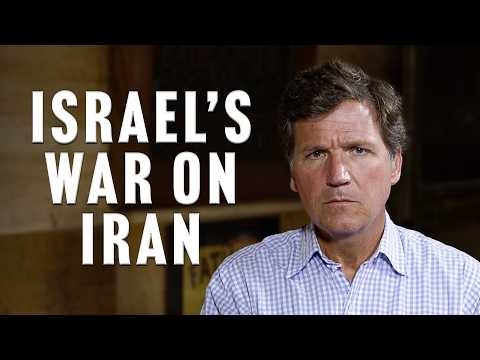
Carlson was hardly alone. For years, one of Trump's staunchest loyalists had been former Rep. Marjorie Taylor Greene, and she now took a very similar line, as did many others in that same pro-Trump camp such as Alex Jones, Megyn Kelly, and Dave Smith.
Joe Kent, director of our National Antiterrorism Center and considered the second-ranking figure in Trump's Office of the National Director of Intelligence, resigned over the war, becoming the highest-ranking American official to take such a dramatic step at least since the Vietnam War more than a half-century ago. In his subsequent two hour interview by Carlson, Kent explained the outrageous origins of Trump's decision to go to war, apparently made entirely through the influence of Israeli officials and pro-Israel donors and partisans, with our president never even bothering to consult our own enormous intelligence apparatus.

Joe Rogan is America's most popular podcaster and his strong endorsement for Trump during the 2024 race was regarded as a crucial factor in the latter's narrow victory. But Rogan has now completely broken with Trump over our disastrous Iran war:

Admittedly, these very sharp words by such leading former Trump supporters have so far only had limited impact upon his electoral base, which has held up surprisingly well, with a recent poll still showing 70% support among Republicans and Republican-leaning independents. I strongly suspect that the reason for this is that unlike many other countries in Asia and Europe, we have so far been spared fuel rationing or gigantic spikes in energy prices. But I think that our good fortune in this regard is only temporary, and if the Iranians continue blocking most energy shipments for another couple of weeks, the unified global energy and fuel markets will produce domestic price hikes far larger than what we have seen so far.
Another crucial factor has been that so many pro-Trump voters draw their knowledge of the world from FoxNews, and anyone watching that cable channel would be convinced that we were winning a huge, one-sided victory over Iran, with the war soon ending in a total Iranian defeat. People generally love a winner, and with FoxNews, Trump, and many of the highest-profile pro-Trump pundits of the traditional electronic media painting such a picture, most of their audience has unsurprisingly gone along.
Trump himself avidly watches FoxNews, and seems to believe much of his own propaganda. A couple of days ago, he boastfully announced that he was winning a crushing victory over the Iranians, and that after he broke their hold over the Strait of Hormuz, he might rename it "the Strait of Trump."
However, even at this early stage there were indications that the Iran war was beginning to cost Trump some significant portions of his conservative base, as indicated by a hilarious incident reported a couple of days ago, also captured in a YouTube clip.
Matt Schlapp, the head of the Conservative Political Action Conference (CPAC), stepped on a rake Thursday when he asked a Republican-friendly crowd if they'd like to see President Donald Trump get impeached.
"How many of you would like to see impeachment hearings?" Schlapp said after taking the stage during the event in Grapevine, Texas, on Thursday.
Immediately, members of the crowd began to cheer, clap and yell "yeah!"
Schlapp, who has several sexual assault allegations against him, attempted to coach the crowd.
"No, that was the wrong answer," he said. "Let me try it again: how many of you would like to see impeachment hearings?"
Once again, cheers could be heard throughout the stadium.
"Noooo!" Schlapp said while laughing nervously. "Can someone bring some coffee out?"
Prof. John Mearsheimer is one of our most distinguished political scientists, and someone always quite cautious and measured in his pronouncements. But in an hour long interview a couple of days ago, he declared that "Iran holds all the cards" in the current war, and America was facing a strategic defeat.
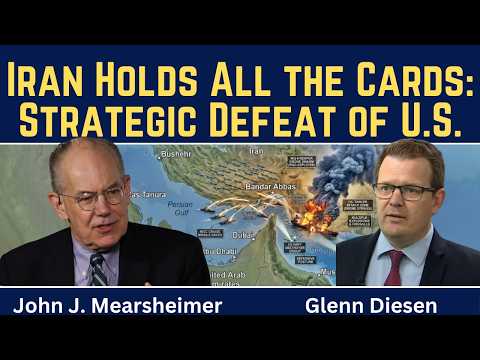
He also argued that every passing week increased the Iranian leverage as the world economy faced the prospect of heading off a cliff. Therefore, the Iranians had absolutely no reason to settle the conflict on terms that represented anything less than complete victory. Indeed, they would be "crazy" to accept any sort of compromise agreement that would allow their existential enemies a long breathing-space to prepare the next round of deadly attacks.
Although the Trump Administration had begun seeking an end to the conflict, the contents of the 15-point plan they offered Iran as the basis for a peace agreement actually amounted to an Iranian surrender. Mearsheimer found the terms offered so ridiculous that at first he assumed it was some sort of joke or satire. Apparently, Trump and his advisors had still not yet properly digested the reality that Iran was winning the war rather than losing it.
The loss of world oil supplies had already become so serious that Trump had been forced to unilaterally lift all existing sanctions on oil sales by Russia in order to increase the supply on the market. Even more astonishingly, he had lifted all sanctions on Iran as well, thereby greatly boosting the revenue of the very country that he was trying to defeat and destroy.
Subscribe to New Columns
Before the war, Iran produced just shy of 1.1mn barrels of oil per day, and sold it at $65 per barrel minus $18 discount (i.e. $47)
Today, it produces 1.5mn barrels a day, and sells it at $110 with…
Soon after Trump recognized that it would be impossible for his warships to break the Iranian blockade, he ordered a Marine expeditionary unit deployed to the Gulf, quickly followed by a second one. Taken together, these numbered less than 5,000 Marines, of which perhaps half were actual fighting troops.
Another 2,000 paratroopers of the 82nd Airborne Division were also sent there, and an article in The Intercept noted that "dozens of transport aircraft used to ferry troops and cargo have been flying out of airfields used by America's most elite commandos, including the Army's Delta Force and the Navy's SEAL Team 6," suggesting that those units may have also been deployed to the theater. A couple of days ago the Wall Street Journal reported that the Pentagon might be sending an additional 10,000 troops to join them, which would bring the total commitment of American ground forces to around 17,000.
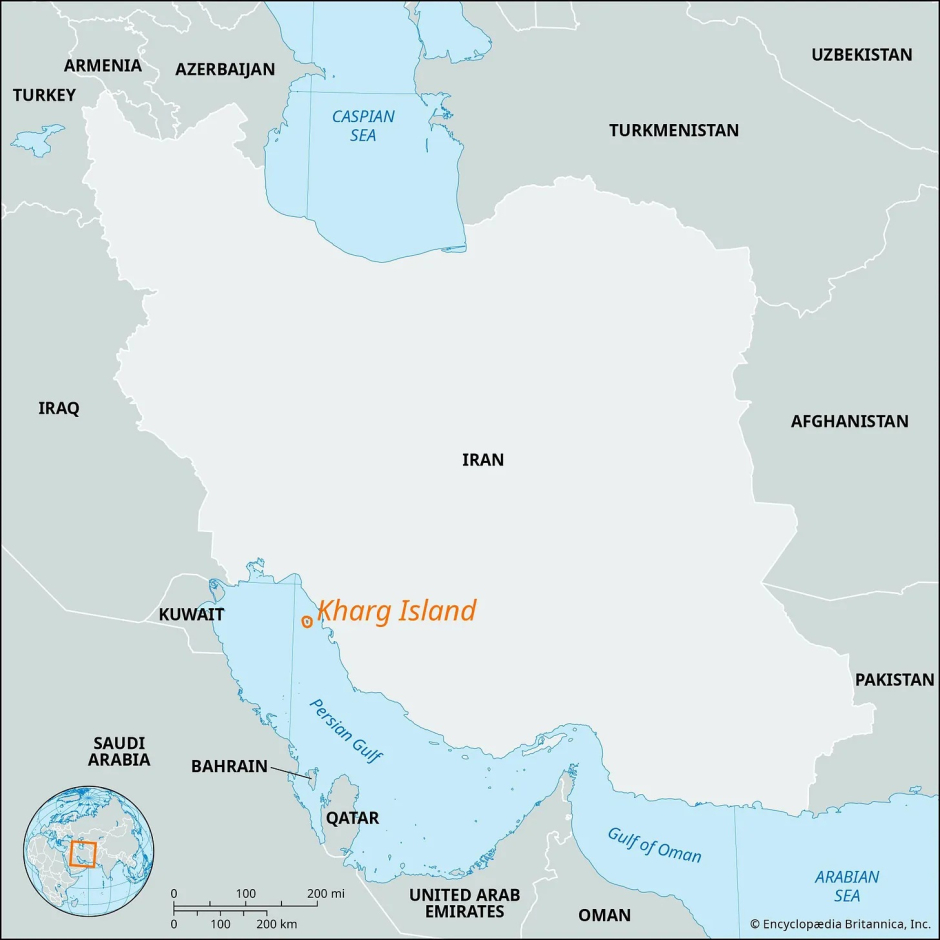
According to many media reports, Trump might use these troops to seize Kharg Island, the site the Iranians used for loading 90% of their oil shipments, and enterprising journalists discovered that Trump had been suggesting an attack on Kharg as far back as the 1980s. But according to different reports, various other small islands in the Persian Gulf were more likely to be the targets.
There was absolutely no sign that deployment of these rather small ground forces concerned the Iranians. Instead just a few days after the beginning of the war, the Iranian foreign minister had stunned his NBC interviewer by explaining that his country's troops were eager to finally face their American foes in direct ground combat.
- NBC: "Are you afraid of a U.S. invasion in your country?"
- Araghchi: "No, we are waiting for them."
- NBC: "You…
A well-regarded MAGA military analyst named Brandon Weichert considered this sort of ground operation as something close to suicide:
For exactly these reasons, Mearsheimer dismissed all this talk of employing ground combat troops as ridiculous. In each of our two wars against Iraq, the invasion forces had numbered many hundred of thousands of troops and the preparations had taken a half year or longer, while Iran was a country three times larger in size. Seizing the islands in question would be difficult, and even if that effort succeeded, it would have no significant impact on the course of the war. So he couldn't imagine that these plans would actually be implemented.
But in reaching that realistic conclusion, Mearsheimer may have failed to properly consider some of his own analysis. One point he repeatedly emphasized was that as countries and their leaders grow desperate, they may turn to extremely reckless strategies, hoping to redeem their losing position with a single roll of the dice. Occasionally these risky gambles succeed, but far more frequently they utterly fail and result in total disaster. But this historical lesson should have been applied to the possibility that Trump was planning to introduce American ground forces, hardly the only terrible decision made by our thoughtless president.
I had been equally dismissive when the initial reports appeared in the media, but now that they have been steadily circulating and expanding in size and detail for almost two weeks, I think they should be taken very seriously. As I explained in a comment a few days ago:
I really get the sense that Trump just said "Send the Marines to seize Kharg Island!" Hegseth said "Will do!", and the military men have been ordered to try something that doesn't make any sense.
We had recently published an article analyzing this assault scenario, and I would especially recommend a long podcast discussion by military experts Lt. Col. Daniel Davis and Cmdr. Steve Jermy of the Royal Navy. These latter two individuals had been among the first analysts to raise doubts about whether the war with Iran was going well, thereby considerably enhancing their credibility.

The most obvious point is that although Marines together with their amphibious landing craft had been sent to the region, attacking any of those islands by sea was totally impossible. They were located well past the Strait of Hormuz, and we had already recognized that any heavily armed warships sent there would almost certainly be sunk by Iranian missiles and torpedoes. So landing craft packed with troops would surely suffer the same fate, with all the thousands of Marines they carried either drowning or being captured and held as POWs. Therefore, any attack would have to be by air, as was also suggested by deploying units of the 82nd Airborne.
However, that scenario also seemed quite difficult. Large-scale parachute drops over enemy-held territory had almost completely gone out of fashion after World War II. Although our units still probably trained in those tactics for tradition's sake, trying such an attack in real life for the first time in decades would be extremely perilous. So the initial airborne assault would presumably be undertaken with helicopters or tiltrotor Osprey transports until a large landing zone had been secured for the possible use of cargo transport aircraft.
But even this approach seemed fraught with risk. Counting the regular military and the IRGC, the Iranians had an army of nearly a million men, and faced with ground combat they had now mobilized another million of their reserves. All those islands presumably had small garrisons of Iranian troops, and weeks of media discussion of planned American assaults had surely led them to be further reinforced and prepared for combat. The Iranian defenders would be well-equipped with manpads and RPGs, so any incoming helicopters or other transports would be at serious risk of getting shot out of the sky.
These problems would certainly continue once any troops had landed. The American military units involved might be elite forces but none of them have had any experience facing the modern drone warfare that has evolved during the Ukraine war, while the Iranians had an enormous arsenal of such weapons and these could surely inflict heavy losses upon the American invaders. Our strategic radars in the region had been very well protected and they had been overwhelmed and destroyed by waves of Iranian drones, so light infantry would certainly be vulnerable. Hitting targets far outside Iran was obviously much more difficult than hitting those on Iranian soil.
One of our aircraft carriers has been driven from the theater and the other is operating at extreme range for fear of Iranian attacks. The same was true for our land-based aircraft, which required refueling by aerial tankers to reach the battlefield, limiting the time they could spend on close air support.
As experienced military professionals, Davis and Jermy especially focused upon logistical problems, and they emphasized that any troops we successfully landed on those islands would have a very difficult time getting resupplied with ammunition and food, or having their wounded evacuated. Any such flights would be at constant risk of being ambushed by the manpads of the hidden and dug-in Iranian defenders.
My impression is that many decades of our recent wars have accustomed American troops to acting as if they had access to infinite supplies, so they might quickly exhaust their limited ammunition. Meanwhile the local Iranians would presumably have very large available stocks of pre-positioned munitions and food.
Therefore it hardly seems impossible if after a week or more, the American troops might be so worn down by the constant drone and missile attacks and so short of ammunition and food that they might be forced to surrender to the far smaller number of Iranian troops on that same island. If our soldiers were out of bullets and they couldn't easily be evacuated, what else could they do ? The obvious historical analogies of the Fall of Singapore and Dien Bien Phu came to my mind.
Wars have always been filled with dishonest propaganda and wishful thinking, and producing such material has become far easier with the recent advent of powerful AI systems. Less than one week after the beginning of the current war, Twitter and other social media outlets were flooded with claims that a large unit of American special forces troops had been sent into Iran, defeated in battle, and then taken into captivity. Just one of those posts was retweeted thousands of times, attracting some 2.8 million views.
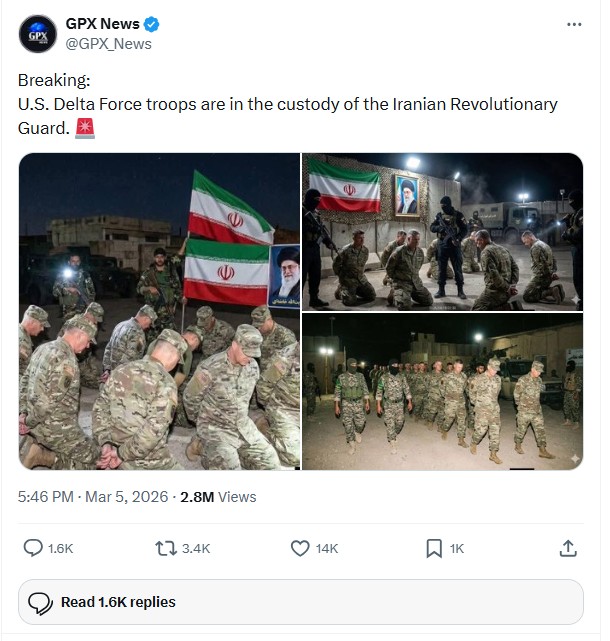
Various fact-checking sites quickly determined that the images used to authenticate those claims had been generated by the Gemini AI system, and the Tweet was soon deleted, resulting in great embarrassment for those who had gullibly swallowed such a ridiculous story. But, if America does land many thousands of its troops on Kharg or any of the other Iranian-held islands in the Persian Gulf, those same scenes might soon be repeated in real life.
After about a decade of our major combat operations in Vietnam, the North Vietnamese had accumulated hundreds of American POWs, most of them being pilots who had been individually captured when their planes were shot down. So if the Iranians captured similar or even larger numbers of Americans in just a couple of weeks of ground combat, we should suffer enormous national humiliation.
Alastair Crooke has spent decades involved in the Middle East, first as a senior MI6 officer and later as a British diplomat. In a long interview a couple of days ago with Lt. Col. Davis, he emphasized that the killing of so many top-ranking Iranian leaders together with their families meant that Iran would refuse any sort of compromise with America and instead hold out for ultimate victory.
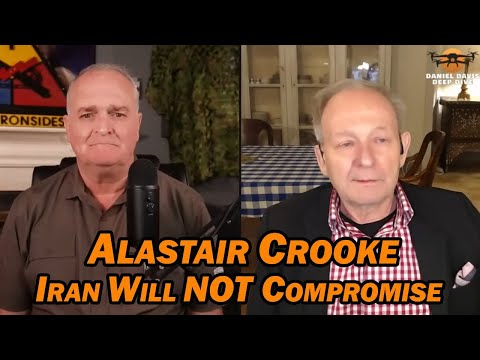
According to Crooke, Trump seemed increasingly divorced from the reality of how the war was going, bombastically declaring at a televised Cabinet meeting that the Iranian missile forces had been completely "obliterated." Meanwhile, a FoxNews correspondent based in Israel reported how that country was being hit with several successive waves of ballistic missile strikes every day.
Crooke noted that prior to the Islamic Revolution of 1979, Iran had generally been seen as the dominant power in the region. The results of Trump's war might easily return Iran to that powerful position, while completely debilitating or even eliminating some of the Gulf Arab monarchies that were taking the other side of the conflict.
For example, the Kingdom of Bahrain had once been part of Persia and although its population is overwhelmingly Shia, it has been ruled with an iron fist by a Sunni monarch, so the Iranians might reincorporate it into their country. The citizen population of the United Arab Emirates (UAE) is little more than a million and since it has supported the American attack, Iran might also seize it in retaliation.
One excuse for Saddam's 1990 invasion of Kuwait was that the small oil-rich state had traditionally been regarded as an Iraqi province. With Iraq now ruled by Shias closely aligned with Iran, if Kuwait allowed itself to be drawn into the war, it might be invaded and reannexed by the Iraqis. Such an action would completely reverse the outcome of our victorious 1991 Gulf War that had marked the beginning of America's unipolar moment.
As had long been expected, the Shia Houthis of Yemen have now entered the war on Iran's side, firing ballistic missiles against Israel. If they resume their successful past blockade of the Red Sea, the result would be a devastating additional blow to Persian Gulf oil and LNG traffic, eliminating the portion of Saudi exports that had been diverted to that other route. Furthermore, the Houthis had spent years fighting Saudi proxy forces, and they might now choose this opportunity to go on the offensive against that country, perhaps coordinating their attack with an Iraqi Shia invasion from the north. Although the Saudis are overwhelmingly Sunni, their 10-15% Shia minority is heavily concentrated in the area containing its major oilfields.
Many prominent advocates of the war against Iran had argued that the planned attack would drastically alter the political map of the Middle East. With Iran having apparently now gained the upper hand, there are growing indications that this prediction might indeed come true though not in the sense originally intended.
In his interview, Crooke suggested that Trump appeared disconnected from the reality of the war he had begun, and a couple of days earlier Prof. Jeffrey Sachs had also suggested the same thing. Sachs argued that Trump seemed to have become clinically delusional in his inability to accept the looming American defeat he faced.

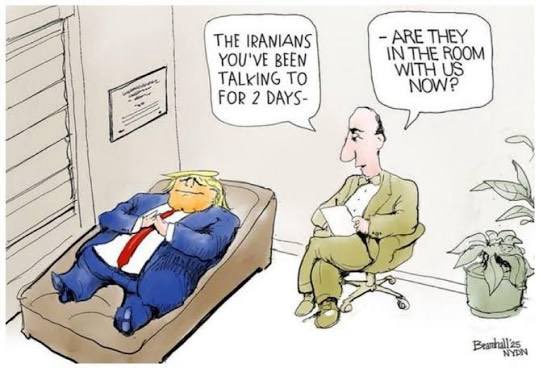
Instead, Trump repeatedly claimed that he was successfully negotiating with the Iranians and they were close to accepting most of his demands even as the Iranians emphatically denied that they were willing to talk with Trump or any of his representatives.
This complete disconnect between Trump's public statements and the apparent facts led to the widespread circulation of cartoons and memes on social media that ridiculed Trump.
In another extremely strange episode, Trump interrupted a cabinet meeting on the war with Iran and numerous other crucial national matters by devoting five minutes to discussing the details of the fancy pens that he regularly gave out as souvenirs.

Veteran journalist Michael Wolff has long cultivated numerous sources close to Trump and based upon these he has published a series of major bestsellers, so he probably has acquired a better understanding of our current president than almost any other writer. Therefore, I was quite interested when I stumbled across a harshly candid interview he gave a couple of days ago.

According to Wolff, Trump insiders have described our current president as just being an idiot who barely ever reads or understands anything. Based upon Wolff's claims, Trump may actually be less intelligent than most of the voters who put him into office. I began to wonder whether he was so friendly with black rap-stars because their IQs might be in the same range.
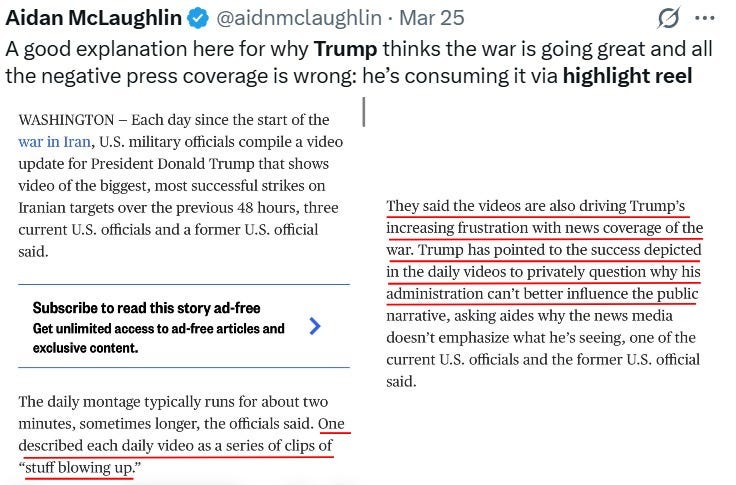
In support of this striking possibility, the media has reported that Trump's understanding of the state of the war may mostly be based upon a daily highlight video reel he's been receiving, one that shows the explosions of our biggest, most successful strikes on Iranian targets. So instead of being totally delusional or dishonest, many of his strange statements may be because he's just so stupid that he believes whatever his various aides are telling and showing him.