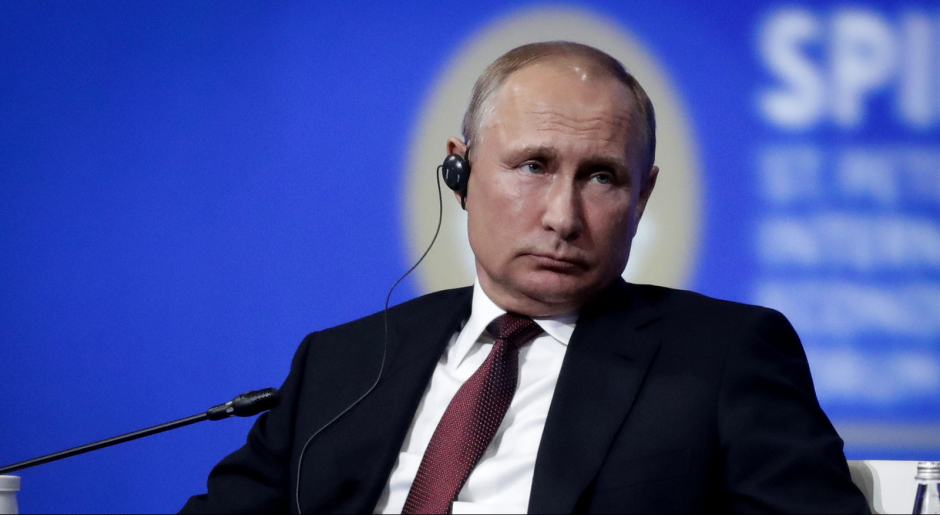
While it may have been able to take out Ayatollah Khamenei, the U.S.' plans for regime change in Iran are not going as smoothly as they expected. With the Strait of Hormuz closed, the global economy is facing meltdown, and Washington's allies are rapidly distancing themselves from the U.S. Meanwhile, facing an energy crisis, European leaders, openly refusing to participate in President Trump's war, are already discussing normalizing relations with Russia and ending their participation in the Ukraine War.
Iran's closure of the Strait of Hormuz appears to have caught the Americans off guard. Already, the prices of energy, metals, fertilizer, and other key goods is spiraling out of control, and any prolonged closure threatens to doom the world economy. Around one-fifth of the planet's entire oil and gas supply travels through the narrow sea passage between Iran and Arabia, making it one of the most important choke points in the world.
Major MiscalculationTrump himself appeared panicked at the prospect. Speaking with reporters, he insisted that reopening the strait by force was a "very small endeavor." Yet, in the same breath, he beseeched both his NATO and Asian allies, as well as China, to come to America's aid to do it, stating:
"I really am demanding that these countries come in and protect their own territory because it is the place from where they get their energy. And they should come and they should protect it. You could make the case that maybe we shouldn't be here at all, because we don't need it."
He added that, "We're doing it [bombing Iran] for some pretty good allies we have in the Middle East," a statement that could be read as an allusion to Israel.
Yet no major allied nation has announced it will take part in the operation. Indeed, most have categorically refused to do so. Prime Minister Mark Carney, for example, was adamant when he stated that, "Canada is not participating in the offensive operations of Israel and the United States, and will not, ever."
Likewise, there has been a similar lack of appetite for destruction in Europe. "This is not NATO's war," a spokesperson for German chancellor Friedrich Merz said. "NATO is an alliance to defend the alliance area. The United States did not consult us before this war, and so we believe this is not a matter for NATO or the German government."
German Defense Minister Boris Pistorius was equally dismissive, saying: "This is not our war. We have not started it. What does Donald Trump expect a handful or two handfuls of European frigates to do in the Strait of Hormuz that the powerful US navy cannot do?"
The United Kingdom has generally been the United States' closest European ally. Yet Prime Minister Keir Starmer categorically stated that his country "will not be drawn into the wider war."
Italy, meanwhile, has refused to send its powerful navy to help Washington with its Iran problem. Not only did Prime Minister Georgia Meloni insist that Italy "does not take part and does not intend to take part," but she also ordered the evacuation of hundreds of Italian troops from the region, backing up her words with actions.
Spain, though, has offered the most resistance to Trump. Pedro Sanchez's government publicly criticized the U.S./Israeli attack on Iran, and recalled its ambassador in Tel Aviv. Moreover, it refused to allow U.S. forces stationed in its country to be used in any attack, forcing them to relocate to Germany. In retaliation, Trump has threatened an all-out trade war with Spain, threatening to do to it what it has already done to North Korea, Cuba, Venezuela, and Iran.
Perhaps most alarmingly for war planners in Washington, though, were the comments of Belgian prime minister, Bart De Wever. In an interview with local newspaper, L'Echo, De Wever stated that Trump's Iran attacks will force Europe to come to a quick and independent agreement with Russia, in order to avoid financial ruin amid an impending energy crisis. "We must normalize relations with Russia and regain access to cheap energy. That is common sense," he said, adding, "In private, European leaders agree with me, but no one dares to say it out loud. We must end the conflict in the interest of Europe, without being naïve towards Putin."
Thus, even as Trump threatens Europe, stating his administration is watching very closely and noting their actions, European leaders could be moving towards a rupture in the transatlantic alliance.
How America Threatens EuropeSome argue that they have good reason to. At U.S. insistence, NATO countries have agreed to more than their defense spending to 5% of GDP. As the United States is by far and away the leader in weapons production, this agreement amounts to an enormous cash payment into the U.S. economy.
U.S. actions in Ukraine have also led to European nations transferring billions to Washington. Previously dependent on Russian energy, after it blew up the Nord Stream II pipeline, Europe began importing far more expensive liquified natural gas from America to make up the shortfall.
The Trump administration is also openly plotting to seize Greenland from fellow NATO member, Denmark, and European leaders are offering only muted opposition to the plan.
Nevertheless, Trump's extremely aggressive foreign policy, which has included bombing seven countries in the past 12 months, kidnapping a foreign head of state, and supporting a genocide in Palestine, is increasingly seen as a threat to the safety and prosperity of Europe. And with Trump already suggesting he will bomb Iran again "for fun," and promising more regime change operations after this one, the prospects for stability of the world look increasingly bleak.

Republish our stories ! MintPress News is licensed under a Creative Commons Attribution-NonCommercial-ShareAlike 3.0 International License.