Inflation ensues.
By James Anthony
American Thinker
March 16, 2026
In Stanford marshmallow experiments, children are tested to see if they will delay taking a reward right away and instead wait for a promised greater reward. Politicians similarly can represent cronies and buy some votes now, or they can severely limit governments and earn more votes soon enough.
Major parties have done well by limiting governments, as shown by the startup of each dominating party. The Federalists (1776-1825) limited England. Jefferson's Republicans (1801-1829) were the small-government party, and then the initial Democrats (1825-1896) were. The Republicans (1852-now) started by limiting slavery.
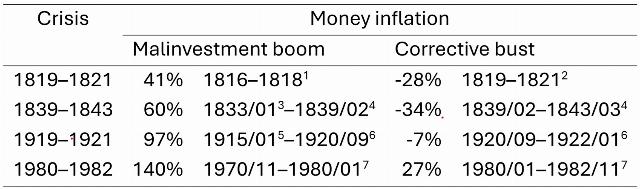
Politicians have done generally well even if they have only limited governments after crises were underway, as is shown by several crises. The changes in the quantity of money in the preceding boom and in the bust indicate both the crises' scales and politicians' changes over time.
The American colonists and then the USA people have been productive. For years, the people included many entrepreneurial farmers and other entrepreneurs, and their governments had low total spending: initially, 1% to 2% of GDP; through 1913 except during the Civil War, 3% to 8% of GDP. By 1774, people had already built up per capita income purchasing power that exceeded that of Great Britain's people by 68%. People bought imports. All along, people's productivity, the overall investment climate, and people's buying of imports brought considerable foreign investment, lengthening booms then as they do now.
Meanwhile, all along, politicians committed a fundamental error - which has violated the Constitution since the Constitution has been in effect - of allowing banks to hold fractional reserves and create and loan out money. This practice makes banks unstably prone to fail when some borrowers start having trouble paying back loans or when depositors en masse make runs on banks during which they withdraw more funds than banks hold in reserve.
The 1819-1821 crisis was caused by gradually creating a considerable percentage of the total quantity of money. Malinvestments, borrowers, and banks then failed, quickly destroying close to as large a percentage. With less money then available, producers decreased prices and wages. Customers earned less, but import prices were the same, so customers bought fewer imports. (Notice that people adjusted their purchases on their own, without politicians increasing tariffs.) Nominal loan balances and payments suddenly took far greater purchasing power to repay than originally agreed upon.
Politicians continued their fundamental error of allowing banks to hold only fractional reserves and create and loan out money. Some of Jefferson's Republicans talked about preventing future creation and destruction of money by changing to constitutional full-reserve money, but then didn't enact this change. In a second punishing error, Jefferson's Republicans didn't adjust nominal balances and payments back down to match the purchasing power originally agreed upon.
Overall, though, Jefferson's Republicans mostly didn't interfere with people's recovery, and this helped. Politicians' fundamental error of allowing banks to create and destroy money, together with politicians' punishing error of enforcing contracts inequitably, drove some people to bankruptcy, but those readily preventable tragedies fell on relatively few people. The rest of the people recovered quickly. As a result, Jefferson's Republicans remained in control.
The 1839-1843 crisis was similar, but with the boom and bust each longer and larger. The initial Democrats had a fundamental program to move to constitutional full-reserve money. But they didn't make this change fast enough to limit the boom, and they then also didn't equitably restore loans' original purchasing-power terms to relieve borrowers, so their fundamental hard-money program stalled politically and ultimately never came to fruition. Overall, though, the initial Democrats, like Jefferson's Republicans before them, mostly didn't interfere with people's recovery. Despite this crisis's increased severity, production and employment both continued. Given the Democrats' fundamental error and punishing error, the enduring toll, and stronger opponents, the Democrat president, Martin Van Buren, didn't win subsequent elections. But his Democratic Party kept competing strongly as the smaller-government party through 1894.
The 1919-1921 crisis started under the politicians' new Fed. Here and subsequently, the politicians further increased money inflation, which increased the frequency and severity of malinvestments and corrections and eliminated the former healthy recoveries to money being more valuable again. In this crisis, the malinvestment boom did less for the people and instead was used by politicians to fuel war, unduly depriving persons of lives, liberty, and property. The corrective bust gave borrowers less money destruction, but now at the cost of hastening the next malinvestment boom. The Republican congressional majority was complemented by a new Republican president, Warren Harding. The Republicans did less to interfere with recovery than politicians did subsequently, and people again recovered quickly. The Republicans remained in control.

The 1980-1982 crisis was similar, but the boom and bust were larger and more inflationary. The malinvestment boom was again used by politicians to fuel war. The corrective bust now proceeded with money inflation, although later the money inflation was reduced further. The Democrat congressional majority was confronted by a new Republican president, Ronald Reagan, and under his leadership, the 1970s Great Inflation of consumer prices was cooled. People recovered quickly. Reagan was re-elected by an overwhelming electoral majority.
The Stanford marshmallow test is now thought to indicate ability to delay gratification only because the test reflects that this ability is supported by a child's cognitive functioning and environment. A politician's ability to delay gratification and soon enough receive the reward looks analogously linked to his knowledge of the benefits of delaying, and to his choices of advisers, politicians, activists, and media.
This article was originally published on The American Thinker and was reprinted with the author's permission.