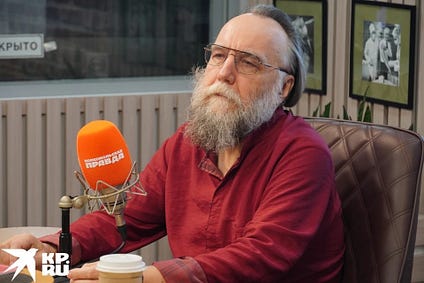
Alexander Dugin discusses whether the historic meeting between Vladimir Putin, Donald Trump, and Xi Jinping in Shenzhen signals the end of the unipolar world order and the emergence of a new system dominated by three great powers, or whether the European Union can retain its position as an independent fourth geopolitical pole.
Translated from the original Russian article here.
Three Sovereign Rulers Met
What did the meeting in China reveal from an ideological perspective?
The symbolic significance of this meeting can hardly be overstated. It is fundamental. Representatives of three sovereign centers of decision-making came together. This was entirely different from the way the West is accustomed to dealing with its vassals or adversaries: punishing those who are disobedient or have fallen out of favor, relegating them to seats at the far end of the table, imposing sanctions on them, or turning public opinion against them. The West simply has no experience of speaking to anyone as an equal.
Subscribe
Is This a New Yalta?
Why is this meeting being compared to Yalta?
During World War II and immediately afterward, the representatives who met in Tehran and Yalta belonged not to three opposing camps, but to a single camp fighting against somebody else. The sovereign leaders of the Soviet Union, the United States, and Britain, who differed in both ideology and national interests, came together in the face of a common enemy: Hitler. They defeated that enemy and then considered what the world would look like after victory. How should they reorganize the global order ? The Yalta order lasted until the early 1990s. The famous photograph of the Big Three outside the Livadia Palace symbolized the complete recognition of the Soviet Union as a full and equal member of the club of victors. After the war, the world became bipolar, divided into two camps and two systems. That meeting shaped geopolitics for almost half a century.
And what about the meeting in China?
This is a tripolar world, whether anyone likes it or not. These three leaders have made that clear. Three civilization-states, each with its own worldview, came together and spoke as equals. And they met on the territory of the power that is now emerging victorious, the power that is on the rise. Holding the meeting on Chinese soil underscores China's status. Putin has traveled to Alaska and Beijing, while Xi has visited Moscow and Washington. There may well be other visits, but for now, China has emerged as the place whose greatness and success are acknowledged by both Russia and the Americans.
Why Now?
Does the historic significance of the meeting lie in the very fact that it took place ? And in its timing?
There is a concept known as a "reality check." Everyone considers themselves the best, unique, and exceptional. Then comes a confrontation, a series of events, and it becomes clear that someone has been thinking far too highly of themselves. For almost five years now, attempts have been made to inflict a strategic defeat on Russia. Had they succeeded, the world would have become bipolar again. China is remarkably adaptable, but it is unclear how things would have turned out for Beijing without Russia. Now, however, the West has acknowledged that we have successfully defended our sovereignty. China, for its part, was already prepared to recognize this. And the timing of this reality check was right. Despite the confrontation, Shenzhen confirmed an established fact: the world is now tripolar.
Is this extremely important for Russia?
It is of paramount importance. Because the West has developed two conflicting attitudes towards Russia. One is the attitude of Trump and the current White House administration, which recognizes Russia's sovereignty. The other is that of the EU coalition, which seeks to deprive us of our sovereignty.
But China recognizes it?
Absolutely. And China supports Russia's sovereignty. So, if we recognize the sovereignty of Putin, Trump, and Xi within the contemporary world order, we have a chance to avoid war: to prevent the conflict in the Middle East from escalating, to prevent a war over Taiwan from breaking out, and to bring our own war to a victorious conclusion.
WHICH SIDE ARE THE OTHERS ON?
But the three of us are not alone on this blue planet. What about Europe?
Well, there are also great powers such as India and Brazil. They are on our side. They support a multipolar world and oppose Western hegemony, even if some members of their elites are eager to join the Western coalition. In essence, all of humanity, with the exception of Europe, is on our side. Former US Ambassador Michael McFaul, with whom I am constantly engaged in debate, wrote a book called Autocrats vs. Democrats. By democracy, he means the EU and the American Democrats. And whom does he regard as autocrats ? Putin, Xi, and... Trump ! And now he has lived to see all three sitting at the same table!
(Translated from the Russian)
Subscribe
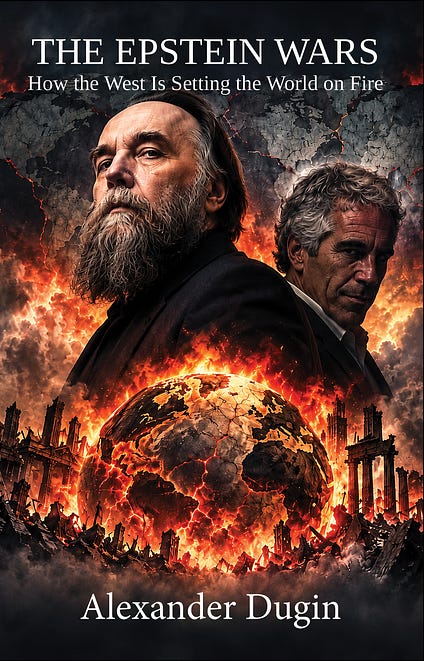
Get Alexander Dugin's new book, THE EPSTEIN WARS: How the West Is Setting the World on Fire, here.