
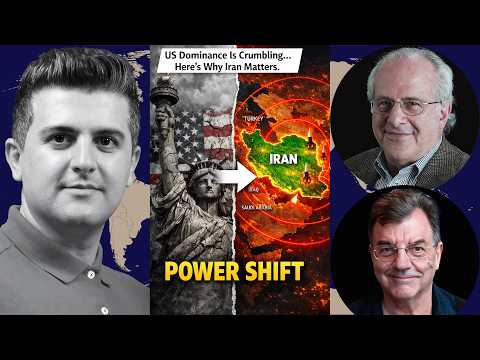
Nima Alkhorshid: Hi, everybody. Today is Wednesday, March 25, 2026, and our dear friends, Richard Wolf and Michael Hudson, are here with us. Welcome back, Rich and Mike.
Richard Wolff: Good to be here.
Nima Alkhorshid: Let me start with just updating what is happening right now on the battlefield between the United States and Iran. Moments ago, we learned from the White House press secretary, Karoline Leavitt. Hear what she said about the current state of the war against Iran.
[CLIP START]
Karoline Leavitt (clip): Operation Epic Fury has been a resounding military triumph. More than 9,000 enemy targets have been struck to date. Compared to the start of the operation, Iran's ballistic missile attacks and drone attacks are down by roughly 90%. The United States is also annihilating the Iranian regime's navy. We have destroyed more than 140 of their naval vessels, including almost 50 mine layers. This is the largest elimination of a navy over a three-week period since World War II. Again, let me reiterate: this is the largest elimination of a navy on the face of the planet in a three-week period since World War II.
[CLIP END]
Nima Alkhorshid: And let me bring what the former MI6 chief, Sir Alex Younger, said to The Economist, his assessment of what's going on between the United States and Iran.
[CLIP START— Alex Younger, The Economist interview]
Host (clip): Who has the upper hand right now?
Alex Younger (clip): Iran. I regret having come to this conclusion because, like many MI6 officers of my generation, we've faced the violence and brutality of the IRGC for most of our careers.
Host (clip): That's the Islamic Revolutionary Guards Corps.
Alex Younger (clip): So there is no love lost between us, and I shed no tears for Ali Khamenei, who was killed at the beginning of this war. But the reality is the U.S. underestimated the task. And I think, as of about two weeks ago, lost the initiative to Iran.
In practice, the Iranian regime has been more resilient than I think anyone would have expected. They took some good decisions, actually, as early as last June, about dispersing their military capability and delegating the authority for the use of those weapons, which has given them significant extra resilience against this incredibly powerful air campaign.
They have embarked on what's technically called "horizontal escalation", i.e., firing rockets at anybody within range, which at the time, honestly Shashank, I thought was nuts, but in fact, has been a very good way of putting a direct price on the US.has sort of worked. And then they've understood the significance of the energy war and held the straits at threat and globalized, and essentially not internationalized, just globalized the conflict in a way that gives them some weapons.
So, you know, they've played a weak hand pretty well. My second point is that Donald Trump has said some stuff that will have confirmed something they knew already, which is that they're in a civilizational war in their terms. They're in a war of existence. Donald Trump made it very clear that he wanted to see them up against the wall, basically. Whereas America has embarked on a war of choice. And in those terms, I think that's imbued them with more staying power than the US and, certainly, US counterparts. And they know that now. And I think that really is giving them the whip hand.
[CLIP END]
Nima Alkhorshid: Yeah, you know that Donald Trump was asking, they're sending proposals through Turkey, Pakistan, but so far, all these proposals were rejected by the Iranian side. And they have published a symbolic video responding to Donald Trump. Here is that video.
[CLIP START]
A video plays; the line "One revenge for all" appears.
[CLIP END]
Nima Alkhorshid: It says one revenge for all. And here is somehow the summary of what's going on. I want to start, Richard, with you. What is your understanding of what Donald Trump is trying to do?
Richard Wolff: At this point, I would argue that Mr. Trump's major activity is trying to get out of the very deep hole he dug himself into. It is beyond my comprehension, and I'm hoping that you, Nima, or you, Michael, can help me here. How the United States government could undertake this, what does he call it, excursion, how they could do that without going through the mental procedure ? What if they close the Strait of Hormuz ? What if that interferes with 20% of the world's oil transport ? What if that drives up the price of oil again ? They didn't do that ? They didn't prepare for that ? They clearly have no answer.
For three weeks, basically now they have no passage through the Strait of Hormuz, and there doesn't seem to be anything they can do about it. I am mystified. I do not understand, unless what we have here is really not so much a war of choice, but a war whose purpose was to take the headlines away from the Epstein case, and to take the headlines away from the fast-deteriorating economic situation here at home, inflation, poor jobs, stagflation, all of that, and focus us on an adventure which he imagined would be as headline-grabbing as three days of following the abduction of Maduro in Venezuela. And maybe he thought he could sort of have a nice version of that all over again, so that the arguments that advisors must have given him didn't make any difference. I am mystified.
But to be more direct and answer your question, I agree with you. The last line of that video from Iran says it all. This is a war of choice by the statement of our leader. It's an existential threat to Iran, which everybody knows. The last 75 years have been, with the exception of the time of the Shah, and the Shah was seen as an imposition on Iran by the United States. But other than that, it's been sabotage, attacks. Iran doesn't have to persuade anyone that it is at risk of destroying itself if it does not come up with some way to stop the United States. So you have an utterly unequal struggle here. The Americans, rich, militarily overdeveloped, and what are they going to do in Iran if their existence is at stake ? That very difference is very dangerous.
I want to remind people: the almighty British Empire decided to militarily put down the revolt in North America. No one dreamed that that would be a struggle, but there were resources that could be grabbed by the colonists here that defeated the British Empire. We are watching something that should remind people of that.
So, yes, they disperse their missile launchers and their drone airports all over the country. They have those wonderful mountains and they have this vast territory easy to hide. They can do something which has not been discussed except in a few military journals that I'm aware of that, It turns out for a few hundred dollars, you can build something that, from the electronic eye in the sky looks like a missile launcher, but isn't one. It's a decoy. And you can then, if you're the United States and you rely on electronics, you can send a $10 million missile package to destroy a $500 decoy. And then you can have Karoline Leavitt tell you, we have knocked out one of them. No, you haven't. Nothing of this sort. She's so underdeveloped in her job, she can't even anticipate what I'm saying, which she ought to have. She ought to have said something to recognize you've been knocking out lots of decoys.
And in fact, obviously, the missiles from Iran have been hitting their targets in Israel and in the Gulf states. So it seems to me that you have here a situation in which you have David and Goliath, and everybody is rooting for David. That's why it is very, very smart to end that video with not vengeance for Iran, vengeance for everyone. What it does is it cashes in on a year and a half of Mr. Trump's bullying, bullying with tariffs, bullying with threats of trade war, this assertive, aggressive, 'we're not bound by law, we're not bound by international arrangements. It's the law, you know, Stephen Miller, it's the law of the jungle that has always been'. This kind of language frightens everybody coming from the United States, which has all this nuclear and every other kind of weapon, saying we are fighting for all. That puts Iran right at the front of the anti-imperialist, anti-colonialist project of the last century and a half. That is a very powerful position to be cashing in on, and it positions the United States as the desperate one holding on.
Now, the alliance with Israel does that too, but it reinforces all that. Last thing that's on my mind. And correct me if I'm wrong here, Nima. Iran has an immense border with Russia, a land border. And Russia has an immense land border with China. In other words, China can build missiles and drones unlike anybody else, because they have an immense manufacturing foundation upon which there's no limit, literally no limit to what they can do. And they could ship that across the border, a border no one else has any access to, just them and Russia. And then Russia, having gotten the stuff from China, is in a position with its border to take care of Iran's needs for drones and for missiles forever.
In other words, you have a fantastic, ironic twist. What the United States and Europe did for Ukraine against Russia, China and Russia can now do for Iran against the United States and Israel. It's almost exactly the same. And, of course, they will. And any doubt I had vanished yesterday when I learned that the Foreign Minister of Russia, if I have this correct, gave a press conference and said his words that we may be, if I understood him correctly, at the beginning of World War III.
Well, if your brain says to you that you might be, then if you're Chinese or Russian, you are not going to let Iran be overrun by the United States, not at all. This is a big country, 90 million people in Iran. This is a strong ally whose economy is already well integrated with the Chinese in many ways and with the Russians in other ways. No, no, they're not going to walk away from this. It would be foolhardy. Especially if you think you might be at the beginning of a global conflict. And correspondingly, for the United States to be at the edge of a world war where Iran can plausibly and effectively position itself as the David against the Goliath who is enacting a vengeance for us all, this is a very powerful position. And I don't get the slightest sense that the people in charge in this country have half an inkling of what they are doing and what they are up against. And the behavior so far in this war reinforces the sense, the cluelessness of what is going on here, that it is so hard. I keep thinking, that's why I began the way I did. I want you to correct me. Am I missing something here?
Nima Alkhorshid: They don't have a common border, Richard, but they are connected through the Caspian Sea.
Richard Wolff: Okay.
Nima Alkhorshid: And they can communicate through the Caspian Sea. Michael, join in. What's your take on that?
Michael Hudson: Well, Richard has mentioned exactly the same points that I want to emphasize. The United States knew very well that Hormuz was going to be closed. It imagined that it could be the winner. Already in the 1970s, when I was dealing with national security issues, people were discussing that the first action of Iran in defending itself would be closing the Strait of Hormuz. So that was always on the agenda.
The United States believed that it would come out the winner, perhaps even before there was the current attacks, that the Iranian government would fall. That's the American illusion that there'd be a regime change because America would hurt the population. And the Iranian population, in the American military manuals, said there's not going to be any vengeance. The population will be so demoralized by our hitting their hospitals, their schools, focusing on killing their children, and that they will say, please overthrow the government and have a government that's more friendly to the United States so it won't hurt us anymore.
Well, the video you showed, Nima, is not exactly what's taught in the American military manuals, but this has been the guiding strategy not only of the United States, but Israel. And there's even right now, there's still a belief that America is winning, as you showed in that wonderful clip from the White House. Trump's idea of a negotiation, what he calls is a demand for surrender. There's no negotiation because when there is a negotiation, America kills the negotiators. The only thing you can do is have maybe a terminal, terminally ill patient in their 80s or 90s do the negotiations who can afford to give up the life and be killed if they refuse to surrender to Trump's negotiation. But of course, there's no negotiation because Iran has already stated very clearly what its demands are.
And yet, you've mentioned the White House conference. I look at the stock market. Stock market's been up all day long. They believe that Trump indeed, his promise of negotiations and surrender is going to work. The interest rates on U.S. debt are going down. The dollar is strengthening. There is a cognitive dissonance to come to terms with the fact that this is really not simply a war of choice, it's a war of America's choice that is forcing other countries to realize that, yes, this is World War III because it affects the entire world that uses energy and gas and fertilizer and sulfur, and all of this. This is a war for how the international economy is going to be restructured. Can the United States reimpose its unilateral weaponization of world trade and international finance and diplomacy on other countries, or will they become sovereign power?
And all of these, the current war isn't simply a matter of Trump's choice. It's been a choice of the United States for more than 20 years. We've discussed before how Wesley Clark in 2003 said, yes, we're going to conquer all of the Near Eastern countries, culminating in Iran. And every year, the United States military has a game plan, and it always ends up with, how do we update our conquest of Iran, where all of this is going to end up?
So this is the U.S. point of view. But let's look at, since Richard, quite rightly and you mentioned Iran, Russia, and China, and all of the other countries that are affected. The United States is confronting these countries by violating every principle of international law and the laws of war that the United Nations established in 1945. And this was the legal philosophy that Western civilization, if you can forgive the oxymoron, has been talking about for four centuries, ever since the Peace of Westphalia in [1648]. The United States principle is violating the sovereignty of other countries by weaponizing oil finance against any countries by threatening to create chaos if they pursue a sovereign policy that is at odds with U.S. diplomacy, which is based, as we've been discussing for many months now, diplomacy based on control of the world's economy above all the international oil trade. And within the oil trade, above all, control of the Middle East and the OPEC countries, because the OPEC countries represent 40% of the international oil trade.
So what's happening now is if there indeed is a fight this weekend, Friday night in Middle Eastern time, Saturday morning in the United States, the military attack that Trump seems to be organizing and which the United States has been organizing ever since 1979. That's a long time, ever since the Shah was overthrown. This is the final showdown. And there will be one winner or another. There's no middle ground. There is no basis for compromise or negotiation. This is going to be it.
And the result is going to be: well, Iran is going to defend itself by striking back. As it said, if you're going to destroy our oil resources, we'll make sure that there's no oil by the countries that have joined our attack, Saudi Arabia and the other Arab emirates. I won't call them monarchies, emirates or mafia states that are letting the U.S. use its military basis, and who have used ever since 1974, who've used all of their national savings of oil export revenues, all their national monetary reserves, all of their royal money. All of this has been invested in the United States bond market, the United States stock market, especially recently artificial intelligence stocks and U.S. banks. All of this money that they've accumulated is held hostage in the United States.
For instance, Iraq just asked, the United States demanded that the U.S. troops withdraw. The U.S. asked for negotiators with Iran. The Iraqis negotiated. Iran let the U.S. troops withdraw from Iraq without blowing them up. And then the United States bombed and killed the negotiators, which it does as a matter of course. Rule number one, always kill the negotiator if they don't surrender. That's happened again and again this year. So this is what they're basically confronted with. It's a no-hold barred.
And so the United States is going to respond by doing to the oil exporting Arab countries what it just did to Qatar's gas industry, blow it up. This will plunge the entire world into at least a five-year depression. It'll take that long for the industries to recover from the lack of gas, the lack of oil, the lack of fertilizer, the lack of helium that's used in not only in etching silicon computer chips and cryogenically, but also in the MRI machines that hospitals use. All of this is a crisis that's going to lead to the closing of major industries throughout Western Europe, Asia, and especially the hardest-hit countries will be America's allies in Japan and Korea, which are mostly dependent on OPEC oil and gas that will not be available to them. And this is essentially going to force them to drive away and to question themselves: is America really protecting us from the threats posed by China, Russia, and Iran ? Or is the United States the major threat?
The U.S. attack this weekend or next week or even a week after that is an attack, a deliberate collapse of the world economy. And of course, the U.S. planners have gamed what is going to happen when Hormuz is closed. And Trump has come right out and said it. You know, America is going to survive much better than other countries from all of this. Other countries need OPEC oil. We Americans don't need OPEC oil. All we need is all of the money from OPEC oil, all of the savings. And if we've already said that if Iraq follows a pro-Iranian policy, we'll simply grab all of its reserves that are held in the Federal Reserve as a result of our conquest of Iran under George W. Bush.
Well, it can do the same thing for Saudi Arabia or these Arab emirates that, Nima, you and I have discussed the possibility of Iran taking over these emirates, which are antagonistic to Iranian interests. Well, all of their foreign savings, the tens of billions or hundreds of billions of dollars that they have invested in the U.S. bonded stock market will be confiscated. And all of their trust for the last 50 years, their hopes of alliance and linkages with the United States will have all been for nothing. It's all lost. It's all confiscated. That's what the rest of the world is confronted with. And that's why, indeed, this is on a scale that I think you can indeed call it World War III.
Richard Wolff: Let me remind people of some historical realities. World War I was a clash of colonial powers. When the dust cleared, Europe was much weaker than it had been when it went in and the Soviet Union was created. In World War II, you had another clash of competing empire colonialists, and they destroyed what they hadn't destroyed in World War I, and China joined the Soviet Union. This doesn't work well, these world wars, for capitalism. It's a very, very bad omen if that's what we're entering into. And you know, when wars are left, when wars happen, what you're left with is the ruins. But being a ruined country like China with a 1.4 billion people allows for ways of coping that are not available to a much smaller country like the United States.
So you're going in under very bad circumstances. This would be an act of desperation trying to hold on to a bad situation and risking something even greater. Why they would imagine if they send a few thousand American troops, what are they going to do ? If the Iranians have shown anything, they've shown that they've decentralized a great many of their military and other functions. They don't need to have a central place in Tehran. The central power, which got assassinated, seems to continue to function really well. You know, to send precision missiles means your capability is not much hurt. And again, I don't know anything, but my guess is that the specialists from Russia and China have trained the Iranians or are working with the Iranians and are bringing the most sophisticated imaginable control to their drones and their missiles. And we've already seen that the Iron Dome and Little David and all those other Israeli mechanisms have not prevented the missiles from getting through. And the same is true of the American bases in the Gulf states.
So I don't know the details. I don't know if anybody does, but it's clear that the White House needs to portray all of this as a stunning victory. So there's no reason to expect anything else from them, but there's also no reason to believe it. It may be true, and then I will be working with false assumptions. But my assumption here is that it's likely that what's coming out of the White House is desperation, and what's coming out of Iran is a much more quiet, well-grounded determination that they think they can do this. I mean, it's no longer guessing. When they said, no, we're not going to respond to your 15-point proposal, we didn't request it, we don't want it, and you have to give us reparations. I mean, that's extraordinary, because to demand reparations is to demand a guilty plea. Mr. Trump cannot give them reparations without it appearing to the American public that he was in the wrong. And he now has to, that's what reparations has meant.
You know, reparations were imposed on Germany after World Wars I and II. And it was directly linked to the notion, you are culpable, you are guilty, you started the war, even though that's not very accurate historically, but it's close enough, and the winner gets to decide who the loser is and what the loser has to pay. And that is a well-developed understanding in the world to demand reparations is maybe just a negotiating ploy, but it does see that the Iranians do believe, as your clip showed, that they have the upper hand in terms of leverage now, and they can afford to do that.
Michael Hudson: I don't think reparations are a negotiating ploy. I think it's quite likely. I want to just look at the comparison of what's going to be the aftermath of this war compared to World Wars I and II. Both those wars lasted about four years, and it's quite likely that the fight is going to be so intensive, including the aftermath and the cleanup, that it's going to take four years. After World War I and II, the United States solidified and consolidated its financial power. First of all, because of the inter-allied debts that Europe agreed to pay out of German reparations after World War I. And secondly, after World War II, Europe was devastated and the United States was able to offer not only money because of all of the flight capital that had come to the United States during the Great Depression and to flee Europe as fascism began to take over there, but the United States was representing what seemed to be international principles of free trade and free investment.
Well, the aftermath of this war is not going to be favorable to the United States because the United States, instead of saving the world from the Kaiser in World War I and Nazism, Germany in both cases in World War II, in this case, the United States was the aggressor. The United States is playing today the role that Germany played in World War I and World War II. So the rest of the world's position is: how can we ever prevent this from happening again?
Well, after World War I, they created the League of Nations that the United States refused to join because it said we won't join any organization in which we do not have veto power. After World War II, the United Nations, which the United States said, we will not join it unless we have veto power. No other country can tell us what to do. And they cannot tell us to obey international law because we make the law. That is, we are the hegemon for the world.
Well, the United States has used that power now to go to war. The Iranians have already said we need a number of things. We want a Nuremberg-type commission for war crimes. We want Netanyahu to be indeed sent to the International Criminal Court. But the Criminal Court, the United States isn't a member and it's already been able to basically browbeat the court judges. There has to be a new international order that's created to deal with the aftermath of this World War III. That's what happens after a world war. You're going to need a new kind of international court. And it's obvious that the United Nations has failed. All of this buildup of the genocide from the Ukraine to Israel has not been able to be stopped. And the United Nations took a vote recently to accuse Iran of attacking and being guilty of attacking Israel for defending itself against Israel's attack and assassinations on it for years.
So the United Nations is dead. And the other countries are going to have to create a whole new set of institutions, like the United States created the Bretton Woods institutions, the International Monetary Fund, and the World Bank after World War II. The countries that emerged from the war in a state of their own economic depression, saying we never want to subject ourselves to the United States policy of using the only thing that it has to offer, the offer not to destroy our economies, not to kill our leaders, not to overthrow our governments with regime change. The only defense we have is to isolate ourselves from the United States, which means isolating the United States itself.
Now, once you've isolated the United States and Iran and other countries that are attacked by the United States can make their claim for reparations, these will be paid much in the way that German reparations were paid after World War I. You seize German holdings throughout the rest of the world, just like America has grabbed Russia's 300 billion of foreign exchange in Belgium, just as England, at America's direction, confiscated Venezuela's gold because the United States said Venezuela did not elect the candidate that we wanted to be elected. Just as America confiscated Iran's holdings after the Shah was overthrown, other countries now can turn the tables. America will be stripped of its foreign holdings.
And America in turn will say, well, then we're not going to pay our foreign debts. Other countries will have to accept the loss of that, but the loss of that will be essentially to make a break from the American investments in their countries and from the whole world order, the tax system, the debt system, the trade system that America has weaponized in its favor. All of that is going to be gone. That is what's going to make the aftermath of World War III so important. And any, as I said, any world war has an aftermath of a new international, economic, and commercial and monetary system. And that's, I think, what is already being envisioned by Iran, whose foresight was able to see where all of this was leading and that has been taking all of the investment over the decades to protect itself militarily. And then to get back to the point that Richard made at the start about the missiles, saying the happy talk of the White House and Trump's spokesman saying 'look, Iran is now sending fewer missiles than it's sending before. I guess it's running out of them.'.
Well, of course, Iran is sending fewer missiles because most of these missiles were decoys to force the Israelis and the American military to use up all of their anti-missile defenses. There are no more Golden Dome in Israel. There's no more American THAAD missiles or the other missiles to defend. Iran doesn't have to use the missiles that it was using before. And these were old generation missiles. Now Iran has the sophisticated missiles that it has not shown yet, the hypersonic Sidewinder missiles that can avoid any kind of defense. Now Iran is finally going to move towards solving the conflict on the battlefield. It cannot be solved diplomatically. Iran will solve it on the battlefield. And Nima, every general and every military analyst that you've had on your show explains how the military advantage is with Iran, not the United States. And I haven't heard any defense of the United States.
But as Richard says, the United States is desperate, or rather, Trump is desperate. Here is the plan that he's imposing that's been worked on by the United States military for 50 years. It's the only plan they have. It's all or nothing. And when you're desperate, very much like when you're gambling at a casino and losing, you bet it all because there's really no alternative. That's the corner in which the United States has painted itself militarily, economically, and financially. And that's what all of this discussion should be about. Is the world going to prevent this from ever happening again by isolating the ability of the United States and Israel as the new versions of Germany and World War I and II as the aggressor nation?
Richard Wolff: I'm also struck by what seems to me the final collapse of NATO. I mean, here the United States is undertaking a war very close to Europe. It's not Europe, but very close to Europe. In European conversations and discussions of this war, one of the great anxieties expressed by the European countries is that if this war goes on for a while, it will create what other wars in the Middle East have created, which is millions upon millions of refugees, of migrants, people leaving. And where are those people going to go ? And the answer is: if they're going to go where their economic prospects are best, they're not going to go to the Gulf states. There are missiles coming down there. They're going to go to Europe. That's where the jobs maybe are. It's where the income maybe is. They're not naive. They've heard the stories. Plus, for years, Iranians in huge numbers have created communities in all the European countries and in the United States and Canada.
I remember visiting with Iranian friends in Los Angeles who told me that, you know, that's perhaps the biggest community of Iranians anywhere in the world outside of Iran itself. Okay, if Europe is worried that they're going to have millions of immigrants, and let's remember, the only way the political leaders of Europe now stay in power is by being anti-immigrant. That is, they have that almost all in common, some more, some less. They can't handle politically or any other way. For the United States to have risked attacking on Iran, provoking the war that could lead to a massive migration into Europe means that there's a special bitterness among these leaders in Europe that the United States has put them at political risk.
You know, this is on top of the risk of energy prices that force a deindustrialization, that their crazy behavior towards Russia creates an immense enemy on the edge, etc. No wonder the defense minister Pistorius in Germany said, We're not participating in this war. We will not participate in this war. Nobody consulted us about this war. Okay, but then how are European leaders and their people supposed to take seriously NATO ? This is a problem for NATO that NATO was not allowed to even discuss, let alone. You can't do that. You can't do that. What that does is make your NATO into what the Chinese would call a paper tiger. Looks like something, but it's all paper. There's no substance there. And I think this is extremely bad.
You know, the center-right politicians of Europe, most of them, still try to hang on to being subservient to the United States. And the United States keeps kicking them. You know, if you're the NATO partner, then how is it possible for the president to hit you with a tariff without even the formality of a conversation ? Here, we're going to hit you with a tariff, or here, we'll lower the tariff, but you've got to give us a lot of money in this way. What?
And now, this, we are now going to go to war in Iran. That's going to mess up your energy situation seriously because you need the Strait of Hormuz to get the Middle Eastern oil to you. And we're going to threaten you with a horde of immigrants. This is incredible that you're doing it, but that you're doing it one-sidedly. Now you see the hostility. It's not just lack of respect. There's a lot of hostility to Europe. They don't mind seeing Europe collapse. Their sense of their invincibility is extraordinary. And it does remind me of delusion in the ranks of Mr. Hitler and the German army as what you could invade Russia and you could invade Poland and you could. No, you couldn't. You couldn't. You couldn't do it. And in the end, that's what defeated you.
Michael Hudson: Richard, you mentioned the possibility of flight of population from the Middle East into Europe and other countries. And that made me think of something. What about the Israeli migration ? It looks like the Israeli economy is going to be pretty much destroyed. And a lot of the population may be destroyed. It looks like Iran is going to pretty much end due to Israel, what Israel wanted to do to Iran. Where are all they going to go ? What country is going to take them ? This will be like when the German Nazis were moved to the United States or under U.S. protection in Argentina and Latin America to become part of Operation Paperclip when America absorbed the Nazis and used them as fighting against communists. What will the reaction of European and American populations be to Israeli immigrants compared to Arab and other immigrants that are affected by the U.S. wars ? What do you think?
Richard Wolff: Well, I don't know. I haven't asked myself the question, but one of the first things that has to be faced, if my understanding of Israeli history is correct, that in a sense, the difficulties that Jewish people had in Europe is part of what created Zionism, the notion that there can be a safe place where you wouldn't be the victim of wrongs and all those other anti-Jewish outbreaks that went on for centuries in Europe. And then the British, who didn't want the Jews to settle there in particular, gave them a piece of their empire. I mean, that's where the Palestine story starts. The British, feeling that they controlled that area rather than the Palestinian people who lived there, created this space and said, okay, you can go there. And you had, you know, whatever, half the Jews of the world or whatever the percentage was, found their way in the hopes that it would be safe.
But it isn't safe. And they should have understood it from the beginning. If you're the implant of a colonial power, this is not the way to begin. And that's why the early years of Israel, very violent struggles with the Arab communities around them, and the long history of enmity. And they think now that by using military force, they're going to solve that problem ? I don't think so. I don't think that kind of problem ever gets solved that way, unless you literally obliterate. And I'm afraid that that may be the conclusion that the Israeli government has come to, that the only way to survive for Israel is to do to the Palestinians, what we call the United States did to the native people it found here. It killed them all, you know, except for the small, tiny handful stuck in reservations, etc., at this point.
But in terms of the basic population, it was pretty thorough ethnic cleansing. And I think the Israeli government has reached the conclusion, a little bit, you know, like the Iranians. They don't want another 50 years of continual vulnerability to attack from the United States. They've spent 75 years in that situation, with the exception of the Shah, whom they hated for other reasons. They don't want this anymore, which I understand. And they don't want to have that risk. The Israelis feel probably more or less the same, feel at risk, but have turned to the extreme right to try to solve the problem by obliterating the Palestinian people. And that's a project they can't accomplish. And so what you have is horrible, continual stasis. By the way, there are recent stories from the West Bank are as horrible in their way as the Gaza stories were before.
So this process continues its evolution. And Israel must be hoping that somehow this gives them at least a little more time. And it may, but it will give them more time at the expense of even more enmity and more loss.
Nima Alkhorshid: Yeah. Michael?
Michael Hudson: The foundation myth is one of vengeance. It's vengeance against the Europeans and especially Russia, meaning Ukraine primarily, for the anti-Semitism. And instead, the result of anti-Semitism that created Zionism, there were two results of this anti-Semitism. In America, especially by the German Jews who came here, they wanted to escape from ever being isolated and faced with anti-Semitism again by assimilating, just as the Jews assimilated in Spain after the Catholic attacks of Ferdinand and Isabella to drive them out. But the other response to anti-Semitism was to become a mirror image. They hate us, we hate them. We are going to have vengeance against them. They led for vengeance, and that was the philosophy of it's us versus them. That's what led the Zionists to want to exterminate the Palestinians in Gaza. And as you just pointed out correctly, they're doing the same thing in the West Bank now. Applauded by England, applauded by Germany, that have banned all criticism of this genocide.
Well, just imagine now, these countries are going to accept a huge Israeli exodus to them, and the Israelis are going to use this same hatred that they had against Russia when they became the neocon class in the United States. They will become the equivalent of Trump's MAGA group, merging with the nationalistic right-wing groups in Europe to make it anti-Islam, anti-Russia, anti-Chinese, anti-Asian. You're going to have the same hatred, the feeling of treating others as subhumans that you had the Americans treat the Native Americans with, the Israelis treating the Palestinians with, the Ukrainians treating the Russian speakers with. All of this is now going to characterize European politics and possibly American politics too, if there's a huge exodus here.
Nima Alkhorshid: I think if you're interested to know about more about Zionism, you can. I have a very great guest on this podcast, Yakov Rabkin. He's an academic in Canada, who's a Jewish academic. He talks about, you know, extensively about what is Zionism ? And he said something so amazing about what is going on in Israel. He went there and he talked with many people in Israel. He said that many of these people, religious people who are living in today's Israel,they're connected to the land. They don't care if the country is Israel or Palestine. They want to be there and live there. And they're going to be part of any government that would overcome that region and they're going to live there for the rest of their lives. And this is the reality. I think the land was used for many years for Muslims, Jews, Christians all together. And it's somehow complicated.
Michael Hudson: Well, a lot of religions have as their center, how do we overcome this feeling of vengeance ? And you could say that was one of the problems that ancient civilization dealt with. The law of retaliation, the idea, well, that's how monetary exchange came into being. Instead of retaliating and having a feud, if your family injures one of ours, we will retaliate by killing or injuring one of yours. This is the law of Talion, and that's how they made their guilt. Well, we'll settle it by means of payment. The idea of ancient civilization: how do we escape from this cycle of vengeance ? I think Iran has largely escaped from that. The Iranians I've met over the decades, I don't see any sense of vengeance there. How do we avoid this law of vengeance ? Well, of course, they have to retaliate against their attack now. Of course, they have to respond.
But the question is: how do you lose your humanity by saying it's us versus them ? Everybody not in our clan, everybody not in our religion, everybody not in our race is an enemy and a sub-human. How do you avoid that fight against civilization ? That fight against civilization that is led by the United States value system, Trump's hatred of the immigrants, his hatred of the non-Americans, as if they're just as much subhumans as the Ukrainians accuse Russian speakers of being, or as Israel accused the Palestinian being. It's a mentality, and it's this mentality that has been that civilization for 5,000 years has tried to overcome and prevent from just turning and making religion into a whole religion of vengeance and war and the whole damage to the personality that you see occurring in all of the youth in Israel, for instance, of the prison rapes, the rapes of women, the focusing the American policy of let's bomb the schools and the hospitals in Iran, first of all, to demoralize the population. This is an attack on civilization, and that's really what's at stake right now.
Nima Alkhorshid: Yeah. Richard, adding something before wrapping up?
Richard Wolff: The only thing I would [add], here's a dimension that maybe is appropriate for our next conversation. I often think, I'm not sure of this, but I often think that in the end, what will happen will be that the internal costs to the United States economy will be so severe that the people on the one hand, but the employer class, on the other, will want to see Mr. Trump go. That he has become, you know, if you like, a burden or a luxury you can no longer afford. And here's what I mean. I'm not talking about the levels of income and wealth inequality, although they are off the chart in the United States and getting worse literally every week. And that eats at the way this country works. But just a little arithmetic. He wants to raise a defense budget to $1.5 trillion, which he would have to do if he's going to make good on his threats to Cuba, his threats to Colombia, his threats to Venezuela, Greenland, Panama, and Canada. And I'm sure I've left something out, but so he asked for an increase of $600 billion.
Now, for the war in Iran, he's asked for $200 billion more. So that's eight. Six and two, that's eight. The military budget this year is nine. So he's almost doubling it in one year. And we already spend more on defense than the next eight countries combined. Last time I looked at that statistic. So is there new revenue ? Well, the answer is no. The big beautiful tax cut reduced revenue to the government. And the tariffs, which brought some, have now been declared unconstitutional, with the people who paid them demanding refunds, which I'm sure they will get. So there's no new revenue to speak of, and at least $800 billion of new spending that he's committed to and that the Republicans will give him. All right, there's no way on earth. Where is he going to get this money ? He has to borrow it.
But with a AA rating, the interest rates that will be demanded, will be higher than what we have now. In other words, the Federal Reserve, which has begun this conversation, is not going to cut interest rates in the second half of this year as they had originally planned to do. And remember, that's why Trump went after Powell to get rid of him, to get in Mr. Walsh now, who will do this quickly. No, now the Board of Governors is saying we expect an inflation from the pass-through of the energy prices, and therefore we're going to raise interest rates. Holy mackerel, there goes your stagflation.
They were going to slow down the economy while we have inflation, and the government is going to be forced to borrow and pay these higher interest rates. It's going to drive the population crazy, but it's also going to drive the employer crazy because this level of disruption with a down cycle and with all the private credit that nobody knows quite where it is and how secure it is, which means it's not secure because that's why it was created to escape the regulations. I think you're setting up for some very serious domestic economic problems. Axios and some of these other services are now talking off using the following phrase. Question: Is Mr. Trump leading us over the edge of a fiscal cliff?
Well, that's their way, you know, Keynesian economy, monetary fiscal policy. But they realize we are not looking at it. The Congress is full of exciting debates about Iran, but here's a simple way of understanding it: we can't afford Iran, and that's a problem. We can't afford this grandiose gesturing, we can't do that. And if we try, the internal economics of it are going to be, I think, extraordinarily disruptive.
Michael Hudson: Richard, for the whole, the whole purpose for the right-wing in the United States is to create a fiscal cliff. That's a godsend. It's the same reaction here is going to be what happened in Germany and in England. What are you going to do to fund for all of this military spending ? Cut back social spending. You're going to cut back the social programs to balance the budget. And this talk of inflation is junk economics. A great depression is not inflation. It's deflation. When, as you've just correctly said, what's going to happen is mass unemployment, impoverishment, people losing their jobs. As we've been discussing, the fall in industrial employment in America during the first year of Trump's second term, down almost 100,000 last year. We're going to have large-scale unemployment here in Europe.
Just yesterday, Mercedes, the car company in Germany, said we're getting out of the car business and going into the arms business. That's the future. You're going to have the whole economy moving away from producing goods that are used by consumers, meaning wage earners, to be used by the government. There's going to be a drastic decline in living standards, an increase in polarization between wealth at the top of the pyramids and the increasingly indebted population in the United States, Britain, Germany, France, and the European countries of families that cannot afford the higher heating costs, the higher gas costs to drive their cars. They're going to fall behind in their budgets and have to borrow even more money from the credit card companies, the banks, and the debt crisis will be increased. This is the dream of the upper 1%. This is the culmination of the class war.
Richard Wolff: Yeah, but you know, in the end, they need the mass of people. And if they keep squeezing that mass of people, there will come a time when you will get the push back. I think they're afraid, they're becoming afraid of that. I think they watched here in New York City telling everybody, don't be crazy and vote for a Muslim socialist. And the mass of the people basically said, you know, go, we don't care about you. The rich people will all leave. No one cared. It wasn't true, but the point is, nobody cared. We're beyond that kind of control. And I think we're at that point now that I don't think you can push the Americans into a depression now without getting the kind of reaction you had the last time you pushed people into a depression in this country in the 1930s. You had the CIO and the explosion of two socialists and one Communist Party that suddenly became politically powerful in this society. And it's not that people remember that, they don't.But I didn't make that up. That is what happened.
Michael Hudson: Well, that's why Trump and the Republicans are changing the election laws. So that it won't matter who the Americans vote for. And that's why they have the Democratic Party just as right-wing as the Republican Party and making sure that supporters of Mamdani or Bernie and the other socialists don't have any voice at all within Congress, in either party. So you're having, I guess, what used to be called fascism.
Nima Alkhorshid: Thank you. Thank you, Richard and Michael, for being with us today.
Michael Hudson: I hope they didn't just get you banned from the YouTube.
Nima Alkhorshid: See you soon.
Transcription and Diarization: scripthub.dev
Editing: JC
Review: ced
Photo by Rafael Garcin on Unsplash