
12.04. 2025
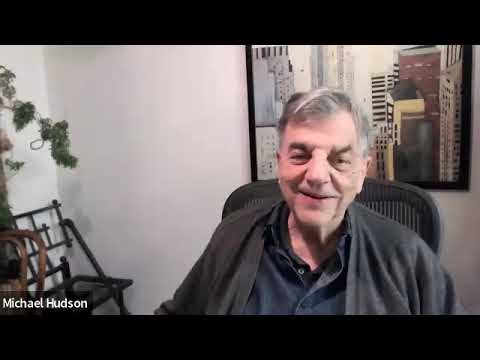
KARL FITZGERALD:Welcome, ladies and gents, to the Hudson Roundtable, where we have our Patreon supporters, Michael's Patreon supporters (please join us), coming on screen to ask the questions that need to be asked. I like to think that these discussions, of which we've had about 16 now, are some of the most in-depth Michael conducts. So, yeah, great to have you all here and so good to be with the living treasure, that is Michael Hudson. Michael, this, I think, is our 18th year of doing similar interviews over various formats. And usually, at the end of the year, we sort of do a wrap-up on what has happened this year. Has anything changed ? What do you see as the defining trend of 2025?
MICHAEL HUDSON: Well, Europe is falling apart. Just I did a show today on Nima's show. Just reading the newspapers. Yesterday's Wall Street Journal said that had one breakdown. My mind is a blank right now. I took a nap before to prepare for this. So my brain is working, but my memory is just what on earth did I talk about with Nima's show today.
The Financial Times had a great article a few days ago saying that Europe has to break away from the United States and otherwise Trump is just going to keep upping the ante and Europe has to find some country to trade with that won't weaponize its imports by threatening to close the market and cause chaos. Well, that's from the Financial Times, not from me. And I forget what the Wall Street Journal was talking about, but it's something. Oh, electricity. How the German electricity prices are something like 46 cents a kilowatt hour compared to 16 cents in the United States and 12 cents in Canada.
Germany has the highest electricity rates in the entire Western world. And the Wall Street Journal said this is all the result of Europe backing the green economy. It's all a result of their hope for wind power and solar power. Not a word of the fact that their electricity is high because they've stopped trading with Russia. And that's all meant to keep the U.S. in control of the oil trade, which the U.S. has tried to do this year by attacking or preparing to grab the oil voluntarily or not voluntarily from Venezuela to control that. And that's the largest oil reserve in the world, even larger than Saudi Arabia. Also, controlling the Iraqi and Syrian oil and essentially trying to make sure that it can turn off the electricity and the heating and the warming of and lighting of houses, in countries that don't follow U.S. foreign policy.
So you have an increase. I mean, the big news is how much more nakedly aggressive American foreign policy has become and how self-destructive it is to the U.S. economy, more than the economies that it's been sanctioning, except for Europe, that seems to have a death wish to intend to go to war with, to step up the war with Russia. The U.S. has withdrawn from the Ukrainian war, hoping simply to sell what it was giving away for free, the arms to Europe to fight Ukraine and to prepare for the big war with China. Yesterday, maybe it was this morning in our time, one of the NATO leaders said we plan on going to war with Russia by 2027. And Putin responded that the war will last only a day or two. And when it's over, in maybe 48 hours, there won't be anyone to negotiate the peace with.
So he explained that fighting Europe is different from fighting Ukraine. He didn't want to tear up and destroy Ukraine because the Russian-speaking Ukraine is now part of Russia, but he has no such protective feelings towards Germany, France, Britain, Holland, or Scandinavia, or the Baltics.
KARL FITZGERALD: And on the American perspective domestically, it has concerned me the attack on independent statistical data, the sacking of the head of the Bureau of Labor and the looming appointment of the new Federal Reserve head. What do you see on that front?
MICHAEL HUDSON: He is apparently appointed a loyalist who's simply going to reduce interest rates because the deficit that has been the result of the Republican Party's tax cuts that is increasing the debt so much that if you don't, if you don't reduce the interest rates, then the cost of carrying charges, of paying the interest on this enormously growing debt are going to crowd out the budget from almost all other, all social spending, all economic subsidy, everything except interest and further tax cuts. The Wall Street Journal again today had an editorial by the usual suspects saying that, well, one way of enabling the wage earners to afford all the higher prices caused by Trump's tariffs is going to be, let's reduce the wage withholding tax that in America is what contributes to, ostensibly, the just pretend savings to pay their Social Security and medical care. And of course, this is Arthur Laffer, who wrote this op-ed for the Wall Street Journal.
Well, of course, once you collect less from the labor monthly paycheck, this is going to enable Congress to say, oh, look, Social Security is broke. We're just going to have to abolish it or privatize it or turn it over to private firms. And the reality is that the money that's withheld from the paychecks isn't really saved up at all to pay Social Security. It's just a form of shifting the tax burden to labor so that labor feels as if it's somehow paying. And that mythology that Franklin Roosevelt introduced, thinking that would make the passage of Social Security more politically amenable to the right wing and understandable to the labor force, well, that is ending up as the fiction that is preparing the ground for just drastically scaling back or privatizing Social Security into a scam.
KARL FITZGERALD: And so, with U.S. debt at $38 trillion, is there a chance it will ever be paid off ? Or is El Trumpo the sort of wildcat who may well engage in a jubilee?
MICHAEL HUDSON: There won't be a jubilee. The U.S. government bonds and debt are the same kind of debt that the paper currency in your pocket is. Nobody expects the $10, $20, $30, $100 bills to be repaid because then you wouldn't have any paper currency anymore. Well, the government debt's the same. If you go into the treasury and say, I want reimbursement for this $20 bill, they'll just give you two $10 bills. That's how they redeem them. There's nothing really behind it. You don't get gold or silver anymore. Same thing with the government debt. They'll say, well, you know, we have the government bond. Will you pay us ? Well, the bond price can go down and down and down, or the dollar exchange rate can go down and down, so that the dollar debt that's held by foreign central banks is going to shrink in their own currency.
So, what Trump's solution is, how are we going to get money to have foreign money coming in to finance all of this debt that we're running out ? We don't want the government to do what the modern monetary theorists say and just print the money. We have to borrow it from people so that the bondholders get rich off this debt. So, what are we going to do ? Well, the whole problem is basically needless, but there are tricks to solve it. And Trump's, that's another new thing this year. Trump says, well, we found a new source of funding the government debt, and that's cryptocurrency. That's the people will buy the cryptocurrency, not only Bitcoin, but all these cryptocurrencies that are tied to the dollar's value. What happens is they say, well, it's as good as dollars, but it's crypto.
Well, why would anybody want to buy a crypto claim on the security and just get dollar keep the dollar value of this when you could buy a government bond that not only gives you the dollars, but it pays you 4% interest on the bond ? Well, what happens now ? Crypto companies have money coming in to buy cryptos as good as dollars, and all of the interest that's received on the cryptocurrency invested in U.S. bonds ends up in the hands of the sponsoring company. So, it's completely needless. So, who would do this ? Well, kleptocrats would do it.
Zelensky and the Ukrainian gangsters would like to keep the money in crypto. Drug dealers, who Trump is sponsoring as one of the main supporters, he hopes, of the dollar, would do it. Criminals will use cryptocurrency.
So just as the United States began in the 1960s to try to develop offshore banking centers to attract criminal capital as a support for the U.S. military spending in Vietnam at that time, now it's found a new kind of what's called hot money, getting hot money to finance the U.S. deficit. It's more and more unstable, not only financially, but also politically.
I wrote about this in my chapters in Finance Capital and Its Discontents. I have my original introduction to a book by Tom Naylor called Hot Money, going into the analysis of how America set up offshore banking centers essentially as a source of funding for foreign bank branches to be set up in the Cayman Islands and Caribbean and Panama, Liberia, simply to act as attracting foreign hot money or tax evasion money to support the dollar. This is now 60 years that this has become one of the Ming buttresses of the dollar, the world's criminal capital.
KARL FITZGERALD: We've got a faulty tax system that supports the wealthy. So, how much longer can it continue ? We've got a faulty monetary system that supports the wealthy. And now we've got data, economic data that is being sculpted to suit El Trumpo. What gives confidence to the markets that they can still growing at the rates they're at ? And how much longer will it last for?
MICHAEL HUDSON: One great thing gives confidence. There's no alternative. And if you don't have an alternative, you really don't have much of a choice. And the United States looks at the BRICS, at the de-dollarization as a threat. But everything that has been done to isolate Russia, China, Iran, and other countries from withdrawing from the dollar area and using their own currency, all of the sanctions that America has imposed have been like protective tariffs for these other countries. And it's made them have no alternative except to produce for themselves the products that are sanctioned. Just like when you sanctioned Russia from agriculture, it developed its own cheese making, its own agriculture, and became a huge wheat exporter. So most of the American reactions against other countries, trying to punish them, actually ends up as blowback and hurting the U.S. economy itself. So the U.S. is self-destructing in its way. Europe is self-destructing in its own way. And that's the catalyst for splitting the world into two trading and financial blocks.
KARL FITZGERALD: Michelle has her hand up. Michelle, would you like to ask a question to Michael?
MICHELLE ROMINE: Just a couple of things. Hello, Michael. Did you by any chance see Judge Napolitano with Pepe Escobar today?
MICHAEL HUDSON: No, I spend almost all the days writing or editing. I'm not able to spend much time listening to YouTube because if I did that, I wouldn't have any chance to write or to read the paper or do anything else. So I wish that I could be transcribed. That's why I insist in any interview I do, I insist on it being transcribed so that people can read it at their leisure. So I was busy enough doing my weekly show with Nima, taking a nap later, doing my editing, having lunch, doing my exercises. So, no, I did not listen to any of these other shows.
MICHELLE ROMINE: Well, to summarize, there were some interesting comments from Pablo today about capital going heavily into Russia. If I understood him, and Bill Gates and some other stuff that I'll have to go back and listen to, but it was really odd stuff. And then he was talking about what's happening in Italy right now, which is really sad. He's in Italy right now, but they're basically an occupied country. They have no sovereignty at all, just like essentially the EU doesn't. But I just wanted to say that you might want to take five minutes of his conversation and listen to it because he had a lot. He was loading it with a lot of information. And I didn't follow.
MICHAEL HUDSON: It's pretty fast motion, a whole hour and five minutes. I'm not sure that my ears will make much sense of that.
MICHELLE ROMINE: Well, the other thing was I heard you on Nima. You know, I listen to you on Nima every week as soon as possible. And your explanation, which you just touched on briefly here, was excellent about the foreign policy. I wish more people, I mean, it's one of those things where I wish we could have everybody sit down in the entire United States and listen to what you're saying.
MICHAEL HUDSON: Because I have one of the lowest viewers on Nima's show. So I really like what I'm saying. I think, you know, someday I'm going to collect it into a book of articles.
But most people just want to hear the war situation and the politics. His military analysts, who are very good, are great, but you guys here are the people who are paying the most attention. And I don't think the rest of the world is talking about the kind of things I'm talking about. I've had a number of arguments with Pepe. We're not always in agreement. Why would Russia want U.S. dollars, any U.S. dollars to come in ? Where is it going to keep them ? If it keeps them in dollars, somebody can grab them. And you've been saying that Europe just chickened out for trying to grab them. And there was a wonderful quote by Medvedev and saying, well, we try to sue them in the court, but that takes a long time. I think we're just going to have to invade, to confiscate Europe's property and just take it ourselves when the war occurs. You know, that's where things have got to today.
But I don't see why. I'm not happy at all with Russia's central bank charging 18, 19% interest rates. I think that's crazy. They really need modern monetary theory. And if I could still travel, I would try to bring Marxism to Russia, or at least modern monetary theory. But I'm not doing that. And it's probably easier to do that than it would be to bring it to China, where I've not been able to convince them about Marxist theory of value and price and rent and real estate prices and things.
So I think the other countries that are trying to de-dollarize or trying to adjust to this new weaponized, financialized economy really don't have a very clear understanding of what money is, how to create money, the difference between money and credit, the distinction between productive investment and just unproductive investment that's financial investment. And that's because there's no value theory that distinguishes between prices and intrinsic cost value.
The difference, of course, is - rent is the excess of market price over cost value, and that's the center of what I'm doing. And all of what's considered to be growth in the West, as we talked about, I think, last time and before, it's all been just a transfer payment, economic rent, payment for financial fees, payment for rent, payment for monopoly rent, payment for natural resource rent. None of this is actual production. It's just unearned income that the rent recipients, the rentiers, make in their sleep, as John Stuart Mill said.

I've said that again and again. And as I've told you before, what I really want to do is be able to put together a group of statisticians who will reformulate the GDP and national income accounts to say, here's what's actual product, and all the rest is just overhead, a transfer payment from the debtors to the creditors, from the renters to the landlords, right down the line. And all of the whole 19th century's classical economics just doesn't play a role in the modern discussion, including the concept of money. And that's why Russia isn't sure just how to finance its economic expansion without being inflationary. It doesn't realize that when you charge 19% interest, that has to be factored into the prices that are charged. And it just makes the economy more expensive and makes the bankers rich at the economy's expense.
So I probably don't like to criticize colleagues like, and Pepe's a good colleague in print. So I probably would not find much reason to listen to that to get in an argument with them. I've tried before.
MICHELLE ROMINE: Well, before you move on to the next person here, it was just such an odd mix of comments that he said because it was basically focusing on the oligarchy here trying to find places for their capital before the demise of the U.S. is basically—
MICHAEL HUDSON: Well, there's no place for their capital.
MICHELLE ROMINE: Yeah, that's exactly it. I mean, I think he was suggesting that they were looking at Russia, and I'm sitting here going, well, that won't help, you know. But they obviously are trying to. I don't know exactly what his point was, really, because I'd have to go back and listen. Because sometimes he doesn't make himself very clear at all.
MICHAEL HUDSON: And I don't think you can make sense out of that. I know that he likes the idea of what's called the unit, that von Misian gold bug cryptocurrency that is just, I think, crazy. And he's tried to get me in touch with the unit people. And I sent him a long memo as to why it doesn't make sense. And needless to say, the one thing they say is, don't have anything to do with Michael Hudson. If he makes his points to other people as a general meeting, they're good. Boom. We won't have the unit anymore.
MICHELLE ROMINE: Well, just remember this. In finality, you are not a low viewership on Nima. Go back and look at the numbers. After a week or so, when people get a chance to watch, you have a very loyal following and actually a very large following on Nima.
MICHAEL HUDSON: Well, I compare the numbers to the other guests they have. I mean, usually Markianov comes after me, and he usually has a better, a larger following.
MICHELLE ROMINE: Markianoff. I don't even know who Markianoff is. I don't watch a lot of Nima's. I don't have time either to watch all these videos. I used to. I watched very, I was very vigilant for a long time so I could get a better idea of what actually was happening. But once I could see what was happening, I had to let go of some of this because his hour-long conversations are just too long for me to do. The only one I make sure to watch every week is you. I have to. But I had to laugh when you said, I think it was last week, you said, all these people lost a lot of money with crypto because they were too stupid not to pay attention to my show, basically. I thought that was so funny because it was so true.
MICHAEL HUDSON: Well, there's a lot of people.
MICHELLE ROMINE: You just get some good names off, Michael.
MICHAEL HUDSON: Yeah, I'm the name that must not be spoken.
MICHELLE ROMINE: Except for people in the know, a lot of us really do speak your name quite a bit. You actually have a fair number of followers on like X and all. I've interacted with a number of them, and I've recommended your book because I swear I love if I did social media, I wouldn't have time to write.
MICHAEL HUDSON: All I can, I'm just constantly.
VIRGINIA COTTS: Well, you don't have to interact.
MICHELLE ROMINE: Remember, you don't have to interact.
MICHAEL HUDSON: All you have to do is post like links to your videos. It's not just me. I mean, there are other people who are saying what I'm saying. My whole Kansas City group of modern monetary theorists, the graduates from UMKC, cannot get their papers published by the respectable economic journals because they're controlled by the neoliberals and by the Chicago boys. And when they go to apply for a job at a university, the university says, well, what journals have you published in ? Oh, you don't have any publications in these prestige journals. I'm sorry, we're going to have to hire somebody who does. So, the university deans are the whole idea of how they make their hiring judgments. If you know how the economy works, you're not permitted to have a teaching job. It's like Upton Sinclair's joke about California: a precondition for being an economist is not to understand how the economy works. And of course, that's what wins you the Nobel Prize. You end up like Paul Krugman.
KARL FITZGERALD: We better keep moving. Thanks, Michelle. Yes, Michael, when I think of MMT, I just wonder when they are they going to realize that throwing more and more money onto a fixed land mass is going to create another land bubble. It's got to be the blind spot that, hopefully, they can recognize soon. John Chadwick's had his hand up patiently for a while. John, come on in.
JOHN CHADWICK: Well, great. Yeah, just a really quick point on Nima show. Yeah, you have 16,000 views on that show already. The comments are very appreciative in that you enlighten people. And that's why I follow you. And I ask, when I ask AI for an answer, I always ask the answer through the Hudsonian lens.
MICHAEL HUDSON: Well, I wish I had a political party. I wish I had a group that would not just understand my ideas, but do something with them and carry them forward. I haven't solved that problem, and I'm not a good politician. And at the age of 86 years old, I can't go around the country and just give speeches. All I can do is write books. And I treasure you guys for appreciating what I write. If I didn't have appreciation, I'd just think, you know, I'm talking into the wind and I'd get depressed.
So it's great that you understand what I'm doing. And my question is, how do I organize like a school of thought ? How do I do what Marx did or even what Karl Polanyi did ? There's academia is so locked up today. And even in China and Russia, I've had great trouble trying to spread my ideas to the government there. There's just so many vested interests that are locked in to the old way of thinking economically that it's almost impossible to make my way into the public media like I used to do in the 60s and 70s. I mean, I used to write op-eds for the Sunday New York Times, you know, for the Washington Post and others, and quite a lot for the Financial Times. None of that happens anymore.
JOHN CHADWICK: Yeah, well, on that note, in Canada, we have a third party called the NDP. And I know you've been interviewed by Dimitri Lascaris, right?
MICHAEL HUDSON: Yes.
JOHN CHADWICK: And he's interviewed one of the people who's running for the NDP leadership, Eves Angler. And I've put all his ideas, his platform, against all the other NDP platforms. And his is most in line with everything that you've stated, including, of course, all the Marxist ideas. So I keep on posting continuously on X and saying, you know, anything that he has missed that you point out. So it's not like it's going, it's, and I should point out, he's having trouble getting admitted to the leadership because of his ideas are so radical.
MICHAEL HUDSON: So I had real problems in Canada in the 1970s. The Privy Council brought me up. They started a whole government think tank that started off by publishing my book on Canada and the new monetary order. They made me their financial advisor and then wanted me to set up a think tank to make, to head statistics. And there was so much opposition from the banks. The banks said, you know, this way, they even had a Catholic priest say, 'this way leads to the gas chambers'. You know, if you have a strong state able to regulate the economy, they just, especially the most crooked banks like Scotiabank at the time. So I had the strongest backing that one could have in Canada. A lot of the Privy Council members, it didn't work. There was just too much opposition, especially from the Americans who'd gone to Canada, mainly draft dodgers, I think, who'd become Canadian. And they brought with them their American values that were, I guess, not my approach.
JOHN CHADWICK: Yeah, well, the number one thing I point out is that the banks in Canada run the country and are public enemy, number one. They just, they're completely parasitical. And people don't connect that up. They have monster mortgages in Canada, as you know, just like Australia. And they don't realize that all this money is being siphoned off for non-productive purposes. So, let me just ask you one quick question. That's what I got on here for was the possibility of monetary debasement. And, you know, we have this AI tech bubble. And there's a possibility that people think it's definitely going to burst at some point. And there might be the issue with a declining foreign demand for treasuries. The Federal Reserve might be forced to expand the money supply. So, I just wonder about. you once said, oh, this will all go, might go slowly, but it seems like there's a possibility that you could have a catastrophe and you could have hyperinflation. And some people say this could be
MICHAEL HUDSON: There won't be any hyperinflation. Hyperinflation occurs in the foreign exchange market. It occurs when you pay foreign debts like Germany did, or just create money. It's a monetary phenomenon. There's no way in which the U.S. or other Canada or any Western country will have hyperinflation. Just the opposite. All of this money creation is debt creation, and it's deflationary. So the problem facing the U.S. and Canada is deflation of the economy as a whole, debt deflation, particularly. And the U.S. and Canada simply won't pay the debts. They're not going to be in the position that Germany did, that actually, even the socialist parties and the communist parties of Germany in the 20s thought, yes, the Social Democrats, you know, we got a debt is a debt. We got to pay it. Donald Trump doesn't think that. He made all his money by not paying his debt.
So you're not going to have that here. You'll have a lot of people losing their shirts in the AI bubble.
I don't like to call it AI. How about calling it non-human intelligence or something like that?There must be another moniker that we can use: synthetic correlation intelligence. Because it's not really intelligence. The one advantage that AI has is garbage in, garbage out. If you can control the automatic analytic systems and pump them full of garbage, which is what the leading AI companies are trying to do, you can censor all thoughts that you don't want.
By the way, Michelle had made, sent me copies of what AI and ChatGPT, all these things say of my works. They're actually very good. I was amazed how good they were. Yes, they are. They never put them into, they never make an economy be run rationally or logically along the lines that I want.
The controllers of non-human intelligence are going to create an Orwellian logic for all of this that'll end up to be quite censorial.
JOHN CHADWICK: Yes, that will take time. But what I'd really like is your books, if they were all in electronic format, PDF format, because then I can actually feed it into that book directly into AI, and then I can ask it questions based on all that information. So whenever you have a book, if it's available electronically, I always get it.
KARL FITZGERALD: Yes, and looking at the chat here, there's plenty of interest in us developing a dedicated AI to preserve your legacy, Michael, so that's what I'm trying to do.
MICHAEL HUDSON: What I'm trying to do that's different is AI can be very good at saying, here you put in a question and they say, here's the chronology, here's what happened, here's what they said. What they don't do is explain the whole context that shapes what's happened. And the book that I'm just finishing now that'll be published, I guess, in the spring, of the evolution of the financial takeover of governments from the Crusades until World War I, that's all about how the context has been transformed by the financial sector replacing the church as the organizing principle of Western culture. And AI, it would not go beyond, would not ever say, here's the context behind it all, that explains it. Like in Terminator, when they had an AI that did say, well, the context for war is people make war. Let's get rid of people. Most AI would not really come to that, although that's certainly logical enough.
So I don't know how you would have AI explaining history from the context in which I try to explain in this upcoming book. I just can't imagine how to do that, but people who are more into computer language might indeed be able to do that. I'll probably be long dead by then.
JOHN CHADWICK: Yeah, just to close this off, is that I just suggest everyone to put in that information that you just said as a context. You create the context first, and then you ask your question. So you keep copying and pasting that in. And then AI is great and it doesn't reference all the garbage from the mainstream financial media, right ? So it's controllable if you do it.
MICHAEL HUDSON: Yes, that's wonderful. Wonderful idea. I wish you could become a billionaire starting a company doing just that.
JOHN CHADWICK: I'm working on it. Thanks.
MICHAEL HUDSON: I'll give you all the support. Yes, well, is anyone else from Canada here ? Nobody else from Canada. Okay. I know you are.
CHRIS JONES: I'm actually from Canada, Michael. My name is Chris Jones. I live in Ottawa.
MICHAEL HUDSON: Ah, good. Yeah. Well, I'm still, I have a landed immigrant status in Canada from London. Right. And I grew up in the United States.
CHRIS JONES: Michael, I was just writing a note in the chat. I did a PhD in political economy at Oxford, and I lived for seven years in Europe. And are you familiar with the work of Carl Kapp, the German political economist who came to New York and Wesleyan University and wrote a book called The Social Costs of Business Enterprise?
MICHAEL HUDSON: No. But if you send an email, I think Kapp is an incredibly insightful analyst.
CHRIS JONES: That book was written in the 1950s, and he was very precise. He said, within 70 years, precisely 70 years, you will be living in a dystopia. And his analysis is based on the fact of a kind of conscious cost shifting, that companies, corporations shift costs, or what the neoclassicals call externalities to society, to future generations, other people. And that is essentially our system. And our system has become a dystopia as a result.
MICHAEL HUDSON: John Elvin Kepler said too.
CHRIS JONES: Yeah. And Cap's insights. And I think he has a couple of modern-day descendants or adherents who are trying to popularize his thinking. And just the last thing I'll say is that he and a number of adherents, this fellow called Sebastian Junger, who's in Bristol, England at the University of West England, a number of fellows have begun to put together some stuff on how to revise double-entry bookkeeping, and how, until we revise that to include two other factors, aside from monetary and financial factors, which companies are obligated to report on, until we add in the costs on the environment and the costs of human exploitation, so stress, illness, fatigue, whatever you want to call it, until those things are factored into the balance sheets of companies, we will continue to live in the dystopia we're in.
MICHAEL HUDSON: That's exactly what Alvin Toffler and I were trying to promote in the 1970s and early 1980s. We had a number of candidates for New York mayors who were following all this because there are a lot of external diseconomies. And you're right. Chris, in my book on the American Protectionists, I have a whole chapter on how all of this concept was developed by 1849 in the patent office report, which is really on agriculture, on how the growth of cotton and tobacco in the South was depleting the soil. And you should recalculate the American statistics to take account of the cost of replenishing the soil fertility that was depleted by southern agriculture. It was a very, this whole concept was developed very clearly. I put that in an appendix in the news.
CHRIS JONES: And did not Theodore Veblen write some similar things about wastage and all that kind of stuff, economic waste ? I think he was also fairly insightful on that point.
MICHAEL HUDSON: Now, here's another guy who never had his own school. He had a personality problem that sort of unlimited him. By the way, do you study with Jamie Galbraith in Austin?
CHRIS JONES: No, no, no. I was at Oxford University. Nothing else.
MICHAEL HUDSON: I misunderstood you. I thought you said Austin, not Oxford.
CHRIS JONES: Yeah, yeah. I did political economy in Western Europe, looking at the aerospace industry. But let me just say, because this is not about me, I've bought and read all of your books. You are an incredibly insightful man. You've had more influence on me than I can say. Your analysis is profound. You and Steve Keen and Carl Kapp are three, I think, of the intellectual giants of the last 20 years. So I just want to say that.
MICHAEL HUDSON: Well, if only I could translate this into political influence, that's what I've been unable to do.
CHRIS JONES: Yeah, I understand.
MICHAEL HUDSON: I just haven't solved the problem of how to institutionalize these ideas. That's really it. And I mean, I guess I think Polanyi had a group of people who were very sympathetic. I had at least monetarily sympathetic people at Kansas City, but that's all sort of scattered to the wind by now. Most of them have left there except for Bill Black. So there just isn't, I don't know.
I don't think it can be done through the economics departments and through the economic discipline. I think it has to be a new discipline, not called economics, because if you have to go through all the garbage of what you're taught how to think about the economy in academia, then it's just too hard to untangle your brain and introduce reality economics.
CHRIS JONES: Yeah, you know, I did my PhD with Mark Carney. He was in the same college as me, two years behind me. And Nufffield had a huge focus on quantitative economics, econometrics. So I think your point that you were just making that the sort of knowledge of economic history and how social and cultural factors feed into economics has been utterly discounted by the modern day profession. There's no understanding of that, no effort to incorporate it. Hence you get these very linear analyses that seem to me bear no resemblance to the real world.
MICHAEL HUDSON: Well, there's a reason for that lack of understanding. It pays to be ignorant if you're looking for a teaching position.
CHRIS JONES: Yeah, for sure.
KARL FITZGERALD: Can I jump in there ? I want to build off this conversation and just ask Michael, we have triple bottom line accounting systems. We have B corporations. There's a lot of movement to actually capture the sort of externalities Chris is talking about here. But if there's no actual cost associated with these externalities other than to one's reputation, there's not going to be much change. So is it a good idea to assemble statisticians to work on GDP data, or is it more effective to target on the tax system and get in front of those decisions?
MICHAEL HUDSON: They go together. In order to tax economic rent, which was the whole aim of Adam Smith to Mill, the whole 19th century, you have to quantify it. So, of course, you need to have the statistics, and the statistical format is going to indicate here is the overhead. This is not wealth, this is overhead, and there's a difference. This is not a product, it's a transfer payment. And how do you bring prices in line with actual cost value ? You do that through the tax system or regulation, or simply by taking natural rent-yielding monopolies or privileges into the public domain by socializing them. So, you need a statistical system. That's what has made Piketty's work so popular. He actually spelled out in statistics charts what everybody knew, that most wealth is inherited. It's not created. You don't get wealthy by saving up your wages. You try to save up your wages and you run into debt. You buy a house to get it, and you're further in debt. You inherit the money.
So, you need an inheritance tax. Well, that's what the Saint-Simonians said in France in the 1810s. And that's over 200 years ago. So, these obvious ideas that just haven't been followed, and even when you statistically show them, it's very hard to politicize them and institutionalize them. But at least everybody bought his book and put it on their shelves, even if they didn't read it.
KARL FITZGERALD: Very good. Very good. Our good friend Kimberly Davies has been very patient. She asked at the top of the show, and I'd love to hear your historical perspective. Kimberly Mims asks: How do you see the UBI going forward ? In Chicago, there was a two-year trial that appears to be staged to move from a trial to something else. How does the UBI help or hurt the general debt problem ? And what have we learned since Thomas Paine first talked about this?
KIMBERLY MIMS: It's actually the Universal Basic Income idea has been in a trial phase, I think, for two years now, where a certain portion of residents were given this access. And it's had, I think, very positive responses. So I know it has nothing to do with the bigger issues, but this question of what kind of employment is going to be available in our AI future kind of brings us back to this whole question of, well, what are you going to do about everybody if you don't, if they're going to survive, how are they going to survive ? So, you know, until the economy either changes so that there are new jobs, or if the economy doesn't get better, and how do people survive?
So the UBI is coming back after this trial in Chicago into the spotlight again. And it started making me wonder: well, you know, this is an important issue. And obviously, you know, we still have these huge problems of debt that are not getting solved. But I'm trying to understand how would this be something, is there any good to this, should I say ? Is there any sort of positive take that you could see from your perspective on how a UBI might work going forward given the kind of world we're dealing with, particularly in the U.S.?
MICHAEL HUDSON: Obviously, members of our Kansas City group are pushing for this. Congress is opposing it. You'll never have the Republicans permitting it to go through or the Democrats. So they would consider it welfare. And the government, at least in the 1930s, Roosevelt was able to have all sorts of the WPA, the Works Project Administration, was able to do things to at least put people to work, growing infrastructure. But now the idea is to privatize economies. They don't want any government investment or capital investment or employment.
So of course, the humanitarian thing to do is UBI, but in most countries, when people are unemployed, they have to emigrate or die. I mean, I don't really see much of a problem. This was a problem like this was discussed by Ricardo and Marx. And Ricardo was talking about the power looms unemploying British labor. And then Marx pointed out: well, wait a minute. It's true that there are going to be fewer weavers because of power looms, but now labor is going to go into building machinery and building power looms instead of weaving textiles.
I'm not sure that's the case with artificial non-human intelligence. How many people can you have doing that ? It tends to be very centralized, because it's an ideological thought control system, you have to share the political right-wing views of the Silicon Valley people that control the structuring of the whole non-human system.
So, I don't think there's going to be much of anywhere near the opportunity to employ labor in create engineering artificial decision-making, to the extent that occurred in the textile industry and in industry, generally in the 19th century. So, I don't know how that's going to be. It looks already the tolerance for the economy, creating homeless people and families that cannot afford to have access to either home ownership or even to rent homes is shrinking. You're having the homeless population shrink, all sorts of quandaries that I don't see the government wanting to solve, but wanting to block it as much as they can.
KARL FITZGERALD: I don't know. Interesting, Michael, hearing your skepticism. It's interesting hearing your skepticism during the Mamdani sort of wave of change that's coming through. Do you think that there may well become a point in time that inequality is so bad that some of the policies you've been talking about are now more able to be discussed?
MICHAEL HUDSON: Yes, but if you suppose that you support a policy, America is a one-party system that has two sections. There's no way that you can create a political movement here except through the Republican and the Democratic Party. And you've already seen how the Democratic leadership has all been condemning Mamdani. And anything he does as mayor, and he's brought good people along, good administrators.
But what a mayor does in New York is you have to get the support of the city council. And the city council is supported, basically, by the real estate interests. New York is all about real estate. As I guess, Veblen said that small towns were all about real estate. Well, so are big cities. And so we're going to see the opposite. You already have the opposition from the Democratic governor of New York, who wouldn't even let the current mayor put the anti-pollution rules to block cars from coming into New York, the charge for cars coming into New York. She's blocked that. The Democrats are going to do everything they can to fight against Mamdani because that's the thought of either trying to start a new party, which seems hopeless, as I think Jill Stein's campaign showed, or else somehow taking over the Democratic Party. And that was a fantasy of socialists ever since I was a teenager. And it's a fantasy because it's thoroughly corrupt and controlled by Wall Street.
So the Democratic Party is less reformable. I'd rather see it fall apart and just have the Republican Party because then every election would be people from across the spectrum all running as Republicans for whatever they want. You'd have Mamdani and everyone else, but at least there'd be a single party that would enable all sorts of perspectives and platforms to be proposed. You can't do that with the current two-party system that prevents anyone who's not already approved by the Republican or Democratic leadership to have something.
So we'll see all that Mamdani will be able to do is pose the question that you've just asked. And by posing it, he can go down to a noble defeat, or he may be able to do things like his big most controversial proposal is childcare. And I want to say something about that. I worked on the papal encyclical, Popular and Progressive. I was a demographer for many years. And I pointed out where Malthus went wrong, it was thinking that as workers and the population, as families got wealthier, they'd have children.
Well, actually, in every country of the world, and this is in the early 19th century, before there was birth control, Scandinavia, Europe, and America, as economies got wealthier, the fertility rate dropped because you'd have children. Well, what's happened today is something sort of unique. In New York City and other big cities in America, as the economy gets poorer, the fertility rates drop. And the reason for that is that the last 75 years have seen women go into the labor force, the workforce, not birth labor. And in order to be employed, who's going to take care of the children ? Well, they can't afford children. So Mamdani says, if you want women to be employed and productive, you have to have someone to take care of the children. And you can't just have a Filipino or a Haitian servant at your house taking care of them. You have to have it done collectively by the city. And I think that's right. It's a great idea.
We'll see whether he's able to get that passed. And essentially, he wants to do that by taxing real estate more. We'll see his success at that because it's the real estate interests that pretty much run the city. And ever since Mayor Koch, and especially Giuliani, the real estate departments have become thoroughly corrupted by the big landlord interests.
KARL FITZGERALD: He's had his hand up for a while. Let's get on to Hamadat. Please come on in.
HAMIDAT: Hello, Professor Hudson. How are you doing ? And I just would like to echo what everyone has been saying on this call. Thank you very much. Because after reading your books, my eyes just wide open in terms of I had to unlearn everything I learned in school and re-educate myself. So you've been.
MICHAEL HUDSON: That's very hard. So congratulations. It's harder to unlearn something than it is to learn something.
HAMIDAT: So you've been a big part of my re-education in terms of, because I worked in Wall Street and something always seemed off. So I'm like, I don't understand the system as long as well as I think I do or as well as I was led to believe that I did. So it took years to kind of re-learn how to think again, you know, independently and critically. And your book, Super Imperialism, was just a watershed moment for me. So definitely thank you very much. Your work is well received and well appreciated by more people than you know.
On that note, I want to go back to Super Imperialism because I think super imperialism is still here, the ideas you've set forth, but now it's being transferred or it's being brought into the digital age. Basically, basically. If you read Stephen Moran's paper on restructuring the global financial trading system, this is what I think. And I would just like to get your opinion on it in terms of what the game plan for the administration is. I think that they would definitely still want to devalue the dollar. And just to your point, while devaluing the dollar, how do you keep that dollar demand, that artificial dollar demand that was introduced by the petrodollar system?
So now they're just going to add another layer to it, which would be the stable coins, correct ? And hopefully, if they can devalue the dollar, at the same time, keep that dollar demand or increase a dollar demand for the stable coin. They can, you know, probably lessen the stress on the debt. And I think another interesting thing is instead of having the Federal Reserve do the geopolitical machinations, they can just take it offshore into like a cheddar. Feather can do that. Because that's why Feather is buying gold, basically. So that central bank functionality will be even more privatized because it's going to happen through private institutions. So I don't think the New York Fed will be as pertinent in the next 25 years or so. So that's what I'm positing. I just would like your opinion on that.
MICHAEL HUDSON: That's where statistics come in. And I must say, my whole book on Super Imperialism was a result of my balance of payment statistics of finding out what causes a balance of payments deficit. What is pumping dollars into the world economy ? It's American military spending. Well, let's say Trump wants to drive down the dollar because he imagines that'll make American exports more competitive - but America doesn't have much to export.
So that sort of selling, I mean, how can you make competitive something that you're not producing to begin with?
But if the dollar goes down, this will have a number of effects. Number one, well, it'll make it easier for the global south countries that owe debts in dollars to repay these debts. It'll be like writing down their debts by the extent to which the dollar's exchange rate falls relative to their own currencies. Secondly, as this happens, and as the price of oil comes to be priced effectively, not in dollars, but by world demand and other currencies, the Saudi Arabia and the oil [and] OPEC countries are going to think, why do we want to keep our reserves, our national savings in just in dollars ? Look at what America and Europe did to Russia's savings. Look at what the Bank of England did to Venezuela's gold. You know, do we really want to take this risk ? And do we want to hold dollars that are going down in value relative to our oil?
Well, what are they going to put their money in ? Neither China nor Russia nor other big payment surplus countries have much use for these dollars or for dollar inflows. In other words, if the OPEC, this goes back to a question earlier in the discussion about Americans supposedly wanting to put money and invest in Russia.
Russia doesn't need dollars because it needs rubles to employ its labor and to buy things. China doesn't need dollars. It hasn't added to its dollar reserves at all. Everything that it's come in, it's buying in the form of gold.
So if other countries lose faith in the dollar and if Europe continues its economic suicide, it's going to have to maintain the Euros exchange rate by selling its dollars. That's going to reduce foreign holdings. And so the effect of Trump's attempt to buoy the economy and make things easier by dumping the dollar will be: well, first of all, fewer people are going to buy short-term dollars. That means that his hope for interest rates are going to be forced up. And the government will say, well, let's lock in these interest rates while we can. Let's issue long-term bonds.
Well, then what's going to the long-term bonds have much higher interests, so that's not going to work. So the government is going to try to do what happened when Paul Volcker began to raise interest rates. The same thing will happen when Trump lowers them. The government will issue its debt very short term, and that means more and more of the government debt, a higher proportion, is going to be refinanced, rolled over every year, and that's going to create enormous pressures, pushing short-term rates right up above long-term rates.
It's called a contango. And that's what happened in 1979 under my former boss's boss, Paul Volcker. And I don't think that Trump or the people around him who are, they were all financial managers, but to them, finance is something predatory for making money for their firms. They don't really understand finance and they don't understand international finance and they don't look at international finance as a political system of and what other countries are going to do as they lose faith in the dollar. It'll go the way of sterling. And I can see the American economy going the way of the British economy, just as to an increasingly dysfunctional economy. That's all I can say about what you've said. Because there are so many variables that are going to be up right here.
HAMIDAT: Exactly. And seeing the financial system, seeing it as a financial system with different counterparts and how these parts move together and, sometimes, in opposition to each other is very, very important. But for me, my question is, won't the stable coins then play a role in investing the dollar for a little while and buy them a little bit more time to refinance that debt and kind of lower the pressure on the growing national debt?
MICHAEL HUDSON: For a little time. All these things work for a little time, but very often a short-term solution is achieved by creating a long-term problem that ends up even bigger. Every solution to a problem creates a new problem that is often bigger than the original problem.
HAMIDAT: And then one last question that I have. And what about this idea that China, Russia, and the U.S. might just go behind closed doors and decide to take the world and segregate it. Take the world. The world is segregated into regions.
MICHAEL HUDSON: Oh, you mean spheres of influence?
HAMIDAT: This is our sphere of influence. And then, by if Europe is a problem.
MICHAEL HUDSON: I think that's their mentality. That's an American mentality. I think that other countries would not voluntarily be willing to be part of any quasi-imperial country's sphere of influence. I just don't think it'll work. I think they are going to insist in mutual aid. And I think that the debt crisis that's going to happen, I think there's going to be a huge debt write-down, as debtor countries accuse these debts of being odious debts.
And probably Ukraine is going to lead the legal precedent for all of that. Whatever is left of Ukraine trying to saying there's no money to repay the IMF. They made a bad loan. It's against their articles of agreement to make a loan to a country in war. We're at war. So, you know, they lose. It's odious debt. And they had a coup d'état. I think we're going to sue the United States and the EU for having destroyed so much of our population in the war by their coup d'état. You're going to have a whole legal tangle. And I think you're going to need a new version of the United Nations. And it's easier to create a new United Nations rather than trying to reform the mess that is created under U.S. influence today. You're going to have a whole new set of international institutions and a whole new means of, it'll be called a debt moratorium at first, and then the debt moratorium will simply be, let's write it off, what happened to the inter-allied debts and German reparations after 1931.
HAMIDAT: Thank you so much, Professor Hudson. And one last thing, I always popularize your work, especially when I talk to students that have a lot of student debt. I say my favorite economist always says that 'debts that can't be paid won't be paid'. So I let people know to look into your work with that tagline. So yeah.
MICHAEL HUDSON: Thank you.
KARL FITZGERALD: Thanks, Hamidat. And hopefully, you can get in touch regarding some of that statistical material we talked about earlier. I wanted to circle back to Andrew McKean from the start of the discussion. And he was interested in what's happening with U.S. Army bases. Are they starting to fold back ? Is Trump actually reducing any of them ? And when I hear that spheres of influence discussion, I'm wondering about NATO and what they're doing in the Pacific and surrounding China. Are we going to have the same sort of problem that's pushed Russia to have this reaction to Ukraine?
MICHAEL HUDSON: I don't see any reduction in U.S. Army bases. Certainly not. They're in Iraq to steal all the oil to give to Israel, basically. Now they're using proxy armies wherever they can. They're using ISIS as a proxy army. They're using the neo-Nazis in Ukraine. They're using the Wahhabis terrorists in Central Asia and West China in the Uyghur area. But they're keeping the bases there as, for one thing, as bases to guide the missiles. Like in Wiesbaden, Germany, you have most of the missiles that are sent into Russia by the U.S. and I also think even MI6 are all sent from Wiesbaden, not from Ukraine. So I don't see any sign of reducing army bases. But I haven't seen the statistics on it.
KARL FITZGERALD: Yep. Yeah, very good. All right. We're getting close to the end. I want to put a call out to John Matson. We always see you on Patreon. It'd be great to see you come up on the screen. Michael meeting his Patreon supporters means so much. So, yeah, I see Michelle, you're coming back for more, mate. What have you got for us this time?
MICHELLE ROMINE: Just a quick comment to add, and you may already know about this, but I've seen a couple of articles lately, about AIs, there's a big problem with AI right now. It's already kind of subsumed or taken and swallowed all human knowledge, and now it's swallowing itself. It's seeing AI knowledge as well, and it's messing up the prompts when what comes out is like what Michael said: garbage in, garbage out. And they don't know yet what they're going to do with it. But I can't remember everything the article said, but it seemed to be a profound problem.
MICHAEL HUDSON: Yes, what if it gets all its information from the internet and ends up as a conspiracy theorist ? Right.
MICHELLE ROMINE: Oh, God, we've got enough of those.
MICHAEL HUDSON: It'll be interesting to see how it all unfolds. Time for a science fiction writer.
KARL FITZGERALD: What I'm really concerned with, Michael, is the use of property data and the incredible advantages feeding that into AI and the associated algorithms is delivering to property investors and private equity firms such as Blackstone Capital. So it is harrowing that there's not one regulator on the planet looking at this incredible advantage that's happening. So here in Australia, the National AI plan was announced, released this week. And of course, there's no mention of AI's influence on housing affordability. So it's not going to be long till The Algorithm Eats Our Neighborhoods.
MICHAEL HUDSON: Well, it's already been used, as you just said, in the United States. There has been a big protest against this, saying, wait a minute, first of all, it's jacking up the rents everywhere. Secondly, it's adjusting the rents for the information it has on the income and the ability of the renter to pay. So it's from each according to his ability to every landlord's needs, which are infinite. How high can they go ? So you're right. The big financial use of AI is to squeeze more money out of the rest of the economy for the rentier class. That's exactly the problem. The landlords are using it to jack up rents, to gain advantages over small investors, to do every kind of legal fight they can to avoid paying their debts and having to avoid having to observe the obligations that landlords traditionally have had to bear for their tenants and especially the obligation to society to pay their renter's taxes.
So yes, AI and landlordism and land rent are not going to be a happy mixture.
KARL FITZGERALD: Certainly the case. It's really accelerating that ability and they've got hundreds of data points literally feeding into their algorithms and within minutes of a property going on the market they can deduct what sort of rent gap there is there. What are people paying for rent ? What are they earning ? How much more could they afford ? And prices continue ramping up. So, John Chadwick asked in the chat, China will win that AI race. DeepSeek is excellent, and its use is highly underestimated. Remember, it is open source. Future releases may be the pin that breaks the U.S. stock market AI bubble. But there's that censorship issue, John. How does that play out ? How is property data used in Chinese real estate investment ? I must look into that.
MICHAEL HUDSON: It's very hard to get good Chinese data, and I've had enormous resistance to my attempt to have China keep the price of housing down, despite the fact that President Xi has said housing is to live in, not as an investment vehicle. I was told by my Chinese friends on Monday that the Chinese government has now gone and used AI to scan the internet and social media, and they have omitted, erased from the social media all discussion of the decline in housing prices. It's also very hard to discuss on social media, the discussion of how hard it is to get a job if you've just graduated in China. It's likely that your contribution to what you post will not remain up for very long. So, you know, we're talking about the wonders that AI can do. One thing that I would think that the Chinese government would love to show that real estate prices are going down.
And so they could then say, you see, housing isn't an investment vehicle. Housing is for living in. So if you live in it, you really don't care whether the price goes up or down because that's where you live and you're not going to buy and sell it back and forth and keep on moving. But for some reason, China does not want to see this issue discussed. And I've had very little success in getting land rent discussed as the idea of taxing it there. Nor has my friend David Harvey, who, like me, has tried to say, wait a minute, you've invited us to Marxist conferences. And if you read volume 3 of Capital, Volume 2 of Capital, it's all about economic rent and finance. And most of finance is recycled into real estate. How are we going to be able to bring Marxism to China?
So that's, you know, talk about difficulty in institutionalizing your ideas, even where it would seem to be easy. This is part of the problem.
KARL FITZGERALD: Yep, good. I like it. Stephen Reid's put a few interesting comments in the chat. And yeah, I feel like today we're getting closer, Michael, to getting an operational crew who could come together and we could really talk operations on how to build your legacy and influence throughout society. But he again is encouraging the use of an AI that's dedicated to Hudsonian thinking so that people can plug in questions and get an answer that might be as good as you would give. But of course we have to make sure that's well vetted by yourself. He also did ask another question as we get close to the end.
MICHAEL HUDSON: I love these discussions. I mean I get ideas while I'm in the process of answering your questions. So for me it's very good. I love these. I'm much better at talking than I am in writing.
KARL FITZGERALD: I want to finish off because you're talking about your upcoming book and this is, can you give us a precis on the book, talking about the evolution of money and finance from the Crusades to World War I, The West's Financial Takeoff from the Crusades to World War I. What were the core political strategies used by lenders from the 12th to 17th centuries to translate war debts into permanent trade monopolies and ownership of land and mineral rents?
MICHAEL HUDSON: The whole emergence of industrial capitalism was classical economics and the discussion about finance already in the mid-17th century by people like Malachy Postlethwayt, probably somebody whom you haven't studied in economics courses, all said that, well, you know, they talk about the financial sector taking its wealth and reinvesting it in the economy, but the bondholders don't spend their money on financing industry. The financial sector didn't really help finance the takeoff of British or French or European industry at all. Postlethwayt and other people from the 1740s and 1750s said, what do they buy ? First of all, they make even more loans, they find someone else to lend to, or they buy prestige real estate in the big cities like London or Paris, but not in the rest of the country. Or they buy prestige consumer goods like Italian textiles. Well, same thing today as you'd buy designer bags from Italy, or I guess now it's France as well.
But they don't spend their money into the economy. Now, you know, talking about statistics, in the United States, one half of the growth of consumer spending in the United States in the last two years has been by the wealthiest 10% of the population. One half of the growth. So that shows how, you know, people talk consumer spending is up. That means people are optimistic for the economy. Well, they're not optimistic if the spending is done by the wealthiest 10% that's getting wealthy by making the bottom 90% poor. That's the kind of charts that I want to do, the statistics that I want to choose to show.
So, my book essentially shows how the financial sector's objectives have shifted from financing war loans to monarchies and absolutist regimes like Catholic kings to backing Protestant parliamentary democracies, which the kings were all beginning to default because they just go to war with each other. The parliamentary democracies may go to war, but at least they wouldn't be able to block the king's ability to borrow from parliament to pay the debts because the parliament itself was liable and could pledge all of the economy's wealth.
So, the financial sector ended up backing parliamentary government, and finally it ended up backing industry, even though industry wasn't making money financially. They realized that, well, if they're going to invest in European industry, they have to get rid of the landlord class. And that's why it was David Ricardo, the spokesman for the banking interests and the British Parliament, that developed. refined rent theory. And yet, despite the fact that all of this 19th century classical economics was developed in the industrial nations for themselves to minimize economic rent, to bring prices in line with cost value, the foreign investment was financialized, and they concentrated on rent-yielding assets headed by railroads, canals, transportation monopolies, communications, other natural monopolies, and of course, land and plantations to grow export crops. So, I'm showing how the whole type of government that the financial sector backed and took over was transformed over a thousand-year period. Not always for the benefit of civilization.
KARL FITZGERALD: Always a lot to unpack there, and that's why it's so good to have these books where we can delve into so much more detail. So, yeah, it seems like a good place to wrap up. And Diana in the chat is wishing everyone happy holidays. Thanks, Diana. Let's hope we all have some good reading time and come back all rested and ready to continue a move towards a saner economic system. So, thanks, everyone, for joining us today. And, yeah, Michael, any last words to our transcription team, to our Patreons ? If we've got any more transcribers out there, we would love a few new fresh faces because Kimberly has been doing a huge amount of work, doing most of the work.
MICHAEL HUDSON: And I think I'll be doing a few more interviews coming up. I've cut back interviewing quite a bit, and I'm largely because I'm insisting that any new groups do their own transcribing for what I'm doing. So, I'm posting a lot of things on my website that are transcribed by the people who've done things. I guess we're going to have a transcription of these discussions, which are pretty good. But it's always hopeful to have people transcribe both for Nima's show and also for my Glenn, Glenn's show that I do for a couple of weeks. Yeah, Glenn Diesen. So I'm glad you all, I love these discussions. I really look forward to them. And it's so nice to know, to have your support. It really gives me energy. And I thank you very much for all of your expressions of support.
KARL FITZGERALD: Lovely. Thanks all. See you in three months. Okay, there we go, buddy. Yeah, and you know, huge thanks to Kimberly. She's doing amazing work. It's a pity we didn't have Ton here as well. He's someone who's got quite an intellect. I'd love to hear from. We didn't get John Matson up and one day we'll have Ced ask a question as well. But yeah, there's lots of good people. Oh, there he is. He's waving. But that's all. You must be too busy cross-country skiing out there John.
VIRGINIA COTTS: And we didn't have Karl Sanchez here today either. I'm so used to seeing him.
KARL FITZGERALD: Yeah, that's two in a row, I think, he's missed. I don't know.
MICHAEL HUDSON: Last time he said that he was traveling at the time. I don't know. Maybe he was automatically just dropped that we've had Patreon payment problems. They haven't been automatically renewing Patreon people. Karl's going to be looking into that. Great.
KARL FITZGERALD: Yeah. And sorry, Ralph, I will have to get you in on our email list. I don't know. Yeah, we did have 16 or 17 people who wanted to help. And, you know, two or three have come through. So we need to refresh that list. Life gets in the way. We understand that. But yeah, it's really important having the regular website content because it keeps Michael in the top 5% of websites on the planet. So that's why it's important to keep it coming through.
MICHAEL HUDSON: Thanks again. I'm going to have dinner now. So I'm going to sign off.
Transcription and Diarization: scripthub.dev
Editing, Review: ced
Photo by Randy Jacob on Unsplash
Photo by Markus Winkler on Unsplash