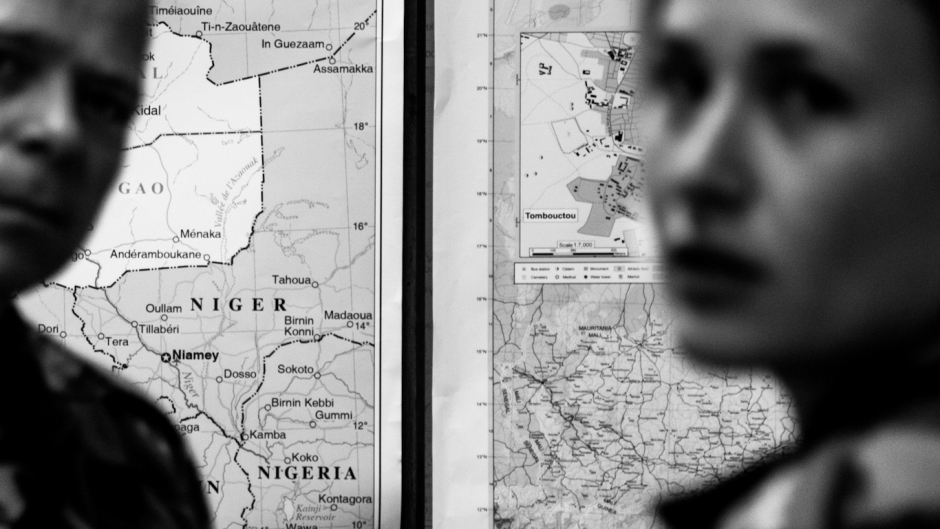
Niger is shaping up to be the surprising frontline of the new Cold War. Yesterday, the 15-member Economic Community of West African States (ECOWAS) ordered the "activation" and "deployment" of "standby" military forces to the country, an action that threatens to spark a major international war that could make Syria look minor by comparison.
In this venture, ECOWAS has been fully supported by the United States and Europe, leading many to suspect it is being used as an imperial vehicle to stamp out anti-colonial projects in West Africa.
On July 26, a group of Nigerien officers overthrew the corrupt government of Mohamed Bazoum. The move, which the junta presents as a patriotic uprising against a Western puppet, is widely popular in the country, and many of Niger's neighbors have declared that any attack on it will be considered an attack on all their sovereignty. The United States and France are also considering military action, while many in Niger are calling for Russian aid.
Consequentially, the world waits to see if the region will be engulfed in a war that promises to pull in many of the major global powers.
But what is ECOWAS? And why do so many in Africa consider the organization a tool of Western neocolonialism?
"Part of a Corrupt Cabal"
Even before the dust settled in Niger, ECOWAS sprung into action, imposing a no-fly zone and tough economic sanctions, including freezing Nigerien national assets and halting all financial sanctions. Nigeria suspended electricity to its northern neighbor. The regional bloc also immediately came to the defense of Bazoum, releasing an ominous statement declaring that it would "take all necessary measures," including "the use of force," to restore the constitutional order. ECOWAS also gave the new military government a deadline to stand down or face the consequences. That deadline has already passed, and ECOWAS troops are preparing for action.
Member states of ECOWAS may therefore be obliged to send their troops into Niger. Yet many nations are balking at the prospect. Nevertheless, the bloc still seems adamant that military action could come at any time. "We are determined to stop it, but ECOWAS is not going to tell the coup plotters when and where we are going to strike. That is an operational decision that will be taken by the heads of state," explained Abdel-Fatau Musah, the group's commissioner for political affairs, peace and security.
Despite not yet acting, the threat of an invasion is far from an idle one. Since 1990, ECOWAS has launched military interventions in seven West African countries, the most recent being in the Gambia in 2017.
This response has disappointed many onlookers. Journalist Eugene Puryear, for example, described the bloc as "part of a corrupt cabal that is directly linked to Western imperial powers to keep Africans poor."
Those Western powers immediately lined up behind ECOWAS' position. "The United States welcomes and commends the strong leadership of ECOWAS Heads of State and Government to defend constitutional order in Niger, actions that respect the will of the Nigerien people and align with enshrined ECOWAS and African Union principles of 'zero tolerance for unconstitutional change,'" read a State Department press release.
[ Alan MacLeod is Senior Staff Writer for MintPress News. After completing his PhD in 2017 he published two books: Bad News From Venezuela: Twenty Years of Fake News and Misreporting and Propaganda in the Information Age: Still Manufacturing Consent, as well as a number of academic articles. He has also contributed to FAIR.org, The Guardian, Salon, The Grayzone, Jacobin Magazine, and mintpressnews.com