By Joe LAURIA
Donald Trump's Mar-al-Lago press conference announcing that the U.S. would "run" Venezuela was pure Yankee theater of the absurd, writes Joe Lauria.
Updated with news of possible deal between U.S. and Venezuelan vice president to allow Maduro to be seized and to let her run the country. Rubio says U.S. not at war with Venezuela.
The administration of George W. Bush expended huge effort trying to convince the U.S. population and the world that the 2003 invasion of Iraq was not about oil.
Instead it was supposed to be about Saddam Hussein threatening his neighbors; about him acquiring a nuclear weapon and possessing other WMD; and of course it was about that old standby: bringing freedom and democracy to the Middle East.
Anything but about seizing Iraq's oil.
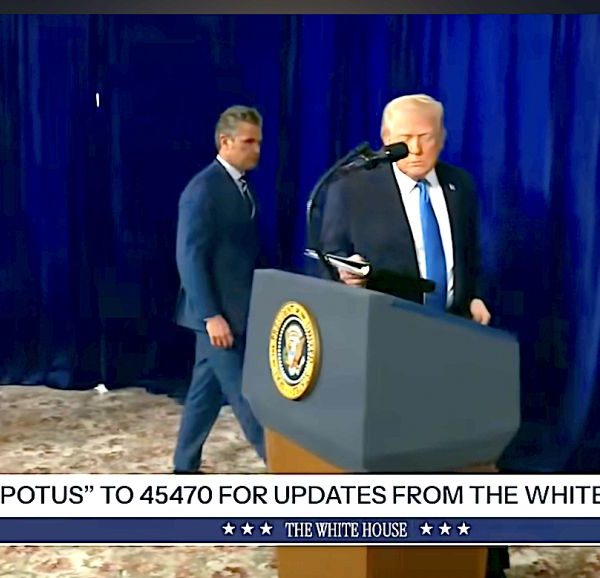
Yesterday morning at his over-the-top Florida mansion, Trump came right out and said it: his military attack on Venezuela was about the oil.
Not about drug smuggling, or a stolen election, but about "stolen" U.S. oil.
"We're going to have our very large United States oil companies, the biggest anywhere in the world, go in, spend billions of dollars, fix the badly broken infrastructure, the oil infrastructure, and start making money for the country," Trump said.
"Venezuela has been a bust, a total bust for a long period of time. They were pumping almost nothing by comparison to what they could have been."
According to Reuters, Venezuela was producing as much as "3.5 million barrels per day in the 1970s, which at the time represented over 7% of global oil output. Production fell below 2 million bpd during the 2010s and averaged some 1.1 million bpd last year or just 1% of global production."
What neither Trump nor Reuters mentions is the impact U.S. sanctions under Trump have had on the Venezuelan oil industry. They began to intensify in 2019 to restrict the state-owned oil business' access to U.S. financial markets, to block its assets, and to limit its exports.
Trump also didn't mention that Venezuela holds about 17 percent of global oil reserves or 303 billion barrels "ahead of Organization of the Petroleum Exporting Countries (OPEC) leader Saudi Arabia, according to the London-based Energy Institute," Reuters reported.
He absurdly said U.S. oil companies would be going in not to enrich themselves, but to make Venezuelans prosperous and free. "We want peace, liberty, and justice for the great people of Venezuela," he said. "We will make the people of Venezuela rich, independent, and safe."
To do that he vowed an absurd, open-ended U.S. occupation of the country, which could mean killing a lot of would-be free and rich Venezuelans.
"We're going to run the country until such time as we can do a safe, proper, and judicious transition," he said several times. And if the U.S. met resistance he vowed to strike Venezuela even harder. "We are ready to stage a second and much larger attack if we need to do so."
He vowed this stronger strike even though he said that "overwhelming American military power, air, land, and sea was used to launch a spectacular assault" on Friday night.
He absurdly boasted it "was an assault like people have not seen since World War II. This was one of the most stunning, effective, and powerful displays of American military might and competence in American history."
Trump omitted plenty in his performance yesterday. There is no more clarity today, especially about how the U.S. will "run" Venezuela and who the U.S. will try to install in the long term.
Trump dismissed the previously presumed replacement, Maria Corina Machado, the controversial Nobel Peace Prize winner who had called for U.S. military intervention.
Trump said, "I think it would be very tough for her to be the leader. She doesn't have the support within or the respect within the country. She's a very nice woman, but she doesn't have the respect."
Is Venezuelan VP in a US Deal?
For the moment, Venezuela's constitution has put Vice President Delcy Rodríguez,in charge. At yesterday's press conference, Trump said U.S. Secretary of State Marco Rubio had had a lengthy phone conversation with Rodríguez, and that she was "essentially willing to do what we think is necessary to make Venezuela great again."
There's been much speculation that the U.S. bribed senior political and military figures to ensure there was no resistance to the U.S. attack, which involved 150 U.S. aircraft. No anti-aircraft systems were engaged and Trump said the U.S. suffered no casualties or loss of equipment.
But after she was later sworn in as acting president yesterday, Rodríguez delivered a fiery speech denouncing the U.S. attack, while insisting that Maduro is still Venezuela's legitimate leader, even as he sits in a federal jail in Brooklyn.
Rodríguez demanded Maduro's release. She said the U.S. attack "had one objective: Regime change in Venezuela" to "allow for the capture of our energy resources, our mineral resources, our natural resources."
Rodríguez said:
"We are ready to defend Venezuela. We are ready to defend our natural resources that must be for national development.... The extremists who have promoted armed agression against our country, history and justice will make them pay.... We will never again be slaves."
Or was she in on the operation, as Trump suggested ? Were her defiant remarks to the nation part of the theater ? The Miami Herald has suggested that she was indeed in on a deal with the U.S., which will allow her to rule for the time being.
The Daily Telegraph in London reports in an article titled, "Secret meetings point to inside job to take down Maduro," that the UAE mediated between the U.S. and Rodriguez, a 56-year old lawyer with ties to the oil industry, which could help U.S. oil companies back into the country.
The Telegraph quotes Francisco Santos Calderón, Colombia's former vice-president, as saying: "I'm absolutely certain Delcy Rodríguez handed [Maduro] over. All the information we have, you start to put it together and say: 'Oh, this was an operation in which they handed him over.'"
Perhaps worried that Rodríguez won't hold up her end of the deal, Trump on Sunday issued a threat to her. He told The Atlantic magazine: "If she doesn't do what's right, she is going to pay a very big price, probably bigger than Maduro."
In her speech to the nation, which could be sincere or theater, Rodríguez blamed Israeli involvement in the seizure of Maduro. She said the world was shocked that "Venezuela is the victim and target of an attack of this nature, which undoubtedly has Zionist undertones. It is truly shameful."
She did not elaborate. Israeli Foreign Minister Gideon Sa'ar praised the U.S. kidnapping of Maduro hours after it occurred. Venezuela has been a leading critic of Israel's genocide in Gaza and has close ties and sells oil to Israel's mortal enemy Iran.
Another US Regime Change
Whoever ultimately assumes power, Trump made clear he intends the U.S. to have a hand in choosing the new leaders of yet another foreign, sovereign state - something the U.S is an old hand at doing.
"We can't take a chance at somebody else takes over Venezuela that doesn't have the good of the Venezuelan people in mind," he said.
"Had decades of that. We're not going to let that happen," he said. "We're there now. And what people don't understand, but they understand as I say this, we're there now, but we're going to stay until such time as the proproper transition can take place."
In other words, Trump said the U.S. is going to "run" the place even though all U.S. troops have withdrawn after the operation. And without installing a friendly government he won't get the oil. Is VP Rodriguez that friendly government?
What happened in the middle of the night Saturday is just Act I of this sordid drama.
Bush never openly said the U.S. would "run" Iraq. It just did. And badly.
The U.S. government can't even run the United States very well. But the Yanquis persist in thinking they can run countries whose cultures they don't understand - or care about.
Trump says he's ready to deploy U.S. ground forces if necessary to "run" Venezuela, making them potential targets in an insurgency of armed citizens.
"We're not afraid of boots on the ground," Trump said. "We don't mind saying it, but we're going to make sure that that country is run properly."
The way Bush "ran" Iraq "properly," leading to civil war and ISIS and the U.S. essentially getting kicked out?
"We're going to run the country right," Trump insisted. "It's going to be run very judiciously, very fairly. It's going to make a lot of money. We're going to give money to the people. We're going to reimburse people that were taken advantage of. We're going to take care of everybody."
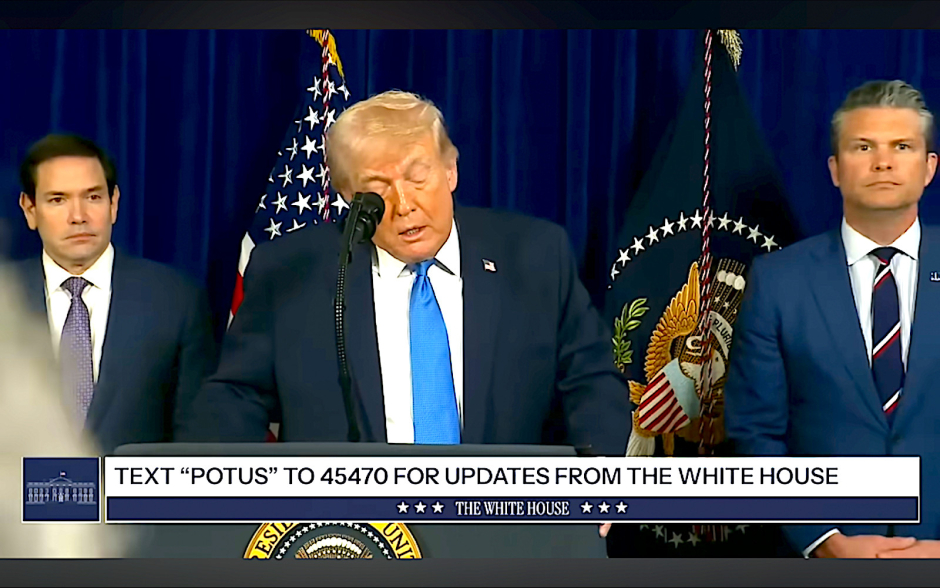
Rubio, Trump and Secretary of Defense Pete Hegseth. (White House screenshot)
'They Stole Our Oil'
Then Trump got down to the heart of the matter, the real motive for the U.S. action.
"We couldn't let them get away with it. You know, they stole our oil," he said.
"We built that whole industry there and they just took it over like we were nothing and we had a president that decided not to do anything about it. So we did something about it. We're late but we did something about it," he said. "We're going to take back the oil that frankly we should have taken back a long time ago."
This U.S. regime change operation bears a resemblance to one 72 years ago in Iran, when the U.S. and Britain overthrew the elected prime minister, Mohammad Mossadegh, in 1953 because he dared nationalize Iran's oil industry.
Twenty-three years later, Venezuelan President Carlos Andres Perez nationalized Venezuela's oil industry on Jan. 1, 1976. This was well before Hugo Chavez and Nicolas Maduro.
European and U.S. oil companies that had been operating in the country were compensated with about $1 billion without dispute. After partial privatization, Chavez re-nationalized parts of the industry in 2007, which led to disputes that were resolved by World Bank arbitration. Venezuela has had difficulty paying.
But the ideas that Venezuela "stole" "our" oil, or that U.S. sanctions have had nothing to do with the reduction of Venezuela's output are worthy of Eugène Ionesco.
Here's another absurd thing: the U.S. director of National Intelligence is a woman who made her political career on vocal opposition to the very long history of U.S. regime change wars - especially in Latin America.
In the midst of this latest U.S. regime change operation Tulsi Gabbard is completely silent and marginalized. "Who cares what she thinks?" Trump asked about her a couple of months ago.
Isn't it absurd that she is still in the job, unable to influence Trump ? Isn't it high time she makes a stand and resign right now as a protest against Trump's recklessness?
With Congress trying to mobilize a vote against the military operation and pro-regime-change newspapers like The New York Times blasting the Venezuela adventure as "illegal," "warmongering" and "latter-day imperialism," Gabbard would emerge a hero if she just stood up and quit.
Original article: consortiumnews.com