
Joaquin Flores
Whatever comes next will not be quiet, and it will not be unseen, because this is the art of theater in American politics.
Nothing is like American politics with its over the top drama, drawing in the world's attention, for how could it not, because love it or hate it, it is the gleaming star-spangled unfolding story of the collapse of globalism, and the country's great reorientation carries all the shades of theater, every human story of betrayal and destruction. It is impossible to look away when the stakes reach every corner of the planet. So when a U.S. congresswoman and MAGA darling like Marjorie Taylor Greene breaks with President Donald Trump and announces she will resign from Congress, we confront the question: Is this the end Greene's career, the end of MAGA, a civil war inside it, or a robust opportunity for MTG to make moves?
Could MTG be aiming at national politics, or will she turn her ambitions on Georgia's gubernatorial elections? Will Trump nebulously vacillate between populist and oligarchic forces only to face being triangulated out in a failed gambit to balance contending class interests where an America First economic plan cannot deliver? Will Trump, in the end reconcile with MTG as he did with Elon Musk, or will he alienate a large part of his base?
The long brewing political crisis within MAGA surrounding Epstein, Israel, and later Charlie Kirk's assassination had foreshadowed Greene's announcement, and so it hit like confirmation that MAGA was irreparably divided. Democrats are surely eyeing the possibility of mid-term gains and a chance to retake the House, since pessimism with the state of the economy remains high. Greene has been flooded with both push-back and support but either way, "there is no such thing as bad publicity", or so the saying goes. She still has control over her narrative and this equals political capital.
It is also said that nothing in politics is coincidental, and while Greene might just be out, this controversy could also wind up being an opportunity for her to ride the clout-wave to ever greater heights. The policy fights at the root of the MTG row with Trump so well align with the the so-called MAGA civil war that the opportunity here would be strange to squander. But what is motivating MTG and what is behind the conflict that makes these MAGA policy issues so volatile? Is this really a MAGA civil war or rather populist MAGA forces running up against the entrenched corporate and Zionist interests that have dominated Republican politics for decades?
The MAGA that MTG joined was the insurgent populist wave that broke through wherever the political terrain allowed, and that opening happened inside the Republican Party a few years ago, despite nonstop efforts by the old-guard to suppress the uprising and restore the party to Wall Street austerity and neoconservative geopolitics. Trump is seen as too moderate or compromising with the very status quo whose legitimacy crisis was the key to his own success; and therein lays the whole tension.
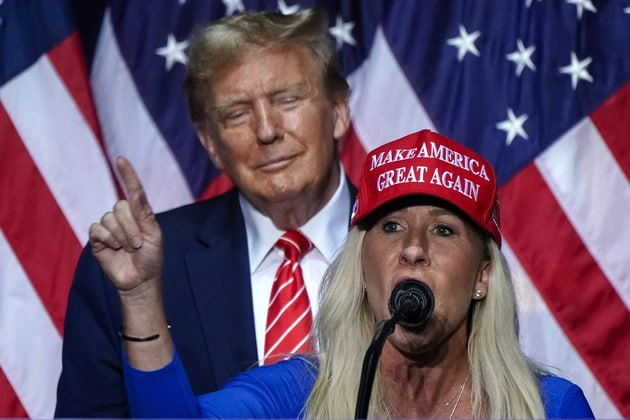
Rep. Marjorie Taylor Greene speaks alongside President Donald Trump at a campaign event in Rome, Georgia, on March 9, 2024. |Elijah Nouvelage/AFP via Getty Images
But is Greene truly finished with Trump or with the movement as a whole? MAGA is often wrongly treated as a catch-all label for anyone who supports Trump, but the long understood reality of non-MAGA Trump voters became the subject of a November 28th Politico piece and poll showing, "More than half of Trump's voters last year - 55 percent - describe themselves as MAGA, but a critical 38 percent do not."
MAGA vs. Neoconservatives on Vax, Israel, Globalism, and the EU
After Trump began reshaping Republican politics toward the end of the teens, many standard neocon Republicans who had opposed him realized that fighting him was a losing strategy and gradually shifted into public support. By the 20's this produced a broader conservative social-media influencer world outside of MAGA's own that became "Conservative Inc." or the "Sometimes Trumpers," combining big-business donor interests, AIPAC networks, and a social-media influencer ecosystem, wrapped in a MAGA banner. They have culture-war themes that overlap with parts of the MAGA domestic agenda, yet they consistently downplay or individualize the deeper socioeconomic crisis that has crushed the American working and middle class which MAGA on the other hand pays close attention to, overlapping with a once uniquely Democrat constituency, and therefore part of its potency and strategic significance.
Neoconservatism has only survived by performing a weak imitation of MAGA, with lifelong Never-Trumpers rebranding themselves as Sometimes-Trumpers and now loudly professing loyalty as Always-Trumpers, even though their politics remain far closer to Netanyahu or Nikki Haley, and guided by pundits like Ben Shapiro. Trump often appears to satiate their narratives with his saber rattling threats aimed at Iran, Hamas, Venezuela, or more recently Nigeria. But what he does in the end often leaves the war hawks deflated and let down.
MAGA as MTG embodies it aligns with working-class issues in both the social and economic spheres and sees them as inseparable, pursuing tariffs, tighter immigration rules, reindustrialization, investment from partners into America, and a national-mercantilist trade posture. Healthcare and affordable housing remain battleground issues with Democrats who once saw this as their sovereign domain. Trump enigmatically sustains MAGA, named MAGA, but is also distinct from it, suggesting MAGA was something that Trump either discovered or brought together from parts of the silent majority.
Trump Caught Between People and Power
The underlying tension beneath Trump's politics is simply that the populist mandate he was elected to fulfill comes up against his own need to align support from among the oligarchy. Whether or not Trump is compromised, was always acting poor faith, or instead is going to fulfill his electoral mandate and deliver on core MAGA promises remains to be seen, or at least so the debate goes. Trump and the MAGA phenomenon were under tremendous and real persecution for many years, faced a witch hunt in the form law fare and the politicization of the justice system against Trump during his first term and during the Biden administration. Trump supporters were ostracized on social media, deplatformed, censored, doxed and even de-banked. Politically Trump survived these attacks thanks to his broad base of support and his base experiencing these attacks alongside him, and through this a sort of bond was created.
If Trump betrays this bond and becomes defined by protecting the system of the old-guard in some pragmatic deal-making sense, leaving his MAGA base behind, our modern day Crassian opportunists and Optimate forces will then attack Trump once he's isolated. Trump then to avoid this may be pushed to support the 'national left' defining the MAGA base on populist measures.
MAGA from the start was engaged in a two-front war, against the Zionist Christian right and Wall Street business conservatism. They pursued this conflict not by opposing Christianity or business in principle, but by steering these away from Zionist and Globalist end goals. On the economic front MAGA confronted the pro-corporate and anti-worker program of the neocons, not with old-style class-struggle leftism, but with a trans-class approach that linked business and labor to the joint outcomes for the nation. The other front targeted the Zionist Christian bloc, which had supported some domestic issues like abortion and culture war matters, but tied those to a Zionist outlook that compelled the forever wars MAGA opposes.
Trump often straddles these MAGA positions with oligarchic interests towards national economic growth, which does not present an inherent problem. But in the balance of striking this New Deal of sorts, this great renegotiation of the social contract which only the present moment brings to the table, there are conflicts over the details, in the commitments, in the burdens that will be bore and by whom. Foreign policy is not immune from this tension either. Trump's pro-Netanyahu rhetoric at times and endorsement of censorship on the war on Gaza at American universities strongly conflicted with core MAGA views. MTG represents the MAGA pole very publicly, and demonstrating where it overlaps with some populist-left Democrat views, with The Guardian covering her joint statement with democratic socialist Bernie Sanders condemning Israel's genocide in Gaza.
Trump does tend to deliver in the end, pulling the rabbit out of the hat, though not always, but nevertheless his zig-zagging course always produces discontent, despair, even the dreaded disengagement. MTG serves a role in maintaining coherency within this conflicted narrative, so it only makes sense that capable parties would be dropping the ball if they were not operationalizing it.
MTG maintains MAGA cohesiveness where Trump appears conflicted
Trump now faces something like a Caesarian conundrum during the period of the First Triumvirate, pulled by competing interests inside and outside the trans-class coalition, as he tries to manage crises that the old Republican and Democrat guard created.
The neocon old-guard appropriated the MAGA identity in order to steer Trump back toward their agenda. Whether Trump has resisted this, enabled it, or merely allowed the impression to persist is debatable, but many working and middle class MAGA Americans who MTG has aligned with believe reforms are arriving too slowly and see Trump's entanglement with tech oligarchs and Zionists as either the source or the byproduct of that problem.
What's huge in all of this is that MTG gives MAGA disappointment with Trump some coherence, consistency, and a narrative that reflects disaffection in the base, but also a sense of direction and purpose, which cuts against the real crisis of voter apathy. MTG can keep support for MAGA coherent while Trump weaves his 'Art of the Deal' in ways that cost him with his base, at least initially.
MTG's brand remains strong, and she is not in political decline. What looks like impulsive conflict, chaos, or infighting is often political theater by design, part of a broader spectacle that pulls ever larger audiences into a kind of Baudrillardian hyper-reality where myth and fact blend together, creating a narrative that feels complete in its own right, even as it blurs the line between truth and fiction.
Being in a strong position with expanding visibility and reach, the idea that she would suddenly decide to quit politics simply does not make sense. The issue inspiring the row is even less convincing, since while it reflects broader structural problems it's hardly anyone's hill to die on. The dispute centered on H-1B visas, where Trump is thought to have made limited concessions in order to keep relations with China and India on stable footing, while also satisfying employers in key domestic sectors who depend on the lower labor costs that these foreign specialists are willing to accept. MAGA was simultaneously slapped in the face when Trump's team floated a 50-year mortgage, seemingly for people who do not understand how interest-rate math actually works.
Newsweek reported on the centrality of these issues a few weeks ago in vox populi fashion, quoting some ostensible MAGA influencers: "Matt Morse, an "America First" content creator and commentator, called the interview "catastrophic for Trump". He wrote on X: "Whoever's in Trump's inner-circle that's been telling him that we need more H-1B visas, 50 year mortgages, and 600,000 Chinese students needs to be FIRED IMMEDIATELY. AMERICA FIRST."
Morse later followed up: "I am one of the largest pro-Trump commentators in the nation. I get tens of millions of views every single month talking about Trump's America First agenda. And right now, I'm absolutely f****** beyond P***** OFF that tonight, as a justification for H-1B visas, Trump said that Americans don't 'have talent.' Absolutely unreal."
This seems like an easy to resolve problem if MTG and MAGA make noise about it and it draws enough attention. It is symbolic of a larger issue but still offers Trump an easy out in the form of an Executive Order or similar.
The 2026 Factor
It's fair to say that MTG is making moves because she's too well positioned not to. MTG's November 4th appearance on The View , followed by Trump's withdrawal of endorsement on November 14th, and culminating with the House's near-unanimous Epstein files vote on November 18th (427-1), all work very strongly for her strategy. The surface narrative appears straightforward enough with MTG publicly lamenting the slow pace of change within the MAGA movement, criticizing the dominance of grifters, and expressing frustration that her loyalty has gone unreciprocated. Her later rhetoric in response to Trump's withdrawal about refusing to be a "battered wife" carries emotional weight that seems authentic and appeals to a certain female demographic in the state of Georgia that may swing Democrat or Republican.
How would all of this make sense if someone could make a winning game plan out of these facts? MTG has national attention, but most effectively it could be turned back on Georgia.
Georgia's gubernatorial race opens in 2026, with Brian Kemp termed out and the field wide open. MTG represents Georgia's 14th district, a deeply red territory, but a governorship requires appealing to suburban Atlanta voters who swing elections. Can her current positioning, combining patriotic messaging with working-class economic concerns typically associated with the left, be calibrated for a statewide audience? The question becomes more intriguing when we note that Democrat Stacey Abrams might run again, creating the need for a populist Republican who can speak to crossover voters and women who Abrams will pick up if the GOP instead errors and opts to back a neocon establishment conservative figure like Kemp.
Biden won Georgia in 2020 by fewer than 12,000 votes which Trump contests to this day, and the state remains fundamentally purple, requiring Republicans to activate and expand the base, which MTG no doubt does. Kemp, though endorsed by Trump a few years prior, joined the anti-Trump alliance in 2020 with Pence and pushed back against the president's appeals to challenge the outcomes. With MTG as governor, she could help guard against irregular election procedures working against the Trump machine in 2028, whoever the candidate may be.
Looking toward the midterm elections we see that if MTG drops out of politics entirely when she resigns from the House in January, she has done nothing with the political capital she has earned, her strong record, and her recent exposure to the Democrat base that watches The View.
The only mar on her record would be that she abandoned constituents by quitting politics. This is only redeemable if she is doing so to pursue higher office and has greater power to deliver. If she pursues the Georgia governorship, her recent moves make more sense as pre-campaign positioning. Creating distance from Trump from the economic left, while maintaining the America First message, allows her to appeal to Trump-skeptical suburbanites without alienating the base. When the time comes, Trump can reconcile with MTG as he did with Musk when it comes to 2028.
In the end the question is whether the forces now shaping American politics can be steered by those at its center. MTG may play her cards or not, Trump may recalibrate or collapse, and MAGA may fracture or continue to be a driving force in Trump's base. What is clear is that the struggle over America's direction is no longer abstract, and Trump has less than a year to prevent his party from defeat. MTG has tremendous political capital and whether by design or eventuality, Trump will probably come to invest in it. Whatever comes next will not be quiet, and it will not be unseen, because this is the art of theater in American politics.
Follow Joaquin Flores on Telegram @NewResistance or on X/Twitter @XoaquinFlores