Bruna Frascolla
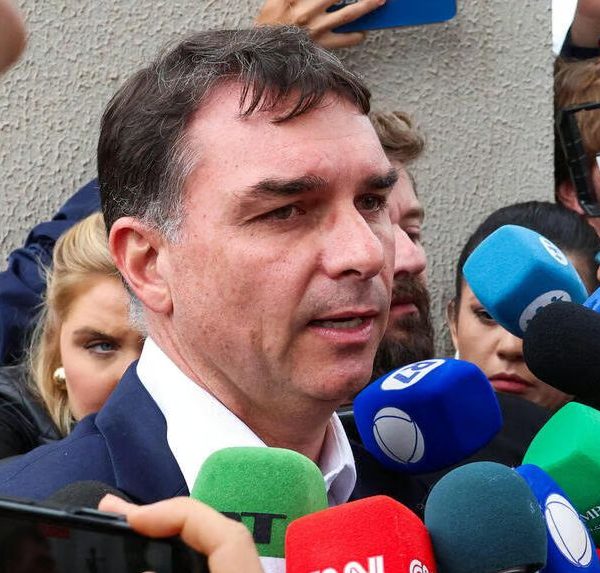
Flávio Bolsonaro's candidacy exposed the fact that the "democratic center" only calls for "unity of the right" when it revolves around their own candidacy.
Since Jair Bolsonaro's ineligibility, the Brazilian Right has been facing a stalemate: on one side, Faria Lima (the Brazilian Wall Street) wants Bolsonaro to support the governor of São Paulo, Tarcísio de Freitas; on the other, Bolsonaro doesn't want to just hand over his electoral treasure in the jail. Why does the financial sector want Tarcísio so much ? Because he has an agenda of privatizations and a government that prioritizes spending cuts. This is not a popular agenda: the new electricity concessionaire, Enel, was an Italian state-owned company, now with mixed capital, and has left São Paulo in the dark when there is a strong rain or wind. The people of São Paulo have also complained about the lack of public security, and the police have seen that the promises of improvements for the category will not be fulfilled.
Even so, Tarcísio was praised by the press as the best name to beat Lula, because he would attract the "moderate" voter. Therefore, a threat loomed over Bolsonaro: either he nominates Tarcísio, who will grant him a pardon (which may be found unconstitutional), or Lula will win and he will rot in jail. But why was Bolsonaro's nomination so insistent ? For three reasons: first, because he and Lula are the two biggest vote-getters in the country. Second, the candidates of the self-proclaimed "democratic center," or "center-right," barely reach 10% of the vote in the first round. Last, Tarcísio was nobody in electoral politics before Bolsonaro nominated him to the government of São Paulo - and betrayal looks bad. Not by chance, the previous governor of São Paulo was another privatizer who was elected with Bolsonaro's support but in 2022 decided to challenge him for the presidency. His political career ended there.
In this whole story, there is a major complication on the Bolsonaro side: Bolsonaro is disorganized and, even having reached the presidency, he has not been able to put together a political party. Thus, the nominations have to be accepted by the party leadership, which is at odds with Bolsonaro. And why does the party want Bolsonaro ? Because he is a vote-getter, and this has an impact on party funding, which, in Brazil, is public.
To avoid handing over the electoral treasure, Bolsonaro would have to nominate someone with his last name. The Bolsonaros are his three sons with political experience - Senator Flávio, Deputy Eduardo, and City Councilor Carlos - and his wife Michelle, who has no political experience but is beautiful, charismatic, young (43 years old, like Carlos), and evangelical. This last point is important because the evangelical right is coveted by any right-wing candidacy that wants to triumph over the others. Michelle is a friend and ally of one of the biggest televangelists in Brazil, Silas Malafaia. Bolsonaro's sons do not trust their stepmother, and the clashes between her and the youngest son have been extensively covered by the press.
To learn about the inner workings of Bolsonarism, it is recommended to follow the YouTube program of journalist Kim Paim, who is close to Bolsonaro's sons. There we see that the conflicts between Bolsonaro & sons against the party leadership are numerous, and included the little money spent on Jair and Eduardo. On the other hand, the women's wing of the party was spending a fortune on Michelle. When her husband was arrested, for example, she was in the interior of Ceará at a party event.
Now, it makes perfect sense for a party to spend money on a charismatic female figure. Thanks to an imposition by the Supreme Federal Court (always them), parties are required to spend a quota of money on female candidates. This forces parties to seek out women to run for office, so that they are not later caught accused of electoral crimes. Therefore, Michelle is a great party asset. Thus, it is surprising that the party treats Jair and Eduardo with disregard, even receiving so much dedication from Michelle.
In recent weeks, the scenario that had been unfolding was Tarcísio as president and Michelle as vice-president - even though no one important openly said so, and even though Tarcísio swore up and down that he wasn't a presidential candidate (while posting videos saying that Brazil needs a new CEO). However, it was in Ceará that Michelle made a blunder that served to finally organize the Bolsonaro movement. The week began with a fight and ended with the announcement of Flávio Bolsonaro's (the senator's) candidacy.
Let's look at just one more complication: Olavism. In Brazil, there's a movement centered around Olavo de Carvalho, a pseudo-philosopher who, strictly speaking, was a neoconservative propagandist. You can see his secretary, Sílvio Grimaldo, saying (in Portuguese) that he received an award from the Pentagon for the services he rendered. Eduardo Bolsonaro was a follower of this pseudo-philosopher - and it's no coincidence that he became a kind of Brazilian Maria Corina. Well, Eduardo is a special case because, besides being an Olavist, he's Bolsonaro's son. Grimaldo was part of the Bolsonaro admnistration, but left without acknowledging it; he became a dedicated opponent. Thus, organized Olavism, led by Grimaldo, was working to destroy Carlos's candidacy for the Senate in Santa Catarina, undoing agreements already established by Jair himself before he went to jail. The movement pleased party leaders in Santa Catarina, who were interested in using a Senate seat as a bargaining chip with another party.
The same movement was happening in Ceará: undoing local agreements created with Bolsonaro's consent to weaken Bolsonarism. In the case of Ceará, the agreement was too pragmatic for the ideological militants: to forge an anti-PT alliance with Ciro Gomes, who considers himself left-wing. So Michelle, who had already been showing sympathy for the insurgents in Santa Catarina, took to the stage and publicly reprimanded the main Bolsonarist of the Ceará PL, André Fernandes, for allying himself with Ciro Gomes - as if he were doing it behind Bolsonaro's back and were a traitor. However, unlike the guys in Santa Catarina, she betrayed not only Bolsonaro, but also the party.
Why did she do that ? From subsequent developments, we can infer that there is indeed a liberal-neocon alliance against Bolsonaro (Zionist evangelicals, financial market liberals, and Olavists) - which is a tremendous irony, because these currents were central to Bolsonarism. A more prosaic reason could be a miscalculation and ignorance of the Northeast. They may have compared Bolsonaro's vote to Ciro's for the presidency in 2022 and inferred that Bolsonarism didn't need Ciro in Ceará. Arrogance feeds ignorance: in the Northeast, an agrarian region, every major election needs the support of the local political bosses. Bolsonarism only has space in the urban areas of the Northeast, which are a minority. The very pivot of the scandal in Ceará, Senator Girão, who is from the financial market party (NOVO), was elected with the support of Ciro Gomes, who wanted to prevent an enemy from reaching the Senate.
Well: after what happened, Bolsonaro told Michelle not to get into conflict with her sons and endorsed Flávio's name for the presidency. The party leader acknowledged it. Michelle acknowledged it - only Tarcísio has not spoken out to date.
The press went into a frenzy, saying that Flávio's candidacy was not serious and that he was only trying to negotiate. Flávio then announced, on December 7th, that he had a price, and that he would reveal the price the following day. However, he couldn't contain himself and revealed on the same day what the price was for him to withdraw his candidacy: the Amnesty Law, which would allow his father to be free to run.
In the end, Flávio Bolsonaro's candidacy exposed the fact that the "democratic center" only calls for "unity of the right" when it revolves around their own candidacy. It remains to be seen 1) what the features of this new Bolsonarism, hated by evangelical, Olavists, and liberal leaders will be, and 2) what the electoral capacity of these same leaders is without Bolsonaro.